

Marathon taper is the time where your body gets a chance to ADAPT to all of the hard work that you’ve been doing. Tapering is one of the most important components of any marathon training plan, but it can also be one of the trickiest to implement.
Runners are sometimes afraid of cutting back on training. This is usually because they worry that taking time off right before a big race will erase all of their hard work.
If you skip tapering, you are going into the race with your body in a deficit rather than in top form.
Tapering should be a welcome relief after hitting your peak week mileage and intensity. Instead, the sudden free time sends some runners into a tailspin.
It’s the time when your mind plays tricks. Was that a niggle or a nag in your left knee? Did you power through enough long runs? What do you do with this abundant free time?!
When it comes to tapering, the truth is that reducing your mileage is critical not only for a full recovery before your race, but also for achieving optimal performance.
In this article, you’ll learn everything you need to know about marathon tapering.
What Does Tapering for a Marathon Mean?
Tapering is the process of gradually decreasing your training volume in preparation for a race. It’s an important part of every marathon training plan (and half-marathon, 10K, and 5K training plans!)
You must be wondering, though, why it is important and why I should do it?
When you cut back on the number of miles you run, your muscles can repair, and your glycogen stores can return to normal. This is important for absorbing your training and getting those race-day PRs!
But don’t confuse tapering with taking a break and resting.
Some rest is part of the ‘tapering’ process. But if you only rest for the weeks leading up to your marathon, you’ll lose the important biological changes you made during your training.
During a taper, levels of muscle glycogen, enzymes, antioxidants, hormones, and other things that are depleted by a lot of exercise return to normal.
It means that on race day, you should feel bursting with energy because the body is relaxed and primed to run. You’ve decreased the odds that you will show up over-trained and unable to get the most out of yourself.
Over a few weeks, exhausted muscles have a chance to rebuild stronger, and micro-tears that were formed during training can heal.
This is based on a review of 50 studies that were published in the journal Medicine & Science in Sports & Exercise in 2003.
Another research published in 2014 found that tapering can also improve the function of fast-twitch muscle fibers, which can lead to faster race times.
Benefits of Marathon Taper
A 2007 study showed that tapering provided up to a 5.6% performance improvement! Meanwhile another study showed that it increased time to fatigue by up to 22%.
So yes the benefits are very, very real.
The top five main goals of marathon tapering are to:
- Increasing muscle glycogen to ensure they return to normal and are loaded with fuel for race day
- Reducing the risk of overtraining right before a race
- Minimizing any stress on your mind and body, which allows you to be fresher.
- Increasing muscle recovery and reducing muscle fatigue
- Improving the function of fast-twitch muscle fibers to assist in faster race times
When Should You Start Tapering for a Marathon?
As discussed in peak week training, traditional training plans used to call for a taper of 3 to sometimes even 4 weeks.
I certainly tested out that style for a few of my races wayyyyy back when (yup like 2002-2007). For my first few races, I had no idea how I should feel and I was so amped up, it probably didn’t matter.
But by the time I got to my second marathon, my legs felt heavy, my brain felt not quite ready. I was all around sluggish.
Since transitioning to the 2 week taper plan that’s a thing of the past AND it also means taper madness is less likely!
With 2 weeks, you’re not forced to relax, but allowed to relax. You’re opened up to prepare mentally for the race. Your body is still in training mode rather than reverting to a maintenance mode.
Consistently in training hundreds of runners over the last decade, I’ve found this has been the sweet spot for most runners.
2 or 3 Week Marathon Taper?
A new study in 2021 showed that a three week marathon taper provided more race day benefits. This was in fact a large study of over 158,000 runners.
However, what the study really proved to many of us was:
- You need a structured taper
- Higher mileage runners often do better with the longer taper
- Many runners try a long taper, but don’t follow it very well
- The long taper may actually involve a lower week on week 3, but still your longest run 2 weeks out
How Should I Cut My Mileage While Tapering for a Marathon?
While tapering, you want to cut back on your volume just enough to help you recover and adapt, but not so much that you feel tired.
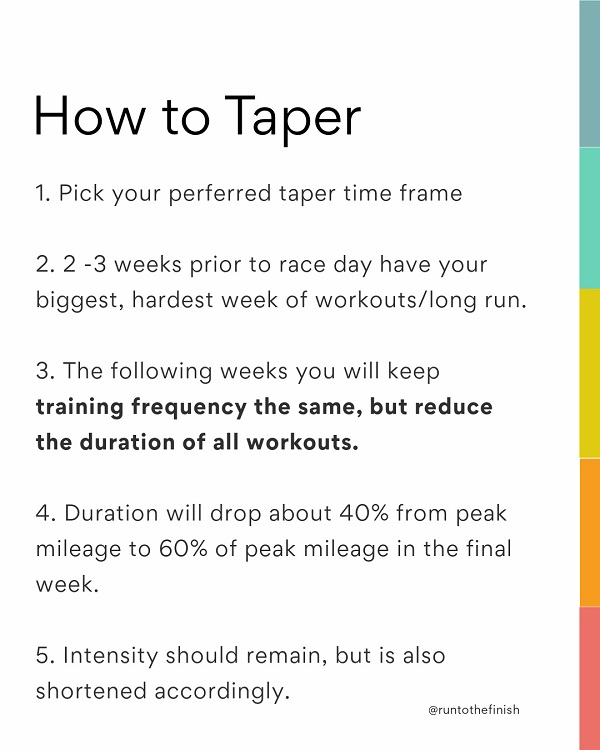
Based on studies you should reduce your overall mileage by 40-60%.
- Week 1 of taper is a reduction of 40% from your highest volume week
- Week 2 of taper is a reduction of up to 60% from your highest volume week
What we lose in distance, we make up for by continuing with speed workouts. Just reduced accordingly to total mileage reductions.
Speedwork While Tapering for a Marathon?
When tapering for a marathon, you should continue to incorporate speed workouts. The goal is to maintain muscle tension, so your legs don’t feel flat on race day.
The key is to ensure that these speed sessions maintain the same level of intensity, but they should be shorter in duration.
A few examples:
- Long run might include 3 x 1 mile at marathon pace in a 10 mile run (if you had previously done something like 6 or 7 miles at marathon pace)
- During the week you might do 5 x 1 minute at 5K pace (if you had previously done 10-12 reps at that pace)
- Running strides at the end of a couple runs
Marathon Tapering Checklist – For Every Runner
👉Start After Your Longest Run
Start your marathon taper two weeks before your marathon race day. It should start the day after your longest run, which is typically a 20+ mile run.
👉Do Speedwork
As I mentioned above, continue to do speed work at the same intensity but for a shorter duration. The goal is to maintain muscle tension, so your legs don’t feel flat on race day. Utilize a short fartlek workout to help calm your nerves and remind your body what marathon pace feels like.
👉Relaxed Pace
Running while tapering should be done at a pace of one and a half to two minutes slower per mile than marathon goal pace. The only exception to this is your marathon-goal-pace run.
👉Lower Mileage
Lower mileage runners may not need to cut back on volume as much. High mileage runners should stick to the same number of days per week and reduce the volume of each run. It is essential to lessen the intensity but not fully eradicate it.
👉Don’t Reduce Volume Excessively
Avoid drastically reducing volume, as this will disrupt your ‘rhythm’ of training and the cycle that your body is accustomed to. Meaning follow the plan listed above of progressively reducing your mileage 40-60%.
No need to drop to 100% no running.
Even if the change is going from a lot of training to a lot of rest, our bodies don’t appreciate things that are drastically different from the norm.
Many athletes discover that if they over-rest, they experience a marked lack of energy on race day as if they’ve forgotten how to put in a hard effort.
👉Still Do a Long Run
Keeping your body in routine and sharpening your endurance is still important throughout the marathon taper. If you drop the long runs too much and too soon, you can over-taper and feel flat.
I recommend an 8-mile run for a half marathon or a 10-12 mile run for a marathon a week prior to your race day.
👉Avoid Anything New or Too Challenging
The taper period is about recovery and consolidation, so avoid anything that’s new or too challenging during these two weeks.
What About Taper Madness?
As noted, with a short race taper, it’s less likely you’ll find yourself craving more runs, but that doesn’t mean you won’t have a little taper madness.
“Taper madness,” coined by long-time runners, refers to the days leading up to the race when your brain starts to play tricks on you, and with longer tapers, where you feel completely out of whack due to the massive mileage drop.
Suddenly, things that have never once bothered you in training will hurt. Why are you feeling your big toe in your favorite shoes? Why is your knee tingling? Why did you get a Rudolph-sized zit on your nose?!
I can’t answer the last one, but I can say it’s all totally normal.
Knowing you aren’t alone is the first step in letting go of the stress that’s likely creating all your issues. A few other tips that work well:
- Find a mantra, like “all is well” and use it all week
- When something hurts, remind yourself it’s likely stress and will be fine on race day (99% of the time this is true)
- Get a massage, allow yourself to relax and treat your body well
Why Do I Feel Sick While Tapering?
It’s very common to develop a cold in the days before a race. Science suggests this is because the body is no longer adrenaline-focused, pushing you through weeks of training, and thus the immune system kicks back into action, no longer suppressed.
Don’t fret, nearly everyone finds that in these two weeks, if they focus on recovery, they are ready to rock and roll race morning. I say that these colds are the body’s way of ensuring we actually follow our taper plan!!
And read this about how your mind is actually in control of how you feel >
Deep breathe, the big day is finally just around the corner. As the taper finishes, it’s very normal to start feeling nervous and surprised, which can actually be a really good thing.
Looking for what to read next?
- Post Marathon Recovery Plan: A Guide to Physical and Mental Recovery
- What’s the Difference Between Active Recovery and Rest Days?
- 10 Best Marathon Running Shoes Ranked: Speed, Cushion, and Support



 6 Unexpected Marathon Travel Tips For Your Best Race
I am in my taper period now and actually injured my leg two days ago. I’m not sure how the race will go or if I’m still doing it, but it is making not running easier because I am trying to heal.
If you still want to run a lot, I would substitute running with easier elliptical. Not a workout, but something to keep your mind at ease :-)
I think that’s where we have to be careful. Adding in or overdoing it on other things when the goal really is to let our body fully recover.
Such great tips! I know the hardest time for my husband is taper just before his marathons and than the days after when he tries to balance wanting to recover, wanting to run, and than the lack of a solid schedule and getting his body back on a regular eating schedule. I like the idea of having something else to focus on and think he’d really benefit from some yoga.
P.S. That green smoothie looks amazing!
I’m not familiar with racing or tapering, but that green smoothie is right up my alley :)
I love how you talk about how you’re not forced to relax, but allowed to relax! That makes a big difference, mentally and physically!
So much great information and tips you shared for using time wisely during a taper! Love the “all is well” mantra to focus on during that time too!
There is so much good information here. Tapering isn’t something I’ve really focused on before but it makes so much sense. Also I’m definitely going to use that All is Well mantra – it’s exactly what I need right now!!
Great post! I’m coaching a team of 12 marathoners right now…10 of them are first timers! Our race is in 11 days, so they are definitely starting to feel the effects of their first taper. It can be a struggle, but it is such an important part of the training cycle!
Great post with a lot to think about. I get super twitchy during a taper! I constantly feel like I *should* be doing something and it takes a lot of discipline to do it properly (and to avoid just sacking everything off and heading for the Doritos)
The madness is so real – niggles, niggles everywhere!
Where can I get that adorable hat in the picture?? Need more hats. Trying to do a better job of protecting my skin while running.
Great article. You touched on so many aspects of tapering. Thanks!
Hey Katie, that one is from Hoke One One
Thank you!! And thanks again for the post
I don’t mind taper and never understood why it’s so hard for runners. I am a low mileage runner though so I guess I’m OK with running less. :-)