

How can I run farther? I feel like I need to run more to hit my goals. Does the 10% rule actually work? I love running and I just want to run all the time!!! A few of the super common questions and statements I get around how to increase running mileage.

Boy do I get it. If could do nothing but run, I likely would.
But increasing your mileage and improving endurance aren’t always the same thing. I’ve talked a previously about the things you can do to help you run farther as a beginner or even regaining endurance post injury.
Right now, we’re talking about that point where you feel good or super excited or maybe you’ve realized you skipped a few weeks of training and you want to jump ahead.
3 Methods to Increase Running Mileage
The timeline for increasing your mileage is going to vary by experience and fitness level. If you’ve only been running 3 miles, then it’s absolutely possible to double your running distance in 30 days!
But if you’re putting in 30 miles a week, then it would irresponsible for any running coach to encourage you to double that in just 30 days.
When considering how to increase your running distance and thus your weekly running mileage, there are some golden rules we look to.
👉 The 10% Rule
The most well known method of mileage increase, the 10% rule, states that runners should only increase their total miles at a rate of 10 percent per week in order to avoid injury.
Example
If you’re currently running 20 miles, then the following week, you can run an additional two for a total weekly mileage of 22 miles.
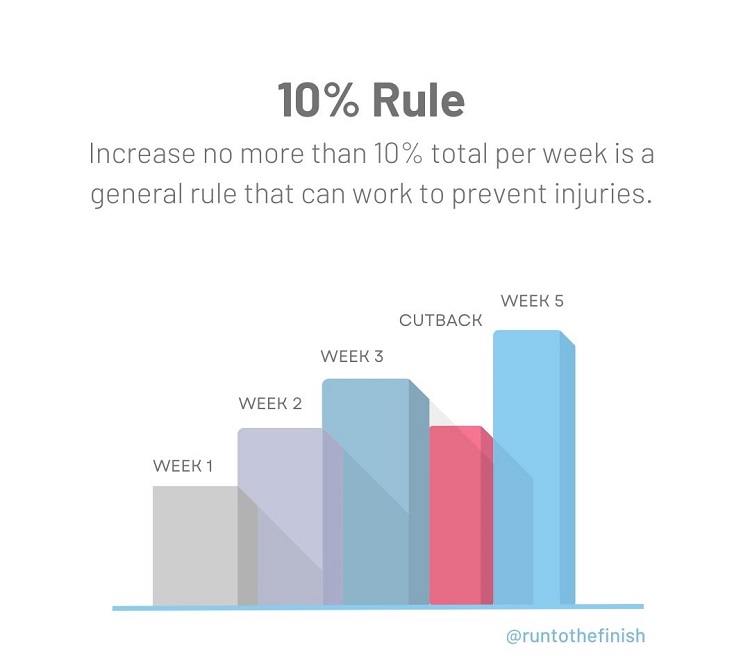
The origins of this rule come from two studies, that showed those who increased mileage faster where more likely to get injured…except that they were increasing 20-30% in both studies.
SOOOOO how accurate is it?
The thought is that runners who increase their mileage by more than 10% per week are more susceptible to injury. Largely because the muscles, joints and tendons need time to adapt to the pounding of running and the microtears it causes (which are key to improvements).
Does the 10% Rule Work?
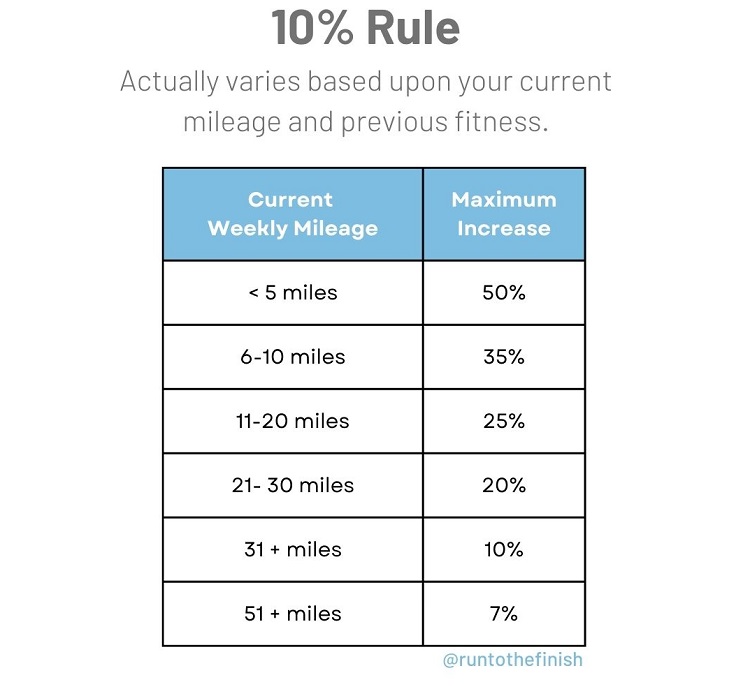
Yes and no. It really depends upon how much training you have been doing.
Newer runners with very low mileage, will be able to progress their total volume faster than runners with existing high mileage programs.
Being smart about slowing increasing the volume or intensity of your runs absolutely prevents injury
And of course remember that it should not be a constant process of adding miles.
There should be a cycle of increase and then a week of decrease to allow your body to adapt as shown above.
👉The Jack Daniels Method
Olympic running coach Jack Daniels established his own guideline for increasing mileage in his book Daniels Running Formula. Dubbed the Equilibrium Method, Daniels suggests that runners increase mileage by a number that does not exceed the number of weekly training sessions.
Example
If you currently run four days per week, then you can add on four miles. If you want to increase the number of days you run per week, then it’s fine to add the four in that extra training run.
From there, runners stay at that level for 3-4 weeks before increasing again. Once you hit your maximum weekly training load (i.e. six days) then you can continue increasing up to six miles until you reach your peak training load.
👉3 Build + 1 Recovery
First time half marathoners, marathoners and ultra runners may feel the mental fatigue or lack motivation after several months of training. The idea behind recovery weeks is to recharge the mind and body to become excited for the training ahead. Further, they can help prevent injury when the miles and intensity add up.
Example
Over the course of 3 weeks you might climb from 20 to 24 to 27 and then take one recovery week by dropping your weekly mileage back to 20 miles or less to give your body adequate time to adapt to the demands.
Rule of Thumb: GO SLOW with adding on miles. You can do plenty of low impact cross training while building, which will help to ensure you gain fitness without injury.
Benefits of Increasing Running Mileage
When you’re ready to increase running mileage and avoid injury, it’s about so much more than just the run. Adding weekly miles is but one part of the equation to becoming a stronger runner.
- Ensures you can handle time on your feet for distance races
- Improves your endurance for all kinds of events
- Will improve your speed at shorter distances
- Long slow easy runs improve your fat burning
- Runners high seems to happen once you’re consistently doing some longer runs
6 Tips for How to Increase Running Distance
There’s no one right way to increase mileage, but there are some pretty good rules that you should know and follow.
Most training plans refer to what is called the 10% Rule. However there are various methods for building mileage. The aim of all of these is to help you increase your running mileage safely!
Simply adding more miles to add miles is a waste of time. And if you end up injured, then you have to go back to square one, which often means you won’t start again.
Let’s look at some different methods and what might work best for your goals.
The real key is listening to your body and cutting back when you need to. Once you’ve built a solid base of miles, you won’t likely need to start from square one after a break or injury.
#1 Variation in Running
Maybe you’re only at 2-3 runs a week, so you want to maximize those and suddenly find yourself doing only speed workouts or hard runs.
If you’ve been running a long time that style might be just fine because in between you take rest, but when you are first building, you need to ensure you get enough EASY running.
- 80/20 is a good model for most runners. Meaning 80% of your runs should be easy or HR Zone 2.
- Speed workouts should vary in distance and pace.
#2 Adding in a Second Run
Running twice a day isn’t something we want to do all the time, but when you are increasing mileage as a higher mileage runner or a super busy runner, it can be a useful tool.
Instead of trying to take an 8 mile run to 10 on a Wednesday you could do 7 and 3, which usually makes the 3 miles feel fresher and lowers the total stress of the daily mileage.
#3 Appropriate Amount of Recovery
Rest and active recovery days allow the body to heal from the stress of adding in new mileage.
While we’re anxious to ramp up the miles or continue cross training to get our fitness up, skipping recovery can eventually lead to missing lots of runs because you’re injured!
- Our muscles don’t heal
- Our performance decreases
- We become fatigued with the sport
- We’re susceptible to overuse injuries

#4 Glute, Core and Hip Strength (aka Pre-Hab)
In order, to increase mileage, you need a body that is ready to handle the load. The most common weakness that leads to knee, ankle, or hip pain is weak hips and glutes!
You can work many moves in to your dynamic warm up before each run, but it’s also worth trying to do at least 2 day a week of strength training.
I actually created the 30 Day Core Program to help you sneak in 5-10 minutes pre-run. It’s a combination of prehab to prevent injuries and strength to help you run faster!
#5 Embracing Extra Sleep
We know that sleep is important, but it becomes even more crucial as you begin to increase the miles and thus the stress on your body. If you find you’re losing sleep because you need to wake up at the crack of dawn to get the miles in, be aware that lack of sleep, can be the source of our running injuries.
When we’re asleep, our bodies…
- Produce the hormone that heals and repairs muscles and tissues
- Synthesize protein
- Create new cells
- Boost the immune system
As we run more, we actually need MORE sleep. So start planning for it!
#6 Proper Fueling
When you begin to increase the mileage, it’s natural that you are going to feel hungry (or as I say rungry). Beginning runners will especially feel as though they cannot get enough to eat. However, burning more calories does not give you a free ticket to eat whatever you want!
Eating for performance means:
- Fueling properly during runs
- Eating a balance of carbs and protein within 30 minutes of workouts to help recovery
- Eating enough of the right carbs for runners to keep your energy high and fat burning
- Not overeating junk because it will impact how your runs feel
- Avoiding under-eating. Running for weight loss is a fine goal, but you need to do it right.
Food is what helps our body repair and heal from the endurance exercise we put it through. Without the right fuel, our bodies cannot do their jobs and keep us healthy.
So, which method is right for you? Try them all out over various training intervals and see which one fits your style best.
Increasing Running Mileage after Injury or As a New Runner
As you build your base, it’s important not to get carried away with adding too much, too soon.
That is the recipe for injury.
Start out slowly and stay at a weekly mileage that feels comfortable for 3-4 weeks, gradually increasing as you become stronger and more fit. The 10% rule doesn’t really apply to runners coming off an injury because the additional weekly percentage will exceed 10% based on the low mileage.
As an example, if you are currently running 15 miles per week and add two more miles the following week for a total of 17, that increase is 13 percent.
The same rule applies if you are coming back from a long rest period, returning after pregnancy, or are just starting out.
What to read next?
- Couch to half marathon training plan
- Best Running Shoes for Knee Pain
- Why does treadmill running feel harder?
Other ways to connect with Amanda
Instagram Daily Fun: RunToTheFinish
Facebook Community Chatter: RunToTheFinish
Sign Up to Receive a Weekly Newsletter with Top Running Tips and Laughs



 37 Game Day Food Ideas (Best Football -Themed Food + Decor)
My preferred method is the 3 build, 1 recovery week. It seems like after 3 solid weeks of training and building mileage, by body is on the edge of burnout and a recovery week is just what I need to feel ready to push further again. Strength training has also played a HUGE role in my injury prevention. 2 years strong! https://runningmybestlife.com/injury-prevention-fundamentals/
Great post! I love running, but I am prone to shin splints and often find myself taking long breaks when my shins aren’t doing too great. Then I get into this nasty cycle of my shins feeling better, I run too much, my shins hurt, I stop running, etc… I’ll definitely use this post next time I get into one of these cycles. I recently ran a half-marathon and got so injured after that I do not know if I want to run one again. Do you have any tips for recovering from a long run so that I won’t get so injured next time?