
Comparing Saucony vs Brooks running shoes will bring out a lot of similarities in these two competing brands, but there are some overarching fit and technology differences. Both brands provide high quality shoes and offer a variety of models to suit different needs from track spikes to marathon training shoes and trail running.
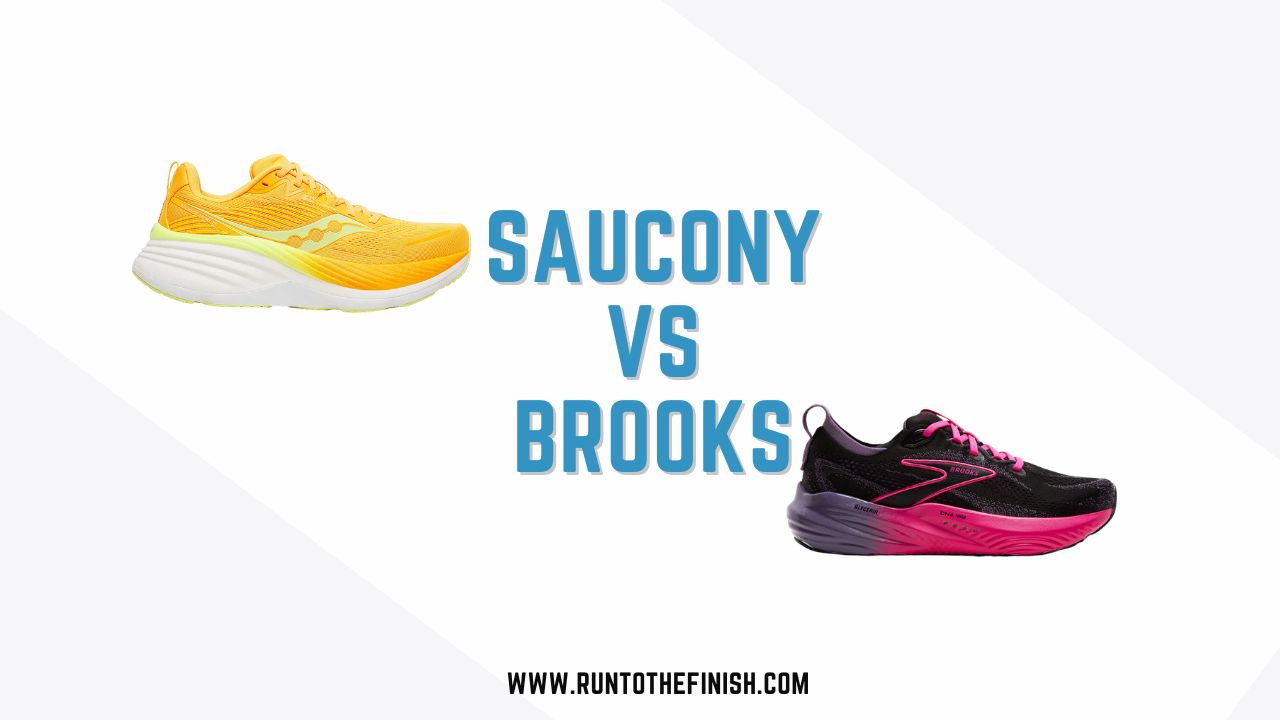
Saucony has made a splash in the last year with it’s new Endorphin collection. Really standing out as shift in technology and flashier marketing than we’ve seen from the brand, which alerted many runners to a brand they may have overlooked.
How do you say Saucony?
Since I used to get this question a ton wearing my Kinvaras, let me help you out.
Sock-a-knee.
It’s actually named after a creek in Pennsylvania and their logo is to represent the flow of water! They really love places for shoe names. I got to visit the actual towns of Kinvara and Kilkenny in Ireland, just a few of their shoe names.
Brooks vs Saucony Key Differences
Brooks and Saucony offer similar features and models for all kinds of runners, from the new runner to trail runner to the flat-footed or high-arched.
Largely, we’re looking at what makes these traditional running shoes different to see which might be a better fit for your training.
I break down the differences in more detail with specific shoe examples, but here’s a quick overview:
Brooks Running Shoes
- Wider Toe Box
- Exclusively designs running shoes
- Science-driven to accommodate rather than correct gait
Saucony Running Shoes
- Often noted as fitting a more narrow foot, with a smaller toebox
- Well known for the casual shoes as well as their running shoes
- Focus is on lighter shoes that provide maximum comfort
- Has an ongoing Fit Tester program to continually update shoes
I’ve worn both brands and will add some personal thoughts, along with links to detailed reviews. In fact, both brands are in my current shoe rotation.
Saucony Vs Brooks Running Shoe Models
Now that you know more about each brand, let’s look at their top models in each of the main categories. There’s no winner declared here because all are great shoes, it’s just about which one is best for your foot.
With each of these, they are the top models so numbers are constantly changing as they make a little upgrade and it becomes the Glycerin 22 or the Hurricane 24.
I was first introduced to Saucony with their original Kinvara in 2009. I stayed with that shoe for over 5 years, enjoying each new model and the fact that it made my IT band feel so much better.
BUTTTT….. I’ve also spent a lot of time in various Brooks models, so truly I like both brands for something different.
Stability Running Shoe
👉Brooks Adrenaline GTS 25
This shoe is great for runners who need more support without sacrificing comfort or cushion.
While the foam upgrade made these shoes feel more comfortable and cushioned than past versions, they still maintain the firm feel of a stability shoe.
 This is due to their GuideRails, which help prevent your foot from rolling inward with every step. By having firm foam around both sides of the heel, it reduces extra rolling of the heel in either direction, allowing the knee to move in a safe range of motion.
They’re still using DNA LOFT v3 foam, but have added 3 mm in the forefoot and 1 mm in the heel, elevating this shoe’s feel to be smoother and softer.
- Weight: 10.6 oz Men’s, 9.5 oz Women’s
- Stack Height: 37 mm
- Heel Drop: 10 mm
- Available in 9 colors
- Available in wide or extra wide
- Available on Brooks Running for $155.00
- Read our full review of the Brooks Adrenaline GTS 25 here >>
👉Saucony Guide 19
The real star of the show here is the PWRRUN foam, which Saucony says is softer and even more responsive in this version of the Guide. In these it was the perfect level of softness, without sacrificing stability and responsiveness.
That broad-based platform makes up what Saucony refers to as their CenterPath technology, which guides the foot through smooth transitions, while the high sidewalls hug the foot to provide additional support through the heel.
We love that nothing here feels overcorrective and there is no firm medial post, meaning you actually feel the cushion underfoot.
The major downside to this stability shoe is one that plagues so many: weight. It’s a basic-looking shoe with a great, comfortable feel, but it’s not the easiest to pick up the pace. Definitely look to these as your easy run shoe.
Part of the weight in this model is more rubber coverage on the outsole, which improves durability.
- Weight: 9.7 oz Men’s, 8.9 oz Women’s
- Stack Height: 35mm
- Heel Drop: 6 mm
- Available in 15 Colors (based on the Guide 18)
- Available in wide and extra wide (D and 2E width for women, 2E and 4E for men)
- Available on Saucony.com for $140
- Read our full review of the Saucony Guide 19 here >>
Neutral Running Shoe
👉Brooks Ghost V 18
The Brooks Ghost 18 still delivers everything a runner could ask for: just the right amount of cushion in midsole, a durable rubber outsole and a breathable mesh upper to keep your feet feeling comfortable mile after mile.
The Ghost 18 keeps the same DNA LOFT v3 cushioning from the Ghost 17, but Brooks made some real improvements to the upper to include the new soft flat-knit tongue, new sockliner for a softer inside, better breathability, and a slightly roomier toe box. Nothing earth-shattering, but the kind of updates that add up over miles.
This is useful to many runners who end up with lower back pain while running in a too cushioned shoe.

The Ghost 18 is your dependable daily training shoe. If you want something that’s going to hold up run after run without making you think too hard about it, this is it. It’s not your race shoe; it’s not your speed workout shoe. It’s the one you reach for the rest of the time, and it does that job really well.
- Weight: 10.2 oz Men’s, 9.2 oz Women’s
- Stack Height: 36mm
- Heel Drop: 10mm
- Available in 6 colors
- Available in Narrow, Standard, Wide (2E), and Extra Wide (4E)
- Available at BrooksRunning.com for $150
- Read our full review of the Brooks Ghost 18 here >>
Saucony Ride or Saucony Kinvara
These two are the most popular neutral running shoes from Saucony. Both have been around for many years and continued to improve.
What’s the difference in the Ride vs Kinvara?
- Cushioning is thinner on the Kinvara making it often more suitable for half marathon and under
- Kinvara is often seen as your tempo run or race shoe, the Ride your everyday training
The Ride is focused on cushioning and support, while the Kinvara is designed for a more natural and lightweight feel.
👉Saucony Ride 18
The Saucony Ride 19 is lightweight, slightly softer, and more responsive underfoot. This is all thanks to a reformulated PWRRUN+ foam.
It’s not going to feel super bouncy like if you put on one of the shoes in the Endorphin line, but you’re going to get a little bit of energy return that’s going to feel really nice especially once you get into those longer runs.
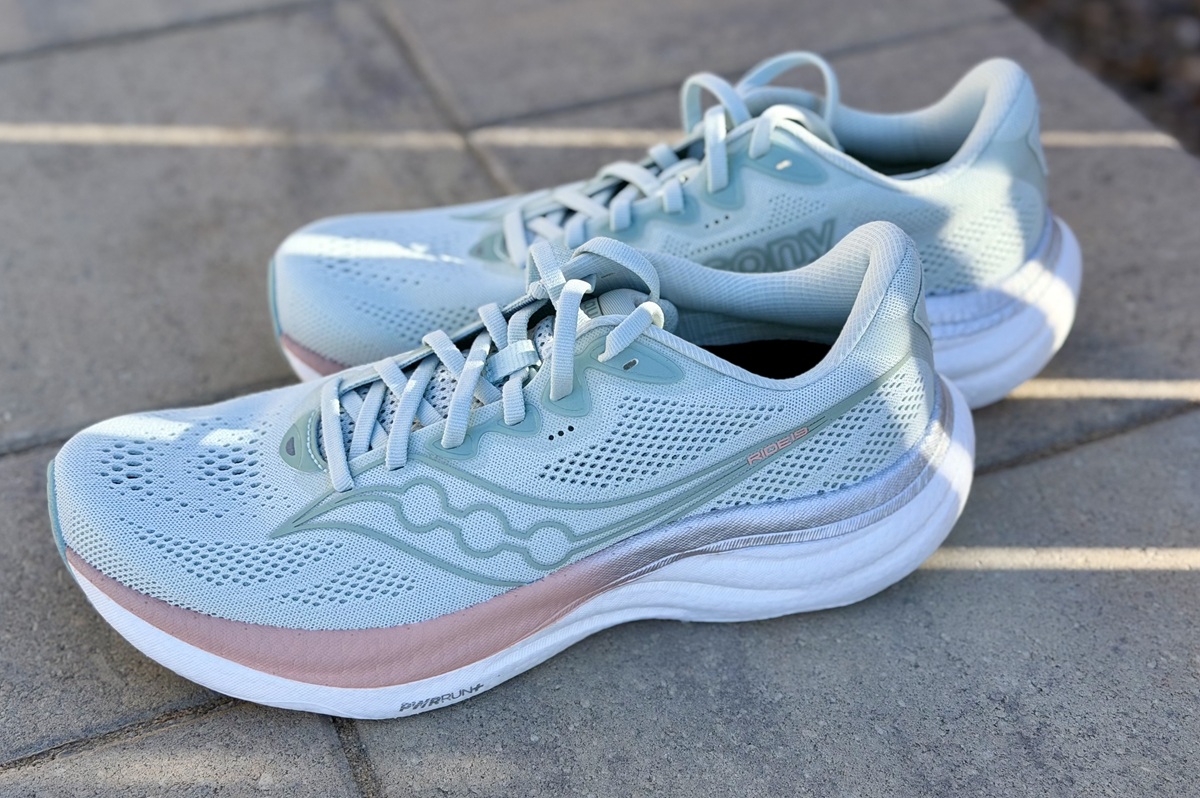
The Ride 19, it’s still a shoe we’d confidently recommend as a daily trainer. It’s not built for all-out speed or hard workouts, but if you sprinkle in a few strides here and there, it’ll handle them just fine.
- Weight: 7.7 oz Women’s, 8.9 oz Men’s
- Stack Height: 36/28 mm
- Heel Drop: 8mm
- Available in 10 Colors
- Available in wide in limited colorways
- Available from Saucony.com for $140
- Read our full review of the Saucony Ride 19 here >>
👉Saucony Kinvara 16
This has been one of my go to shoe’s for many years. The newest model is taking some steps back to what the shoe was with a great cushion, but not overly built.
The stack height has increased to add more cushion and stability to the run, but as you can see they are holding on to that lightweight and low drop. It’s hard to find low heel to toe drop shoes, so this is a big time winner.

The shoe’s upper is made from a breathable mesh material that allows for maximum airflow and helps to keep feet cool and dry. This one has a bootie style fit, meaning that the tongue is attached. I LOVE this because it means it’s not going to be moving all over while I run.
- Weight: 7.0 oz Men’s, 6.2 oz Women’s
- Heel drop: 4 mm
- 8 colors available
- Available in wide
- Available now on Saucony.com ($130)
- Read our full review of the Saucony Kinvara 16 here >>
Cushioned Running Shoe
👉Brooks Glycerin 23
It‘s a great all–around running shoe, providing great cushioning for a variety of running distances.
The Glycerin 23 uses nitrogen infused DNA Tuned cushioning, the same as the Glycerin 22s, with 2mm more foam in the forefoot. YES!! In our Glycerin 22, we mentioned a few times wisher for more under the forefoot. Clearly Brooks is taking feedback from runners.

These shoes were created with a tune dual cell technique which means the heel has large cells for plush landings and the forefoot has small cells for responsive toe-offs.
While this is going to provide great support with each step, it’s considered a neutral shoe. If you’re looking for a little extra stability, that’s where the well loved Glycercin GTS (or any GTS Brooks shoe) would come into play.
- Weight: 10.6 oz Men’s, 9.5 oz Women’s
- Stack Height: 38 mm
- Heel Drop: 8 mm
- Available 8 Colors
- Available in wide and extra wide
- Available on Brooksrunning.com for $175
- Read our full review of the Brooks Glycerin 23 here >>
👉Saucony Triumph 24
The Triumph is cushioned, comfortable, and energetic – a great combination for your daily miles and especially those long easy miles.
The incrediLUX foam is meant to feel plush and responsive underfoot while also dramatically reducing the shoe weight as compared to traditional TPU foams used in prior models.
While Saucony reduced the weight of the Triumph from 9.2oz in a men’s size to 8.8oz in this latest version, they also increased the stack height on the shoe, changing it from a moderate stack height to a true max stack height contender.
The prior model of the Triumph had a 37mm stack height, while the Triumph 24 clocks in at 43mm at the heel. What amazed me was the ability of Saucony to make this change while keeping the shoe so lightweight and durable – a big upgrade for my peak training feet!
The outsole of the Triumph 24 is pretty standard rubber that feels durable and supportive on the road and on the treadmill.

While I wouldn’t reach for these shoes for uptempo workouts or speedier days, I do think these shoes are incredibly wearable for long, easy miles and for non-running activities alike.
- Weight: 8.8 oz Men’s/7.6 oz Women’s
- Stack Height: 43mm
- Heel toe drop: 10mm
- Not available in wide
- Available at saucony.com for $170
- Read our full review of the Saucony Triumph 24 here >>
Carbon Fiber Plate Shoes
Are they cool new technology, yes. Do they last as long as your other shoes, nope.
So if you want to test these out use them for speed work and then race day! Watch my detailed video on how Carbon Fiber Shoes work.
👉Brooks Hyperion Elite 5
The Brooks Hyperion Elite 5 is a lightweight, high-performance running shoe designed for speed and efficiency. It’s doesn’t have a full solid plate like we see in other Super Shoes and the reasoning behind that is both to keep the shoe lighter and only provide stability to the cushioning not dampen it.
SpeedVault Race+ plate has been “fine tuned” so that the plate is actually different based on the size of the shoe and thus meeting the needs of that runner. The larger the shoe, the stiffer the plate in essence.

Now they are using what they call DNA Gold 100% Super Critical PEBA foam, instead of Super Critical EVA. This helped to drop an entire oz of weight from the shoe, but more importantly, changed the feel underfoot.
- Weight: 6.9 oz
- Stack Height: 40 mm
- Heel drop: 8mm
- Available in two colorways
- Not available in wide.
- Available at brooksrunning.com for $275
- Read our full review of the Brooks Hyperion Elite 5 here >>
👉 Saucony Endorphin Elite 3
This lightweight, race-day shoe is perfect for those looking to hit PRs, from the 5k through the half-marathon. Front of the pack runners will find it holds up for marathon day, but we recommend other shoes for mid to back of the pack marathon runners.
The Elite 3 uses Saucony’s new IncrediRUN foam, which has a super-soft, energetic feel while still providing enough cushioning to stay comfortable during harder efforts and race-day miles.
Saucony also updated the plate design from previous models by introducing a new slotted carbon fiber plate.

- Weight: 6.5 oz Women’s, 7.2 oz Men’s
- Stack Height: 39.5mm
- Heel to Toe Drop: 8 mm
- Available in 1 colorway at launch
- Not available in wide
- Available on Saucony.com for $290
- Read our full review of the Saucony Endorphin Elite 3 here >>
Trail Running Shoe
👉Brooks Caldera 8
It’s been a few years since I’ve run in this particular model, but I really enjoyed it at the time. I’ve just been testing a lot of other shoes!
When you first look at these shoes, your eyes are probably immediately drawn to the amount of foam. But don’t worry, this doesn’t translate to the Caldera 8 being a super squishy ride. The cushion is there to help protect your feet from rugged trails. But the trade-off is that it’s missing some of that responsiveness to help you pick up the pace.
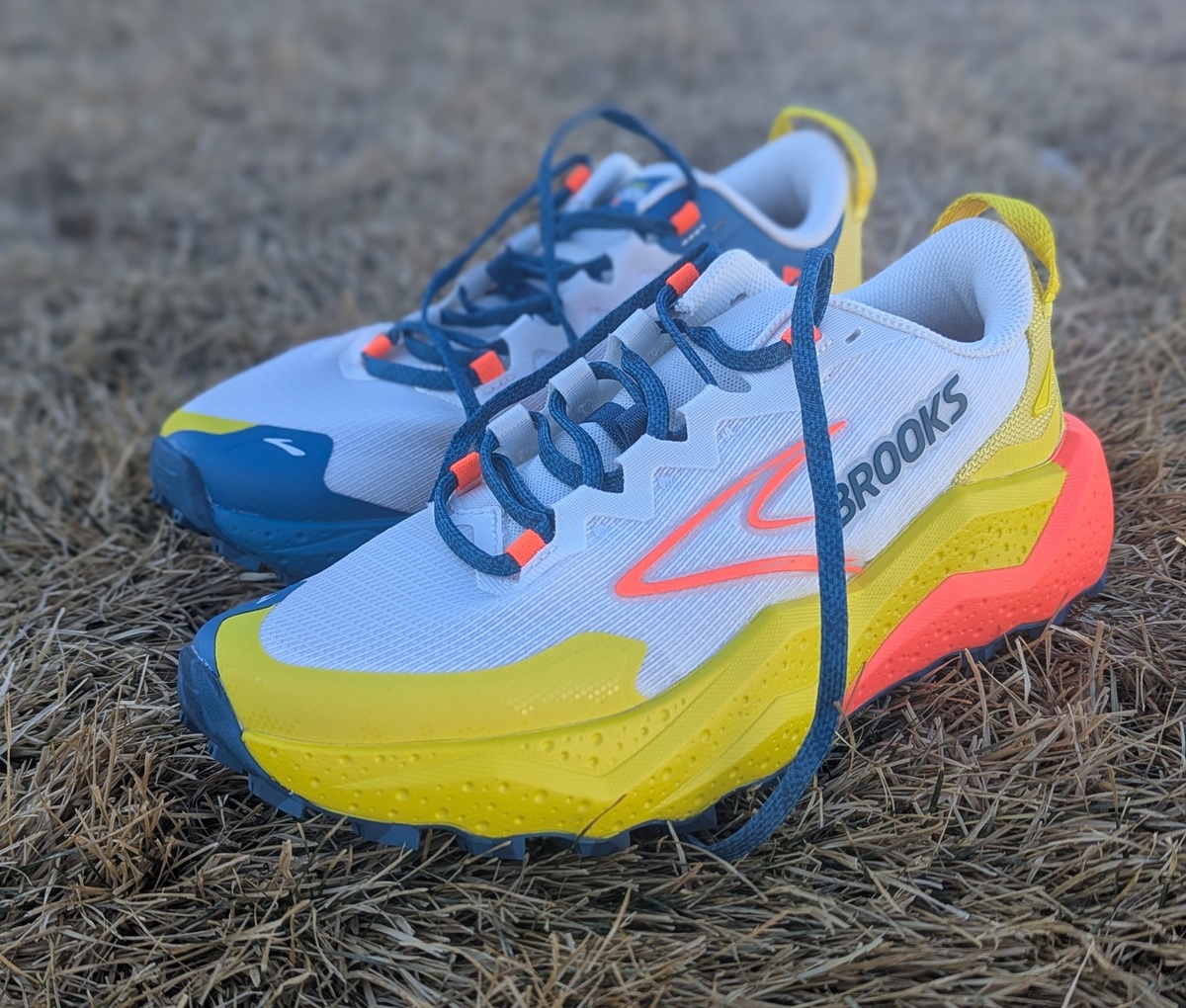
The DNA Loft v3 foam brought the cushion but was still firm and bouncy enough to feel connected to the trail. With all the cushion the Caldera 8 was still stabilizing, flexible, and responsive enough to handle the most poorly chosen line through roots and rocks.
This is a perfect match for trail and ultra runners looking for a little extra cushion while spending lots of time on the trails.
- Weight: 14.4 oz Men’s, 9.3 oz Women’s
- Heel drop: 6 mm
- 2 colors
- Not available in wide
- Available from Brooksrunning.com for $150
- Read our full review of the Brooks Caldera 8 here >>
👉Saucony Perigrine 16
The Peregrine 16 brings back support and confidence on technical trails while still feeling easy on smooth singletrack.
It keeps things comfortable with a nice amount of padding around the back of the heel collar. In addition to the slightly padded tongue with a PWRRUN+ sock liner, there is gusseting for about two-thirds of the length just to keep things from sliding side to side over the miles.
And the gaiter hooks are still there for that added accessory on the gravel terrain.

The 4mm heel to toe drop is another reason we’ve long recommended this shoe. It reduces that knee angle and really helps with IT Band issues for a lot of runners.
- Weight: 8.4 oz women’s, 9.5 oz men’s
- Stack Height: 32 mm
- Heel toe drop: 4 mm
- Available in wide and GTX
- Available in 3 colors
- Available at Saucony.com for $145
- Read our full review of the Saucony Peregrine 16 here >>
Checkout my complete breakdown of the best Saucony running shoes >>
Brooks vs Saucony Feature Comparison
Both brands have been around for a very long time and are leaders in running shoe design. They both offer various technologies to aid with comfort, support, stability, and cushion.
Where they differ most are in the fit and that Saucony is also well known for their casual classic shoes.
It’s gonna get a little TECHY…so you can just skip on down to the specific model comparison if you want, but personally if I’m shelling out $150 for shoes, I want to know why.
Durability
The lifespan of shoes from both companies is fairly comparable.
- Brooks shoes have a life expectancy ranging from 300 to 500 miles, or three to six months, depending on your monthly mileage.
- Saucony states their shoes last around 400 miles, which is pretty average. The new Endorphin pro with the carbon fiber plate is more like a racing shoe and therefore only expected to last around 200 miles.
Determining when to replace running shoes, of course, all depends on your gait, weight, and whether you run mostly on trail or road.
Fit
Brooks shoes have a wider toe box, which makes them a great choice for runners with wide feet or bunions. The brand recommends that buyers go up a half size from their everyday shoe.
Brooks does a great job with online fit, the Brooks shoe fit finder will give you an idea of what to look for in a running shoe when you do visit your local store.
Saucony has their own Shoe Advisor to help put you in the right model.
Their often lower heel to toe drop and cushion make them a favorite of distance runners, who find the decreased drop helps with issues like IT Band Syndrome and ensures they are working on hip strength over a shoe correcting a weakness.
Cushioning
Brooks uses two types of cushioning in their designs:
- DNA LOFT – Soft cushioning, that adapts to a runner’s profile, stride, and speed
- BioMoGo DNA – also adapts to runner’s profile, stride, and speed, providing a more balanced experience with a bit of spring.
Saucony has transitioned most of their shoes to PWRRUN technology, which they promote as a better than the standard EVA foam used by most brands.
- PWRRUN+ midsole cushioning provides more flexibility, durability, and springiness in a foam that’s 25% lighter
- Again and again their focus comes back to lighter, flexible for more power in your take off and more energy return
Stability
Brooks refers to individual running gaits as the “Run Signature.” Rather than “fix” the way someone runs, Brooks technology helps to stabilize your stride based on how you naturally run.
They put runners into two different categories: Neutral and Support.
Brooks GuideRails technology allows hips, knees, and joints to move naturally, offering support when needed. Neutral runners may only require them to kick in when their stride is off.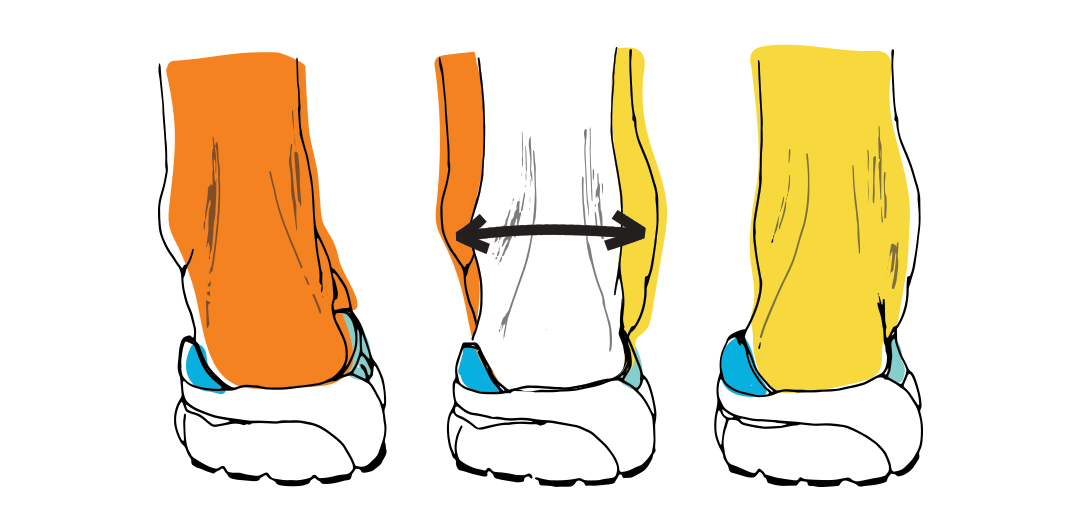
Saucony has also been transitioning to less aggressive stability tools, ensuring the shoe is not over correcting or doing the work for you.
They utilize a medial post (which is a device within the midsole that is firmer) to help provide control and a TPU heel plate which again makes the rides slightly firmer and adds control. Thanks to the cushioning, you don’t so much notice the stiffness and reap the benefits.
Affordability
The prices between the two brands are fairly comparable. Brooks prices range between $100 to $160, while Saucony starts at a slightly higher price at $110, averaging $149 for many models and then up to $249 for the Endorphin line.
You’ll notice that every brand offers a range and this is indeed due to a difference in technology and where they sell the shoe.
They know that the big box store can sell the shoe with less in it, while the local running store needs to be the best for dedicated runners. Having run in all the different things, I can 100% tell you it’s worth paying more for the better running shoe than what is at the box store.
What about the Endorphin Line?
Because Saucony really shook things up introducing a whole new line of shoes, it feels like there needs to be at least some discussion here!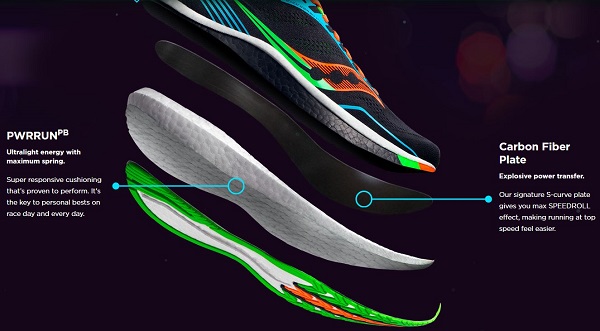
One of the big things they talk about is the Speed Roll to help roll your foot forward, which is actually pretty similar to the rocker that Skechers put in their running shoes from the start.
- Endorphin Pro 4 – Designed for speed with the carbon fiber plate, this is your race shoe. It’s a winner.
- Endorphin Shift 3 – This feels like a cushioned slightly stabilizing shoe, good for everyday training. It’s not been my favorite Saucony shoe and I tend to like most of their shoes.
- Endorphin Speed 3 – Also designed to be a neutral, cushioned shoe you can take to the race, but without the carbon fiber plate, as it uses a nylon plate instead.
Are carbon fiber plates everything?
Some runners have found injury using them and since the shoes wear out faster, you are only doing a few training runs in them prior to race day. But…the data does shoe there are some speed benefits! So it’s really up to you.
More About Brooks
Believe it or not, Brooks started out in 1914 making ballet slippers and bathing shoes. Since then, they have made everything from baseball and football cleats to roller skates.
It wasn’t until Frank Shorter won the marathon at the 1972 Munich Olympics that Brooks considered limiting its focus. The first running shoe debuted in 1974 and their most popular running shoe, the Adrenaline GTS first hit the market in 1999.
In 2001, Brooks decided to focus solely on running.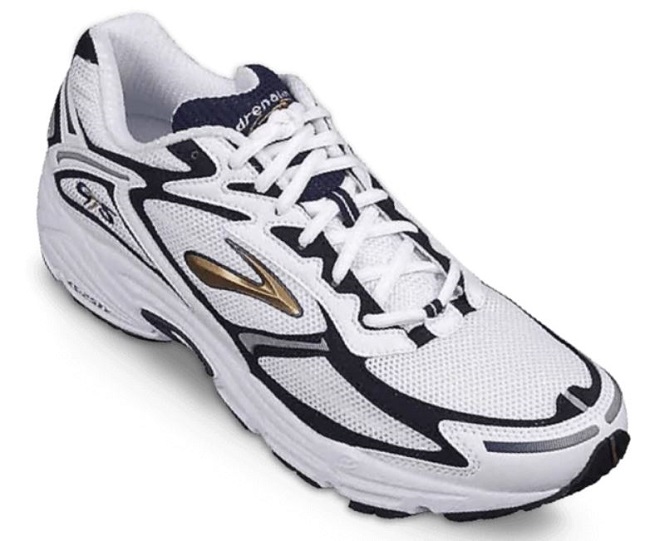
They introduced the Transcend in 2013, a shoe that used new biomechanics technology to create a GuideRails technology, allowing runners to run naturally without trying to correct their gait.
The Seattle-based company is also well known for its commitment to sustainability and giving back. Brooks donates time, gear, and money to companies that align with their values around diversity, equity, and inclusion and staff receive paid annual volunteer time.
Your gait and feet will likely change over time and you may need to change shoes.
This is also why I recommend rotating through several pairs of shoes at once.
And remember, just because these are two of the most well known brands on the market, there are still plenty of other shoe brands to select from if neither Brooks nor HOKA has the right shoe for you.
Keep in mind that shoe design can change, even with the same model, so always assess how the shoe fits every time you replace a pair.
More about Saucony
Like another well known running brand (New Balance), Saucony started it’s first factory in 1898. And by 1910 they were making running spikes…but few people were running or even looking for running shoes, so it wasn’t until the 1970’s that they started to grow.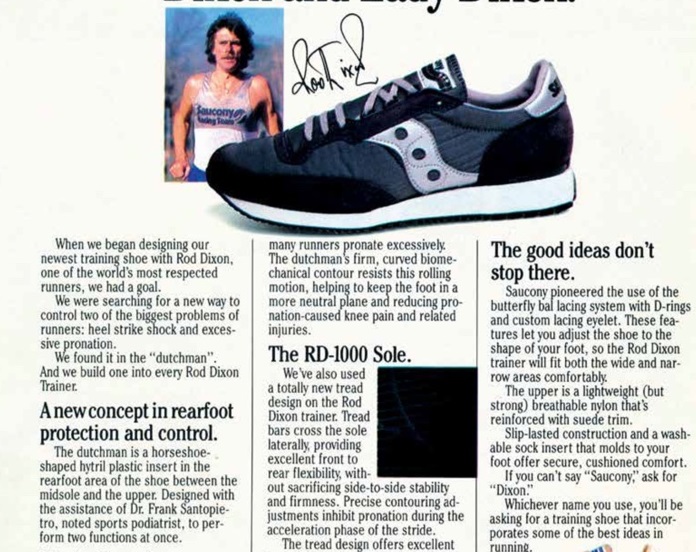
First they became known for their casual shoe with it’s cool style and then, the big time hit.
Runner’s World featured them in 1979 as a top 10 running shoe. By the 80’s they were making shoes with a non-slip sole which was a big innovation.
Then came 2009 and the Saucony Kinvara – this one shoe changed many things about their design and philosophy. It was the more natural running shoe (yes during the barefoot trend). The new goal became how to strip shoes down, without sacrificing cushion and comfort.
Good performance, good health and good community are their guiding principles. You may have seen their hashtag #runforgood – which is really about doing good, giving back and finding sustainable practices.
For more help selecting the right shoe for you, don’t worry, I’ve got you:
- Best Trail Running Shoes
- Top 5 Marathon Running Shoes
- Skechers Running Shoes review (you might be surprised!)
- Best Running Shoes




This is a great review, thank you! I’m a long time sponsored Brooks athlete, but I still enjoy learning about other running shoe brands and the various benefits each brand offers. I am wondering, is there a reason that you did not include Brooks’ carbon plated shoe, the Hyperion Elite? Thanks again.
This is really interesting! Thank you for the very detailed comparison.
I’ve been wearing Kinvaras for many years but am currently dabbling in other options both by Saucony and other brands. I’d always written off Brooks because I’ve heard it suits a narrow foot so it’s very interesting to see your point about the wider toe box. I’ll definitely give them a try on my next visit to the shoe store.
I’m happy to see that I’m not the only person who has focused my attention specifically on these two brands. I can never decide whether my favorite shoe is Brooks Ghost or Saucony Ride, so I always have one pair of each on hand, and tend to alternate between the two. As long as I mix it up a bit between these two, I don’t get in a rut and I seem to be able to run without pain.