

When it comes to shedding those extra pounds, finding the most effective exercise strategy can feel like an overwhelming task. This often leads people to ask me if running is the best way to lose weight?

On the face of things, it makes sense because it burns a lot of calories.
100% in my early days of running I was absolutely focused on the idea that it was the fastest way to torch calories and keep me in that ever talked about deficit. Man, I wish I’d known what I do now 20 years later as an experienced run coach and personal trainer.
Before lacing up your sneakers and hitting the pavement, it’s essential to understand a bit more about how the body works and that while calories in/calories out works…it only goes so far.
In this article, we will delve into the question: Is running the best way to lose weight?
The quick answer is no.
Well, at least not on its own.
Yes, there are plenty of stories of people taking up running and losing weight (It was part of my journey to keep off 35lbs), but there’s almost always more to it.
So what’s the real story? Can running and weight loss go hand-in-hand? What else plays a role in our ability to change the number on the scale or what we see when we look in the mirror?
Is Running the Best Way to Lose Weight?
Like I said, the long and short of it is…no. You can lose weight by running, but honestly, it’s a bit more complicated. I’ve also talked about the fact that I wish I’d known my real goal was learning how to lose body fat. Who gives a hoot what the scales says if I don’t look strong, fit and healthy?
While exercise can contribute to weight loss, it’s only one piece of the puzzle. You’re also going to need to ensure that:
- You don’t lose muscle mass. In fact, we really want to gain muscle.
- Food is used to support all the activity you are now doing.
- Learning not to overtrain which stresses out the body and isn’t great for weight loss.
- Remember that weight loss and marathon training don’t usually go hand in hand.
A comprehensive approach to weight loss should involve both dietary modifications and regular physical activity (which is to say more than just running). Diet plays a crucial role in controlling calorie intake, ensuring proper nutrient balance, and supporting overall health.
Exercise, on the other hand, helps to increase calorie expenditure, build muscle, and improve cardiovascular fitness.
On a recent episode of the Tread Lightly Running Podcast, we sat down with someone who knows this topic inside and out.
Lydia Nader-Urdiales is a registered dietician who works closely with runners to help them reach their performance and body composition goals. In this conversation, she shares how to approach weight loss safely as a runner, the common mistakes to watch out for, and even why some athletes end up gaining weight during marathon training, plus more!
How to Safely Approach Weight Loss as a Runner
I’m a HUGE fan of learning how to run to lose weight if that’s your goal for a healthier happier life. I’m not a fan of trying to get to a specific “runner weight”. We know this can lead to a lot of disordered thoughts around food and body image.
So let’s talk about what it takes to do this in a healthy way and turn your body in to a running machine you’re proud of.
#1. Enjoy The Workout
Wait the first tip is to have fun?! WTF.
Let’s be honest if you hate running, then you just aren’t going to stick with it. And that my friends is no way to develop a lifelong habit that helps you feel your best or lose weight.
Which means you need to learn how to run the right way. Chill out. Stop trying to break world records on every run.
- Follow a smart program like Couch to 10K to get started
- Embrace walk breaks to allow you to go farther without overtaxing your body
- It really does get better the longer you’ve been running, but if you continue to hate it… FIND DIFFERENT CARDIO.
#2. You MUST Strength Train
Strength training provides numerous benefits to us as runners. It helps reduce muscle imbalances, lowers our risk of injury, improves our biomechanics and running economy, increases our power and speed, increases bone density, and helps us maintain lean muscle mass.
The one I really want to focus on though for this article is maintaining lean muscle mass.
Did you know that by age 30 both men and women start to lose muscle?!
Muscle takes up less space than fat and burns more calories. Baby we want to hold on to this at all costs and if we can build more to keep that metabolism humming.
Strength training doesn’t have to be complicated either. You can do it at home with a few dumbbells, meaning no gym membership required, and focus on working the entire body.
- Add in 2 to 3 sessions per week
- Sessions can be as short as 20 minutes, shoot I’ll take 10 if it gets you started!
- Start with a progressive bodyweight program to build a strong foundation
- Then you MUST start lifting weights to actually stress the muscles enough for growth
Trust me, you won’t be getting bulky. That requires eating in a calorie surplus and is very difficult alongside running. But you will be getting that more “toned” look.
Some exercises to consider including in your workout include planks, squats, lunges, push-ups, deadlifts, and glute bridges, just to name a few.
👉Ready to get started?? We’ve got everything from a Bodyweight At Home Program to a Heavy Lifting for Runners Course, all designed by our team of run coaches with years of experience.

#3 Stop Focusing on The Scale
A great way to hinder progress is to step on the scale daily and let it determine your mood or your worth.
One other thing I want to touch on is to not get hung up on the number on the scale. You can truly change your body composition and not see the scale budge. There’s also the fear of seeing the scale go up with strength training.
There are truly many other measures of success besides the scale. Take measurements of different body parts like your upper arm, thigh, waist, hips, and calves or get your body fat measured by a professional or an InBody scan.
Focus on how your clothes are fitting. You may find they become looser because of a change in how your body is shaped because of an increase in lean muscle mass and lower body fat. You may also see and feel improvements in your running.
#4 Rethink Your Nutrition Plan
As I mentioned earlier, improving our diet and nutrition along with running is positively linked with weight loss.
It’s really easy to overestimate the number of burned calories as a result of exercise. Caloric burn is a hard thing to measure and our treadmills, ellipticals, apps, and watches just aren’t going to get it exactly right. In fact, they often grossly overestimate the number.
It’s estimated on average we burn about 100 calories per mile. However, that varies based on age, sex, current weight, body composition, and exercise intensity, among other things.
It’s easy to then say well I ran 4 miles, that’s 400 calories, so now I can have a plate of fries or a big bowl of ice cream. But this can completely defeat the calorie deficit we created with our run and even put us in a surplus.
A surplus of calories, especially logged over time, can lead to weight gain, whereas a consistent calorie deficit usually results in weight loss. This surplus or deficit doesn’t have to be large either.
In the podcast episode, Lydia talks about a few key things you can do on your own to help improve your diet, ensure you’re well-fueled for your activity and the rest of the day, and support maintaining lean muscle mass while seeing weight loss or improvements in body composition.
#5 Prioritize Protein
When you’re running to lose weight, you want to ensure that you’re primarily losing fat rather than muscle mass. Consuming an adequate amount of protein helps preserve your existing muscle mass and even supports muscle growth.
Including protein-rich foods in your meals and snacks helps you feel fuller for longer, reducing the likelihood of overeating or succumbing to unhealthy food cravings. Cravings are a common issue during marathon training and often a sign that you are underfueled or that the body is lacking NUTRIENTS.
While a lot of people track their macros, you don’t have to do this to ensure you’re getting enough protein.
Make sure that each of your main meals includes a lean protein source. This could be eggs, dairy, meat, plant-based options, or protein powder, for example. Protein helps keep you fuller longer and supports muscle repair, recovery, and growth.
If you follow me on Instagram, you also know that I prioritize refueling shortly after running with protein, often a shake of some kind. This is because for running after 40, that recovery window is key to maintaining our muscle!

#6 Don’t Shy Away From Carbs!
Carbs really do get a bad rap, but they’re crucial for supporting glycogen stores in our muscles that fuel our activity. Basically they’re a source of energy!
You’ll find that having some easy to digest carbohydrates before a run can help you perform better. Think about having a small snack or meal consisting of whole grains, fruits like a banana, and vegetables you enjoy.
Remember that by taking out too many calories, you not only end up performing worse in your workout, but then you move less all day long. And by moving less, you burn less calories. So you effectively keep yourself at the exact same calorie deficit!
Many people end up losing more weight once they stop with big restrictions because they have the energy to do a lot more all day long, like getting those 10,000 steps outside your workout.
Consuming a balanced amount of carbohydrates supports metabolic efficiency. When your body receives an adequate supply of carbohydrates, it signals that there is no need to break down muscle tissue for energy. Plus, all that fiber from whole foods helps you feel full and well carbs make you happy!!
Your brain runs on carbs!! Feed it.
#7 Avoid Fad Diets
It’s easy to fall in the trap of a fad diet or just a style of eating that’s not sustainable long term. They also often leave you underfed, frustrated, and likely to binge.
You may hear of people doing Keto, intermittent fasting, or insert any number of other popular diets. They may work for some, and may have in the past for you, but also often result in gaining back the weight lost, developing health issues, injury, and more.
- Keto has been shown to create hormonal issues in many women and men (especially endurance athletes)
- Fasting when compared to any other calorie controlled diet has the exact same weight loss (it’s all just reducing intake)
- Fasting prior to workouts leads to poor performance and increases your body stress hormones (cortisol)
- GLP-1 is literally all over the place on social media, but it doesn’t mean that it’s going to be the fix all for everyone
Focus instead on fueling your body with foods that are both full of the vital nutrients we need and that you enjoy.
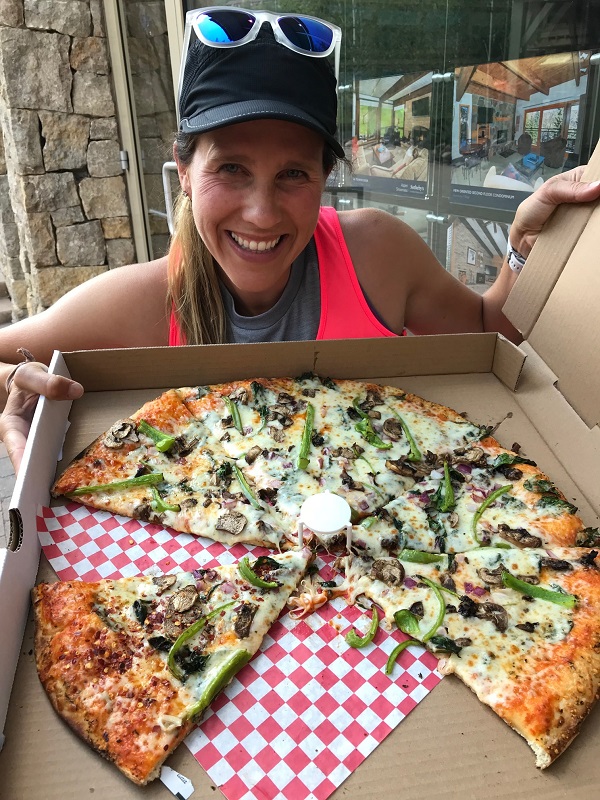
For example, we all know I love pizza. A lot of people may look at pizza as something to avoid, but in reality you can make it great with a variety of toppings including meat, veggies, and even fruit if you’re into that.
#8 Steady State Running
Often referred to on social media as LISS (low intensity steady state) cardio.
While interval training is effective, longer steady-state runs have their own benefits. These runs, at a comfortable pace, help build endurance and improve aerobic fitness.
Longer runs also provide an opportunity to burn more calories during the workout and contribute to weight loss.
#9 Interval Running
If you’re short on time or have now been running for awhile, then it’s time to mix things up a little bit.
Please note, these efforts should only be a small portion of your weekly mileage (80/20 principle). Most runs should be lower-intensity.
High-intensity interval training (HIIT), which includes running intervals, has been shown to have metabolic benefits. It can increase the production of growth hormone, which plays a role in fat metabolism.
Sprinting workouts have also been associated with improvements in insulin sensitivity, which can aid in regulating blood sugar levels and promoting better energy utilization.
As you can see, running and weight loss can go together quite well, but it’s not simple and there are many factors at play.
There are a number of ways to successfully lose weight and keep it off. As you can see, running can certainly be a part of your journey and it definitely can lead to positive outcomes.
Ultimately, it’s truly a combination of things that will lead to success, including strength training, solid nutrition, and workout variety.
Looking for more tips?
- Why your weight goes up after long runs?
- Strength Training for Runners
- How to Reboot Your Metabolism
Other ways to connect with Amanda
Instagram Daily Fun: RunToTheFinish
Facebook Community Chatter: RunToTheFinish
Sign Up to Receive a Weekly Newsletter with Top Running Tips and Laughs



 Ultrahuman Ring AIR Review: Brilliant Tech, But Do we Really Need Another Wearable?