
You’ve cranked up your training from half marathon mileage to run your first marathon or maybe your 20th, either way you’re putting in the miles, making great food choices {minus that well earned post long run burger} and yet that damn scale keeps going up…. say thank you to the combo of cortisol and exercise.
What does that mean??
This seems to be an oddly familiar cycle for a growing number of athletes who are piling on the miles in addition to the rest of their already jam packed days of work and family, which means it’s nice to know you’re not alone.
But a bad sign that we’re all finding ourselves trying to climb out of a hole rather than seeing progress for our efforts.
It’s time to understand how cortisol is impacting your body.
Does exercise increase cortisol levels?
Yes.
But that doesn’t mean it’s a bad thing.
If you’re working out at an appropriate intensity for you, taking rest days before you start having signs of overtraining and eating enough to fuel those workouts then your body will respond as it should.
- Stress is what helps the body to become stronger.
- Every strength workout breaks down muscle.
- Every run stresses the heart, the muscles, the bones.
- Then you spend time on recovery and the body grows stronger.
If you have chronically high cortisol from leading a stressful life, then you need to ensure your workouts aren’t pushing that number even higher. That means not working out 7 days a week, not doing double days and not doing a ton of HIIT.
This is one reason I switched to Low Heart Rate training and have found it beneficial for many of my athletes. Now they know how to truly run easy on easy days, which make up the majority of your miles.
Endurance athletes tend to have a higher threshold for pain (and stress) which leads us to believe that we are “handling it all just fine”. In reality our bodies are physiologically unable to respond to a consistently high level of cortisol.
Chronically high levels of cortisol lead to weight gain despite all your efforts!
Let’s dig in so you can understand this tricky little hormone and what to do about it to get back on track, optimize your recovery and continue enjoying those runs.
Cortisol and Weight Gain
First things first, a little bit of science, but I promise to keep is simple!
- Cortisol should be highest in the morning to help you wake up
- Cortisol should be lowest in the evening to help you sleep
- Cortisol will rise with any stressful situation from work to kids to exercise
- Consistently HIGH cortisol from non-stop stress is when you start to experience issues
Here is an overview of how cortisol should rise and fall throughout the day, plus an interesting bit on the impact of food as well. 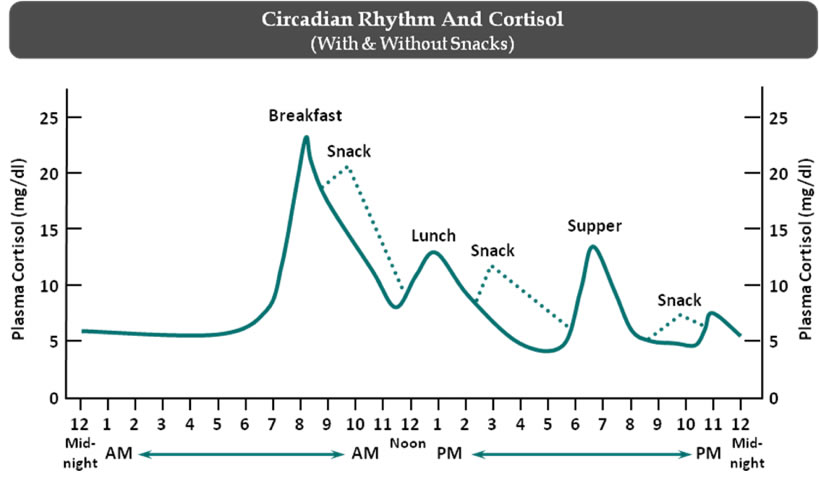
What does Cortisol Do?
While cortisol is thought of as our stress hormone due to it’s label around “fight or flight” the reason we care about regulating it has far reaching impacts as runners. From WebMD:
- Manages how your body uses carbohydrates, fats, and proteins
- Keeps inflammation down
- Regulates your blood pressure
- Increases your blood sugar (glucose)
- Controls your sleep/wake cycle
- Boosts energy so you can handle stress and restores balance afterward
How Can I Tell if My Cortisol Levels are High?
It’s important to know that LOW cortisol is just as detrimental to you as high cortisol. And often if you’ve allowed yourself to stay in a high cortisol state for too long then you’ve got adrenal fatigue and that leads to low cortisol (discussed below).
At home cortisol tests are an easy option to find out if your levels are high, low or just right.
If you do decide to get tested, it’s important to get a FULL day.
Personally, I used Everlywell testing.
- You spit in to a tube 3 times over the course of a day
- You mail it back
- You get your results
- Basically the easiest way to get the most accurate info about your cortisol levels
- **UPDATE** you asked which test and there are a few that include Cortisol. I did the full women’s hormone panel because that’s what I needed, but the cheapest option including cortisol is the Metabolism test.
You need to see what your levels are at different times per the above graphic because it’s SUPPOSED to change during the day.
Many doctors will just take your AM Cortisol, but that’s not a true picture of what your body is doing. This graph provides some examples of ranges to help when you get those test results back.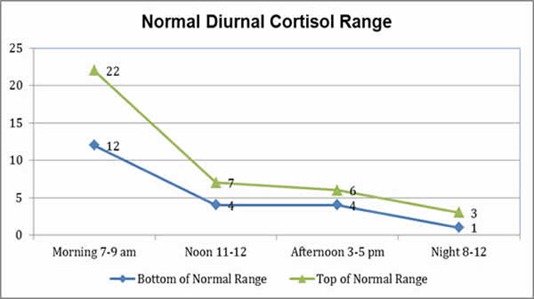 Testing is really easy and the information is really valuable.
Cortisol Levels and Sleep Issues
Cortisol levels should be elevated to increase alertness when you first wake up.
If you struggle to wake up in the morning, hit the snooze button multiple times, or need several cups of coffee to get yourself moving then chances are your morning cortisol levels are abnormally low.
Cortisol levels should naturally decline throughout the day to help us prepare for sleep.
Excessive cortisol from stimulants, stress, “busyness” prohibit melatonin production making it hard to fall asleep or get in to a deep sleep. Checkout these natural sleep aids to help you drop your cortisol at night.
Symptoms of High Cortisol
Following are the impacts of allowing our stress {life and training} to go unchecked:
- Prevents short term memory from transferring to long term
- “tired but wired” feeling
- Decreased metabolism {gaining abdominal fat}
- Increased bone loss
- Inhibits pituitary function
- Higher inflammation
- Lowered immune system {frequently sick}
- Mood swings, anxiety, depression
One tool which has helped myself and many others is CBD for workout recovery.
Ever wonder if your exercise is causing you too much stress? Read this #fitness Share on XGreat visual from Dr Axe on the symptoms of high cortisol levels. 
How to Reduce Cortisol?
If you’re showing symptoms, it’s easy to make changes right away to give your adrenals some much needed love. Consider it a training bonus to put some effort in to your recovery plan.
The saliva test noted above was really helpful as I figured out my own hormone imbalances. I was told my cortisol will always run high due to no estrogen, but thanks to low heart rate training I’ve actually managed to run marathons, hit PR’s and keep it in check!!
Ways to regulate your cortisol:
- SLEEP, at least 7-8 hours
- In bed by 11pm to help restore natural circadian rhythms — wear blue blocking glasses if using a lot of screens to help make this early bed time happen
- Eat nutrient dense foods {lots of greens, vegetables, fruits}
- Eat good fats {coconut oil, avocado, nuts}
- Eat enough food to fuel your lifestyle, being too low in calories for too long is a big stressor
- Stop using stimulants like coffee {sorry but these stress your tired body}
- Support digestion with probiotics and fermented foods
- Address life stress {make changes, meditate, understand mindfulness}
- Consistent moderate exercise {that’s right no more HIIT for awhile}
- Focus on rest days and post workout recovery meals
- Rhodiola is a natural herb he recommended in the morning to kick start levels {it’s part of why I like the Vega pre-workout}
- CBD oil for sleep or CBD gummies for nerves during the day
- Talk with a doctor for a specific protocol
I think we’ve all heard that stress makes it harder to lose weight, but as athletes we assumed that simply didn’t apply to us…turns out maybe it applies even more.
This certainly isn’t meant to be an exhaustive study of adrenal fatigue or to say that your eating habits aren’t the cause of a little extra weight, but hopefully to make us all more aware that stress isn’t just a bad day at the office…plus really isn’t de-stressing the best task you’ve been assigned lately?!
How can you balance exercise and cortisol?
Balancing training, a job and a family will never be a perfect equation, there does has to be some give an take to keep your body humming along.
- Reduce exercise intensity or duration when life stress is high.
- Train in cycles that allow you to go hard and then have recovery periods. Elites often take off a full month after races.
- Utilize the cutback week in marathon training plans, this allows you to build, recover and then build again.
- Pay attention to the signals your body is sending. Instead of just “pushing through”, know that sleepless nights might be a sign that a couple rest days will help you get back on track.
- Don’t attempt to drastically cut calories for weight loss. It not only backfires, but creates larger problems like the female athlete triad.
What about Low Cortisol Levels?
We often get so focused on levels being high that we miss a bigger issue of once you’re body is so taxed that it stops producing enough cortisol and you move in to Adrenal Fatigue.
It’s a word that is tossed around a lot these days, but did you know that it is not a medically recognized health issue? It’s actually called HPA axis dysregulation. I’d say they are one in the same, but the more holistic term is “adrenal fatigue.” And for us common folk, adrenal fatigue is just is easier to say, am I right?
An explanation from RD Kelsey Kinney:
“The hypothalamic-pituitary-adrenal axis (HPA axis) is the control center for your body’s stress response. When you get stressed, the hypothalamus releases corticotropin-releasing hormone (CRH), which is the first of a cascade of hormonal changes that eventually result in the production of cortisol (the “stress hormone”) from the adrenal glands. This is a normal response and is something your body was designed to do.
However, in the modern world your HPA axis is constantly being activated, as you’re being exposed to stressors all the time. From money problems, to traffic, to waking up to an alarm clock – stress is all around you.”
Whoa whoa whoa, you mean our every day life problems can cause adrenal fatigue?
Yes!
And on top of that, so can too much exercise, too little sleep, improper calorie consumption and nutrient intake, poor gut health, and inflammation. Sheesh, that’s a lot.
This is more than just over training.
Symptoms of Adrenal Fatigue:
- tired, trouble concentrating
- irritable, more susceptible to colds
- stomach problems, low blood sugar and cravings
- heart racing
- headaches
- hormones were all over the place, especially cortisol (the fight or flight hormone)
Adrenal Fatigue Diet
If you’ve passed the point of merely raising your cortisol a little too often and tipped in to adrenal fatigue then it’s a more serious issue. The above tips really become modified to say stop running, go for walks, do yoga and really fuel your body appropriately.
That being said, all of this will help to combat cortisol and exercise elevations, helping you to progress!
- Eat breakfast – Intermittent fasting is not great for anyone whose body is under high levels of stress
- Sea salt – salt levels can become extremely low due to the reduction of aldosterone (hormone)
- Probiotics – foods like kimchi, kombucha or other fermented foods help gut health to help total health
- EPA/DHA omegas – salmon, walnuts
- Vitamin C and K foods – brussel sprouts, kale, bell peppers, oranges
- Carbs – Yup that’s right, we need to get your body some good energy from things like potatoes!
Other Weight Gain Causes
If you’re positive you aren’t over doing it or don’t have any of the signs listed above of high cortisol, but you’re still gaining weight, these are a few other common causes:
- Overdoing it on healthy foods (yup it’s possible)
- Eating foods that are “healthy” but which you have an intolerance too, leading to bloating
- Not getting enough sleep, which means craving more sugar
- Thyroid levels that are out of whack (read this book to really understand what to ask your doctor)
- Over estimating your calorie burn or calorie needs
Exercise and cortisol does not need to be a bad thing. It’s a great way to reduce your overall life stress and to maintain health. But it needs to be done in a way that balances everything that’s going on for you.
How do you regulate exercise and cortisol?
Do you know when your workouts are causing too much stress?
Other ways to connect with Amanda
Instagram Daily Fun: RunToTheFinish
Facebook Community Chatter: RunToTheFinish
Sign Up to Receive a Weekly Newsletter with Top Running Tips and Laughs



 Tips For Running Together (No frustration or fighting, just fun!)
High Cortisol levels are something most people are not aware of but have a big impact on you both physically and mentally. Great article.
I have definitely had this problem in the past! Great post.
I have noticed a huge change in my body as I have gotten older…I can’t eat whatever I want anymore!
I recently took a couple months off of running and actually lost weight and noticed a big decrease in my appetite. Now that I am running again, my appetite has returned but I’m learning to reach for healthier foods instead of mindlessly snacking.
Thanks for sharing!
Cannot lie, running definitely increased my appetite for a long time. A few years ago I noticed that wasn’t really happening and I think it might be due to the low heart rate training!
I totally needed to read this!! I have gained a lot of weight for me and yet I feel strong. It’s all in my belly, the scale is up, my measurements are up, my face was breaking out. I worried it was my IUD or hormones regulating or maybe my metabolism. I seriously needed to read this. Especially as I’ve been super active, marathon training and feeling like my nutrition hasn’t been bad enough to accumulate the pounds. Thanks!
It’s so easy to do when marathon training!! You might find a few days of rest and sleep make you feel better, which will get things moving back on track!
Wow, I did not know this, but I think increased cortisol must have been part of my eating disorder recovery that really inhibited regaining my period and even stabilizing my weight. I love reading your articles, because they teach me so much that I didn’t know before.
Interesting and good information! I gotta get more sleep. I can definitely tell that it has an adverse impact on me when I don’t.
Stress is a huge problem that I see walk into our Chiropractic office all the time and it has a myriad of side effects as you mentioned, including causing the body to burn sugar instead of fat… aka aging weight. Decreasing stress is essential for anyone working on weight loss. A common misconception today is if I workout hard and long enough I will lose weight…not the case. I recommend patients monitor their heart rate while working out. If it is too high, the body burns sugar instead of fat, so it needs to stay withing a specific range for them in order to lose weight. Great article with a lot of good information! Thanks :)
Hey, I was gaining weight when working out too. I then learned that if I’m working out, it doesn’t mean that I have to eat more as well!