

Ready to tackle the exhilarating challenge of a 10K race? Feel completely overwhelmed at what should be in a 10K training plan? If so, you’ve come to the right place.
As a long-time running coach, I’ve dedicated my expertise to help runners of all paces unlock their full potential and conquer the 6.2-mile journey with confidence.

Whether you’re a beginner venturing into your first 10K race or a seasoned runner aiming to set a new personal record, this guide is designed to provide you with practical advice, proven strategies, and expert insights to help you unleash your potential.
We’ll explore every aspect of a 10K training plan (I’ve got multiple plans available below for you), from understanding the race distance and setting realistic goals to choosing the right plan for your fitness level and incorporating essential components like mileage, speed work, and recovery.
Let’s dive in and discover the secrets to 10K success!
Brief Explanation of a 10K Race (6.2 miles)
A 10K race, also known as a 6.2, is a popular distance that covers a total of 6.2 miles (or approximately 10 kilometers). It strikes a balance between the shorter and more intense 5K race and the longer and more endurance-focused half marathon.
The 10K distance is an excellent challenge for both beginners and seasoned runners.
It provides an opportunity to push your limits and test your endurance while still being manageable in terms of training time and race duration. It requires a combination of speed, endurance, and mental resilience to perform at your best.
Free 10K Training Plans
Rather than giving you a one size fits all 8-week 10K Training Plan, I’ve got a number of options here to help you find the best fit. Each 10K training plan is described below, but follows some general guidelines.
While you may often see Monday as a recovery day with runs Tuesday, Thursday, Saturday and sometimes Sunday, the days can be shifted around. The goal is to ensure you get enough recovery between workouts so that you can keep easy days TRULY EASY EFFORT and have the energy to go hard on longer days or speed training sessions.
For every single workout, it is expected that you’ll spend at least 5 minutes doing a dynamic warm up and then start your running workout with light jogging leading in to your easy pace.
Couch to 10K Training Plan
This training plan that I’ve shared here is for 12 weeks and will take you from an absolute beginner to running a 10K in that time. You’ll be utilizing walking, then transitioning to the run/walk method to slowly increase your endurance over that time frame.
Get the complete breakdown of the Couch to 10K Plan >>
In that article, I go more in-depth about this plan and provide you a free printable version!
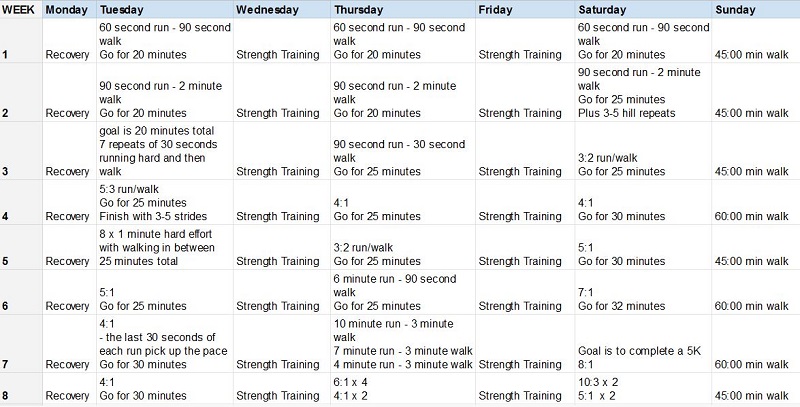
10K Training Plan for Beginners
If you’ve moved beyond the Couch to 5K style training and are looking for something a little more challenging, this might be the winning formula. This 10K training plan is 8 weeks, which means it assumes you have a good base of running or run/walk before starting.
You can do anything listed as an easy run, as straight running or as a run/walk. This plan does not yet incorporate a ton of speed work, but light amounts to get you used to that challenge.
Grab a free copy of this plan here >>

60 Minute 10k Training Plan- Running Under an Hour
This 10-week training plan will be perfect if you have a solid base of running or run/walking before starting.
You’ll practice everything from your goal 10k pace, some workouts will be a little faster, and there will also be a few fast finish long runs. The goal of all of the workouts is to help you feel more comfortable with what it feels like to run your goal pace AND to have some energy left for that final push to the finish line.
Get the complete breakdown of the 60 Minute 10k Training Plan here>>

Components of a 10K Training Plan
To prepare for a 10K race, a well-structured training plan is essential. This section will outline the key components that make up an effective 10K training plan, providing guidance on weekly mileage, long runs, interval training, threshold runs, tempo runs, cross-training, strength training, and rest and recovery days.
A. Weekly Mileage and Long Runs
- Gradually increase your weekly mileage over the course of your training plan to build endurance.
- Incorporate a weekly long run to improve your aerobic capacity and mental stamina.
- Increase the distance of your long runs incrementally, allowing your body to adapt and recover.
B. Interval Training and Speed Workouts
- Integrate interval training into your plan to improve speed and anaerobic fitness. This applies mostly to those who are not running their first 10K, newer runners need to focus on building endurance.
- Interval workouts will likely be at a variety of paces, not just your 10K goal pace
- Hill sprints are the first assigned speed for most runners, to build strength and avoid injury.
C. Tempo Runs and Threshold Workouts
- More advanced runners, will progress to including tempo runs to enhance lactate threshold and running efficiency.
- Tempo runs can be steady-state runs or broken into intervals.
- They are often described as the pace you could hold for 1 hour, but coaches also break them down in other ways, so read the details of your plan.
D. Incorporating Cross-Training and Strength Training
- Engage in cross-training activities such as cycling, swimming, or elliptical training to complement your running can be beneficial if you are injury prone or new to running.
- Incorporate strength training exercises to improve muscular strength, power, and injury prevention.
- Checkout the 30 Day Core for 10 minute a day workouts that help prevent knee pain, increase speed and endurance.
E. Rest and Recovery Days
- Allocate rest and recovery days within your training plan to allow your body to repair and adapt.
- Rest days are crucial for reducing fatigue, preventing injuries, and optimizing performance.
- Use these days for gentle stretching, foam rolling, or engaging in low-impact activities.
Pacing the 10K Vs 5K or Half Marathon
When it comes to pacing, the 10K race presents a distinct challenge compared to the 5K and half marathon. Understanding these differences is crucial for developing an effective training strategy and executing a successful race.
In a 5K race, runners often push themselves to near-maximum effort, sustaining a high intensity throughout the entire distance. The race is short and demands a rapid pace from start to finish.
However, in the 10K, a more measured approach is required. This distance combines elements of speed and endurance, necessitating a balance between pacing and stamina.
Middle-of-the-pack runners in the 10K need to find a pace that allows them to maintain a consistent rhythm while still being able to push themselves towards the end of the race. Starting too fast can lead to early fatigue, making it challenging to maintain the desired pace.
Conversely, starting too conservatively may hinder your ability to make up time later on. It’s crucial to strike the right balance and establish a sustainable pace from the beginning, gradually increasing the effort as the race progresses.
Compared to the half marathon, the 10K demands a higher intensity level. While a half marathon requires a greater emphasis on endurance and pacing oneself over a longer distance, the 10K allows for a faster pace and more aggressive racing. It requires finding a pace that is challenging yet manageable, allowing you to maintain a strong effort throughout the race without burning out too early.
Practice Pacing
To develop an effective pacing strategy for the 10K, it’s beneficial to practice different pacing techniques during training runs. I’ve found that many runners never spend time at their goal pace, but instead going slower or faster.
For experienced and intermediate runners, I like to include fast finish long runs and goal pace intervals in the training schedule to gradually increasing your comfort level with sustained efforts at a challenging but manageable pace. This helps develop a sense of your target pace and improve your ability to maintain it during the race.
Remember, every runner is unique, and finding the optimal pacing strategy may require experimentation and adjustments based on your fitness level, training progress, and race-day conditions.
Adjusting Free 10K Training Plans For You
While training plans provide structure and guidance, it’s crucial to remember that they should be flexible and adjustable based on your individual needs and progress.
Every runner is unique, and what works for one person may not work for another. It’s important to personalize your training plan based on factors such as your fitness level, previous running experience, time availability, and response to training.
Monitor your progress and be mindful of how your body is responding to the training.
If you’re consistently feeling fatigued, experiencing pain or injuries, or not making progress, it may be necessary to make adjustments. Consider reducing mileage, adjusting the intensity of workouts, or adding more rest and recovery days.
Seek guidance from a coach or experienced runners if needed, as their expertise can provide valuable insights and help you navigate any challenges you encounter during your training journey.
Remember that training for a 10K race is a gradual process that requires patience, consistency, and adaptability. Trust the process, stay committed to your training plan, and make adjustments when necessary to ensure you’re continually progressing towards your goals. With the right approach, you’ll be well-prepared to tackle the 10K distance and achieve your desired performance on race day.
Additional plans like Sub 50 minutes, Low Heart Rate 10K and others are available as part of Run Club.
Looking for more tips to help your training:

Other ways to connect with Amanda
Instagram Daily Fun: RunToTheFinish
Facebook Community Chatter: RunToTheFinish
Sign Up to Receive a Weekly Newsletter with Top Running Tips and Laughs



 10 Best Half Marathons Around the World