

Many runners use target heart rate zones to inform and guide their training. Training by heart rate can provide so many benefits, but it often relies on runners knowing some basic information like resting heart rate and how to calculate maximum heart rate. We’ll help breakdown different methods here to get your training on track.
To even begin talking about target heart rate zones, we first must determine our maximum heart rate (MHR). This information helps you set up appropriate target heart rate zones, which can then be tracked via your watch during workouts and used to improve your training and results.
In this article, we’ll be focusing on the many ways you can calculate your maximum heart rate. And yes, there really are several ways to do it from formulas to time trials to VO2 Max tests. This in itself is a really important piece of the puzzle to understand!
Let’s dig into what the maximum heart rate is, why it’s important and personal to each individual, things that can affect your hr max, and how to calculate your own MHR.
Understanding Heart Rate Training
We’re focusing on one area of the the heart rate training system today, but it comes with a lot of questions. I think a few of these are important before we get in to the specifics on max HR.
Do Athletes Have a Higher Maximum Heart Rate?
No. While athletes do tend to have a lower resting heart rate, this does not correlate to them having a higher max HR.
In fact, one 2008 study comparing trained athletes to sedentary people found that the athletes actually had a lower MAX HR. This is likely because their heart simply isn’t working as hard to create the volume or pressure to keep blood flowing during exercise.
Another study showed that the type of exercise can impact the max HR recorded: “exercising on the rowing ergometer and on the treadmill results in higher HRmax than exercising on the kayakers, cycle, or ski ergometers. ”
What if You Exceed Max Heart Rate?
While uncommon, it can happen if you are doing sprints and pushing yourself to a new level. For some athletes, they may be seeing a normal change in their max HR and it’s just a new data point.
If it only happens for a few seconds during a really hard push, then there’s usually nothing to worry about. It’s not going to be a pleasant workout and you should be feeling every bit of the intensity. But numerous doctors have said it’s not a concern and could simply be due to the inaccuracy of the formulas as we will discuss below.
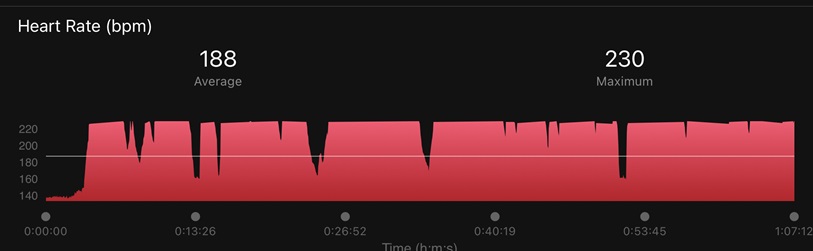
If you feel fine and your watch says 230 BPM then it’s probably an inaccurate HR Monitor reading.
This example from a Garmin forum shows that you need to understand your body and heart rate zones rather than blindly trusting the data. A max HR of 230 is pretty rare and even in a race you aren’t averaging 188BPM for an hour.
If you’re doing an easy run and suddenly it starts shooting up high, you have issues breathing or continuing to perform, then you need to slow to a walk.
Don’t sit down as this could cause blood to pool in the feet, instead try to slowly move. You will likely want to get checked out by a Dr. I had this experience when using an inhaler after Covid.
I’ve already written several articles on heart rate zones and I encourage you to check them all out when you have a chance. They include:
- Guide to Running Heart Rate Zones
- Zone 2 Heart Rate Training Explained
- Zone 3 Training: Avoiding the Gray Zone
- Zone 4 Heart Rate Training Explained
- Heart Rate While Running: What’s Average? How to Use It?
- Resting Heart Rate for Runners
- What Happens if You Run With a High Heart Rate
What is the Maximum Heart Rate?
To put it simply, your MHR is the number of beats your heart can make in one minute (bpm) when under maximum stress, such as intense physical activity.
MHR’s vary from person to person, but this number is important to know as it informs your heart rate training zones, which are all percentage ranges of your maximum heart rate.
Why You Should Know Your MHR?
As mentioned, your MHR is personal to you. There are several things that can impact your MHR, which I’ll get into shortly.
Many people use heart rate zones to guide their training. Your heart rate can tell you (and your coach) how hard you’re working in a given workout. This is really helpful when heading out on an easy run, for example, because it can help you stay at a lower intensity level.
I personally like HR because it tells you how hard the body is working and thus takes your ego out of worrying about pace.
Another example would be when you’re heading out to do a speed workout. Knowing when and how to tap into those upper heart rate zones can help you get the most out of your workout.
Applying the principles of heart rate zones to your training can help you reach your goals more efficiently and in a healthy way too.
What Factors Affect Your MHR?
There are several things that can affect your max heart rate. These include age, sex, fitness, genetics, activity level, body size, altitude, and more.
Another thing to be aware of is that certain medications can impact your heart rate. For example, beta blockers can impact the heart’s response to stress.
People take these medications for a variety of reasons, such as to manage blood pressure or to help control their heart’s rhythm, so it’s important to pay attention to how they affect you and consider whether other methods of monitoring exercise intensity would be better.
How to Calculate Your MHR
There are a number of ways to calculate your max heart rate, most of which are free and relatively easy to do on your own.
First I want to go through the most commonly cited formulas. However, it’s important to note that more precise methods, such as direct measurement during a clinical test or even a field test are recommended.
It’s crucial to recognize that these formulas provide estimates, and individual variations can be significant.
Using a Formula to Determine MHR
Probably the easiest way to figure out your maximum heart rate is to use a formula. Yes, we’re talking about math but don’t worry, just break out a calculator to keep things simple. There are a couple of formulas to choose from and some are better for certain demographics than others.
Fox Formula: 220 – age
This formula is simple and widely known, but it has some limitations. It was originally developed based on observations in a relatively small and non-diverse sample population, and individual variations in maximum heart rate are not fully captured.
Additionally, research has shown that there can be a significant margin of error when using this formula.
- This age-predicted formula is the most common formula used.
- Used by fitness watches.
- Can vastly under predict maximum HR for anyone over 30 and gets worse as we age
Tanaka Formula: 208 – (0.7 x age)
The Tanaka equation was derived from a study that included a broader range of individuals, spanning a wider age range and incorporating both men and women. It’s therefore cited as a more accurate formula because formula’s coefficients were adjusted.
- This formula is more accurate than the Fox formula, specifically for those over age 40.
- This is the one I’d generally recommend using
Gulati Formula: 206 – (0.88 x age)
Developed by Dr. Martha Gulati, a cardiologist, based upon 5,437 healthy Chicago-area women aged 30 and older. “Now we know for the first time what is normal for women, and it’s a lower peak heart rate than for men,” said Martha Gulati, M.D., assistant professor of medicine and preventive medicine and a cardiologist at Northwestern Medicine.
- This formula was developed specifically for women in 2010. The argument was that other formulas were based solely on male biology.
HUNT Formula: 211 – (0.64 x age)
Developed during the HUNT fitness study, which looked at more than 3,300 people ranging in age from 19-89.
- Determined to be a better measure for active men and women than the Fox formula.
- This one has been used in a number of following clincial studies
It’s important to note that all of these formulas have a margin of error. The Fox formula overestimates MHR for women. However, all of these formulas get you in the general ballpark of your actual MHR.
Which Heart Rate Formula is Most Accurate?
As you can see from the data above each one has it’s limitations. However, what’s clear is that the old method of 220-age is not the most accurate for the majority of the population.
It’s important to utilize one formula consistently and then plug the data in to a heart rate zones calculator to get the ranges that are right for you. Having done that then it’s requires the runner and coach paying attention to how you feel. It’s possible that you will need to further refine your Zones based upon your physiology, life and results.
#2 Calculating your Maximal Heart Rate in a Lab
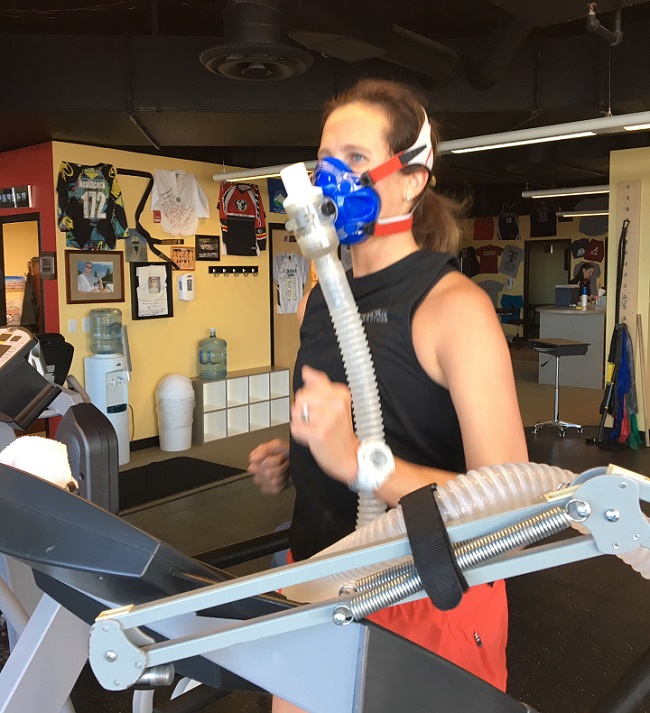
If you’re looking for the most accurate way to measure and determine your MHR, you’ll need to head to a lab for a VO2 max test. This laboratory test can be very expensive, ranging from $130 to $300 and beyond.
Exercise testing is usually done on a treadmill with the athlete connected to a variety of monitors and it is supervised by an exercise physiologist or cardiologist.
The test requires you to run on a treadmill, although it can also be done on a bike, with the speed increasing at intervals until exhaustion. Yes, it means running to that want to vomit or pass out kind of feeling to get the best data and that’s surprisingly hard with a crazy mask on your face.
In addition to MHR, the test can also provide aerobic, anaerobic, and lactate thresholds.
Read all about VO2Max testing and charts >>
#3 Calculating Your MHR with a Field Test
This is the option that myself and other coaches prefer to formulas for those really focused on HR training.
Another option to calculate your MHR is to do your own field test. Some options for a field test include a 1-mile time trial, doing 800 repeats, or doing a 5k. Let’s dig into each of these a bit more.
For all of these, I recommend getting a heart rate monitor that goes around your torso (a chest strap or an armband HR monitor). It’ll be a bit more accurate than a reading from your watch on your wrist.
In addition, please make sure you are well rested ahead of time, having not done any hard workouts within 2-3 days of the test. I also encourage you to do an adequate warm-up, including dynamic movements and even doing an easy 1-2 miles of running before beginning your test.
One Mile Time Trial
To do this, head to a track if possible. After your warm-up, start your 1 mile run and run at your tempo pace, or what you might run a 10k in.
With one lap remaining (400 meters), increase your pace until you’re in a sprint for the last 100 meters.
Look at your heart rate during that final lap, the highest number would be your max heart rate.
5k Test
Another option is to run a 5K. A race may be the best option since you’ll be more easily inclined to push hard, especially at the end.
To do this test, line up for that 5k and race it but keep in mind you’re going to want to have a good finishing kick. As you near the finish like the last 1k or so, try to pick up the pace until you’re going all-out for the last 200 meters or so.
After the race, check out your heart rate readings during your finishing kick and consider that your MHR.
Another option for this test, particularly if you’re a well trained athlete who runs a 5k in less than 20 minutes, is simply to do a 20-minute test. You’ll want to go hard for the entire 20 minutes, picking up the pace to an all-out effort as you’re coming into that 20 minute mark.
800 Meter Repeats
This is another heart rate test I’d recommend doing at a track. After a warm-up, this test consists of running 800 meters (½ mile) all out.
You then rest for 5 minutes and follow that with another all-out 800 meters.
Your heart rate at the end of the 2nd repeat should be very close to your personal max heart rate.
As you can see, there are a number of viable ways to determine your max heart rate. With the exception of the VO2 Max Test, all are free and relatively easy to do. I guess it all depends on whether you want to run or just do a little math.
Other ways to connect with Amanda
Instagram Daily Fun: RunToTheFinish
Facebook Community Chatter: RunToTheFinish
Sign Up to Receive a Weekly Newsletter with Top Running Tips and Laughs



 TRX for Runners: Benefits and Workout