

Runners like numbers. We really like that our watches now give us more numbers than ever, including a VO2 Max chart and a daily note as to whether we are detraining or progressing.
It’s why we’re obsessed with running around the block an extra two times to get our mileage to end on a whole number…I’m sure some kind of cosmic disaster happens if you end on .67.
We measure our miles, our pace, our heart rate and because those numbers do indeed give us indicators about progress, it’s natural to wonder if there are other numbers that might help us tweak our training.
So today we’re leaving Mr Rogers neighborhood and heading over to Bill Nye to get a little more sciencey (I bet he loves that term) with our data: RMR and VO2 MAX.
What is VO2 MAX?
To understand what VO2 Max is, let’s first consider what it stands for.
V is for Volume, O2 for oxygen, and Max for maximum.
In other words, VO2 Max measures the maximum volume of oxygen. It’s also commonly referred to as ‘peak oxygen intake,’ ‘maximal oxygen consumption,’ and ‘maximal oxygen uptake.’
One theory to explain what it is was that a VO2 Max test allows you to gauge someone’s fitness level and put them on a continuum of least to most fit. It’s commonly considered to be a gold standard to measure cardiovascular fitness in a range of endurance sports.
This test specifically measures the maximum amount of oxygen your body can use while exercising at your maximum capacity. It’s expressed in liter/minute (L/min) or milliliters/minute per kilogram of body weight (mL/min/kg).
VO2 max represents the maximum ability of your body to consume oxygen and is a key indicator of your potential as an endurance athlete. Your performance in endurance sports depends on your ability to consume oxygen at a high rate for a sustained period of time.
A high VO2 max is necessary for success in endurance events, but a high VO2 max alone does not ensure success.
From HSS.EDU
The above statement is what got so many runners to start testing their VO2 Max a few years ago! It sounded like a number we could track and prove to ourselves that we were improving.

In other words, VO2 Max defines how aerobically fit you actually are. It’s one single number that captures how your heart, circulatory system, lungs, and muscle cells are working together as well as independently.
When your VO2 max is high, your heart can pump more blood with each heartbeat.
Now, you might see this number popping up on your Garmin watch and wondering is it accurate? Is it useful?
- Garmin GPS Watch breakdown – do you need a watch with VO2 Max and how it does it.
- Run Data Analysis – My take on how to use ALL the data you’re getting from your watch
So let’s dive in to the testing and the lessons we can learn!
What’s a Good VO2 Max?
This VO2 Max chart of elite athletes proves it can be used to help with training or guide changes, it isn’t really the be all end all of numbers.
| VO2 Max | Runner | Details |
|---|---|---|
| 92 | Matt Carpenter | Pikes Peak marathon course record holder |
| 87.4 | Marius Bakken | Norwegian 5k record holder |
| 85 | Dave Bedford | 10k world record holder |
| 85 | John Ngugi | World XC Champion |
| 84.4 | Steve Prefontaine | |
| 82 | Kip Keino | Olympic 1500 champion |
| 81.1 | Craig Virgin | twice World cross country champ |
| 81 | Jim Ryun | US miler WR holder |
| 80.1 | Steve Scott | US miler 3:47 |
| 78.6 | Joan Benoit | 1984 Olympic Marathon Champion |
| 71.2 | Ingrid Kristiansen | ex-Marathon World Record Holder |
| 67.2 | Rosa Mota | Marathon runner |
For non-elites here is a VO2 Max chart to see how you would compare.
I won’t lie I like being in the “superior” category, but now I’ve totally got a goal to get on the elite level which would be closer to 50 for females.
VO2 Max chart for the average athlete.
| Female (ml/kg/min) | ||||||
|---|---|---|---|---|---|---|
| Age | Very Poor | Poor | Fair | Good | Excellent | Superior |
| 13-19 | <25.0 | 25.0 – 30.9 | 31.0 – 34.9 | 35.0 – 38.9 | 39.0 – 41.9 | >41.9 |
| 20-29 | <23.6 | 23.6 – 28.9 | 29.0 – 32.9 | 33.0 – 36.9 | 37.0 – 41.0 | >41.0 |
| 30-39 | <22.8 | 22.8 – 26.9 | 27.0 – 31.4 | 31.5 – 35.6 | 35.7 – 40.0 | >40.0 |
| 40-49 | <21.0 | 21.0 – 24.4 | 24.5 – 28.9 | 29.0 – 32.8 | 32.9 – 36.9 | >36.9 |
| 50-59 | <20.2 | 20.2 – 22.7 | 22.8 – 26.9 | 27.0 – 31.4 | 31.5 – 35.7 | >35.7 |
| 60+ | <17.5 | 17.5 – 20.1 | 20.2 – 24.4 | 24.5 – 30.2 | 30.3 – 31.4 | >31.4 |
| Male (values in ml/kg/min) | ||||||
| Age | Very Poor | Poor | Fair | Good | Excellent | Superior |
| 13-19 | <35.0 | 35.0 – 38.3 | 38.4 – 45.1 | 45.2 – 50.9 | 51.0 – 55.9 | >55.9 |
| 20-29 | <33.0 | 33.0 – 36.4 | 36.5 – 42.4 | 42.5 – 46.4 | 46.5 – 52.4 | >52.4 |
| 30-39 | <31.5 | 31.5 – 35.4 | 35.5 – 40.9 | 41.0 – 44.9 | 45.0 – 49.4 | >49.4 |
| 40-49 | <30.2 | 30.2 – 33.5 | 33.6 – 38.9 | 39.0 – 43.7 | 43.8 – 48.0 | >48.0 |
| 50-59 | <26.1 | 26.1 – 30.9 | 31.0 – 35.7 | 35.8 – 40.9 | 41.0 – 45.3 | >45.3 |
| 60+ | <20.5 | 20.5 – 26.0 | 26.1 – 32.2 | 32.3 – 36.4 | 36.5 – 44.2 | >44.2 |
*From RunningForFitness.org
Why is VO2 Max Important?
The ability to utilize oxygen efficiently directly correlates to physical performance and endurance during exercise.
When you run faster, work harder, or just do things more efficiently, you need more oxygen. This means, your fitness potential is higher the more oxygen your body can use.
VO2 max is also important because it provides a useful method for measuring performance and tracking improvements. If you want to train with a specific range or specific number in mind, VO2 Max charts can help you out.
It can help any person assess their fitness levels, even though there’s a common misconception that it’s only useful for trained runners, cyclists, and other endurance athletes.
As a running coach, I’m going to also remind you that it’s just ONE number of many. It’s not something that I care about on your watch compared to HR, effort level and overall pace information.
Factors that Affect VO2 Max
Age and Aerobic Capacity
Age has a strong impact on VO2 max, and the highest values are usually found in people between the ages of 20 and 25.
Why is this the case? Our VO2 max has been shown to decrease linearly with age. It usually decreases at a rate of about 0.5ml/kg/min per year. Part of the explanation for this is that as people age, their maximum heart rate and heart stroke volume naturally decrease.
The age-related decline in VO2 max can be postponed with aerobic exercise, especially high-intensity exercise. This is probably because cardiovascular exercise can delay the decline in maximum heart rate that comes with aging and support the maintenance of stroke volume.
Gender
Aerobic capacity is partly determined by how much blood your heart pumps.
In general, men have larger organs than women do, and this includes the size of their hearts. The larger size of the heart enables it to pump a greater volume of blood throughout the body.
Other things like blood volume, muscle mass, and the amount of hemoglobin in the blood also play a role, which is why women’s maximum oxygen uptake is lower than men’s.
Altitudes
Altitude has two effects on VO2max.
First off, as air pressure drops at altitude, less oxygen is available, which in turn lowers aerobic capacity. So, when we are at a high altitude, our aerobic capacity is less than when we are at sea level. With increasing altitude, the magnitude of this decrease accelerates.
It’s interesting to note that the impact of altitude can vary greatly between individuals, with larger reductions typically being seen in athletes with a higher VO2 max.
Altitude also has a secondary effect, which is that the adaptations that happen after enough time at altitude can lead to better aerobic capacity at sea level.
Body Type and Body Composition
Any change in body weight will have an impact on VO2 max because it is typically expressed as a function of body weight. In this way, larger athletes (even if they are leaner) tend to post lower values than their smaller counterparts.
Body composition is also known to affect VO2 max. An athlete with a higher percentage of body fat tends to have a lower VO2 max than an athlete with a lower percentage of body fat who is the same size.
So, how exactly does body weight influence VO2 max? Simply put, more oxygen can be distributed per kilogram of body mass when a person is lighter.
Training Level
Training can have a significant impact on VO2 max. Aerobic capacity can be increased by up to 20% depending on current fitness, prior training history, and your current training program. However, the exact amount of any increase varies greatly between individuals.
How to Test VO2 Max?
This is not something that you can truly measure on your own. Your watch is trying to estimate the data, but as we’ve seen it’s not very accurate.
Following is how you do a full test, I’m sharing my experience to give you more details.
PART 1: RMR
An RMR (resting metabolic rate) test has you sit comfortably while a machine measures your respiration. The best tests will utilize a mask that covers your nose and mouth then allows you to breathe in and out through your mouth, while laying down.
The machine measures CO2 output to calculate results. Some places will simply clip your nose, but it’s slightly less accurate. You fast for 12 hours prior to the test and do as little activity as possible to ensure it’s truly measuring what your calorie expenditure for the day would be if completely at rest.
After adding in numbers surrounding daily life an exercise you’ll have a more accurate number than any online calculator.
An RMR is a great way to find if your metabolism has slowed or to prove to yourself that it hasn’t and you just need to clean up the eating! (But honestly, I got a lot more out of the less intense metabolic test.)
Do you need a VO2 Max test? RMR test? Find out what these numbers tell us #fitness Share on XWhen doing the test myself in 2012 (during the height of my health issues) I found my RMR to be only 1100 where every calculator said it was 1400!! 300 calories is a pretty big difference from losing to gaining weight.
I spoke with a nutritionist after the test and found out that another important component of this test is your respiratory quotient.
My respiratory quotient was .76 which equates to 19.2% carb and 80.8% fat utilization. This is pretty much where you want to be as a distance runner, but you’re burning carbs mostly carbs (an RQ closer to 1) it could explain frequent fatigue because your body requires more consistent fuel.
VO2 Max Chart
This V02 Max chart helps explain where the cross over happens from burning carbs to fat.
As noted it’s different for everyone and improving your VO2 usually means you move your set point so that more of your running is done on fat for fuel.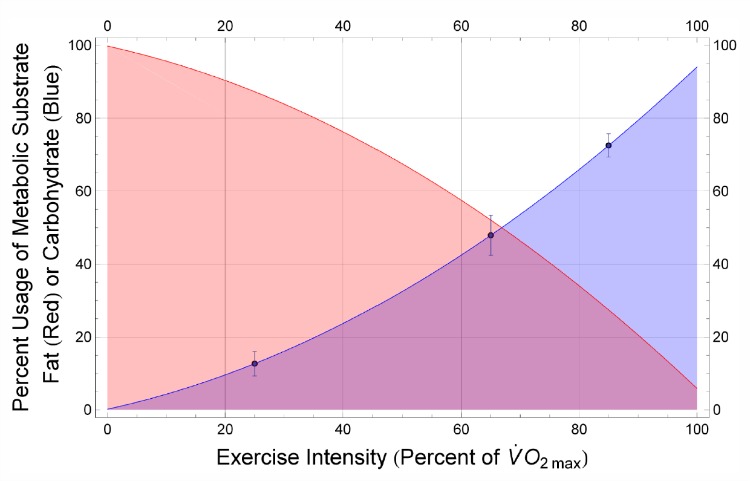 Chart source
Not surprisingly this is what made many people start touting the benefits of longer lower intensity workouts.
This information can also help you see where you need to make changes in your training…i.e. more muscle mass would help increase RMR (this certainly worked for me) and training in a glycogen depleted state can increase your fat usage.
Testing Part 2: Treadmill Run
VO2 Max is tested for your specific sport, which means my heart rate zones calculated via running will not apply to cycling or CrossFit.
The test is performed by putting you on the treadmill or bike trainer, then placing a mask over your mouth and nose. This is the most uncomfortable part for most people as it then requires you to breathe only through your mouth for the system to measure your levels.
The entire test will take only 10-15 minutes.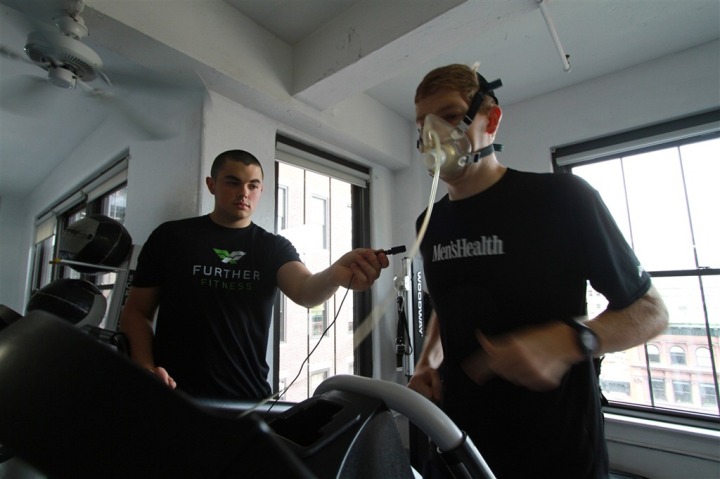 Sorry no great image of me during this huffing and puffing. Thanks to DCRainmaker for the image, check him out for every possible new running gadget review.
The practitioner starts you at an easy level (like ho hum is the treadmill moving), then either increases the speed or the incline every couple of minutes.
Eventually, you’ll reach a point where it feels like you just can’t catch your breathe and you cry “Uncle“.
Congrats you’ve just found your VO2 Max (and hopefully not barfed).
In my case, we actually ran the test twice and I definitely preferred sticking to a lower speed an increasing the incline, it’s less “I want to puke” instigating than running as hard as you can.
How to use VO2 Max Chart numbers?
Most people use them to determine zones for Heart Rate Training or to create a baseline to measure how well their training program is working.
If they do the test again in 3-6 months with no change then something in the program is not allowing them to progress.
What About Fat Burning?
This was actually the piece that interested me the most in the numbers!!! You can see at exactly what Heart Rate you switch from using fat to carbs as fuel!
This is huge for an endurance runner and supports my love of Low Heart Rate training because it proves that running below that threshold is teaching your body to go farther on fat stores, which is great for endurance!
In my case, my fat usage drops dramatically once I leave my LHR zone. This is also key because it helps you understand when you’ll need to fuel during a race! I.e. before you hit big hills and your HR spikes or before you enter the later half where HR is higher.
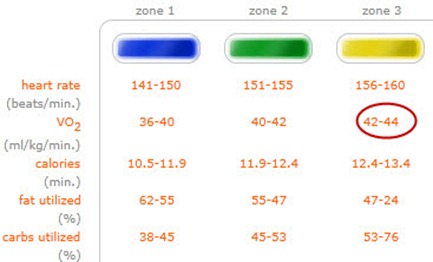
As noted previously, while you can learn this information from this test, there is a MUCH easier version where you don’t have to run until you want to puke.
I did a huge write up on how it helped me to shed some fat by simply changing a little on my running and eating.
How VO2 Max Helps Us Run Faster?
Muscles run on oxygen, that’s one of the reasons trainers used to spend time measuring VO2 max. It told them how much oxygen muscles were receiving and therefore gave them means to improve their athletes and reduce muscle fatigue.
Better VO2 Max should mean you can more efficient send oxygen to the muscles, which means better endurance and speed.
How do you increase your VO2 max?
The truth is it’s pretty straight forward, you have a couple of options:
- Increase total mileage
- Increase intensity of workouts
It’s commonly believed that the most effective method of improving your VO2 max is high-intensity interval training (HIIT).
But of course there are also the nuances that come with training like eating whole foods, cross training and rest! You need your whole body to improve, not just the ability to run farther.
While VO2 Max is a point of debate for many coaches, I always find more information helps me understand my body and thus run better.
So if you want the numbers and want to skip the extra test, and grab a Garmin to estimate it for you!
Other ways to connect with Amanda
Instagram Daily Fun: RunToTheFinish
Facebook Community Chatter: RunToTheFinish
Sign Up to Receive a Weekly Newsletter with Top Running Tips and Laughs



 Treatment for Runner’s Knee vs. Jumper’s Knee
I’ve never done a test like this before. Seems really interesting though! Anything to show improvement! :-)
An yes, the world would end if I stopped at 2.87. haha!
All of this is so interesting! I haven’t had my VO2max tested professionally although it definitely interests me. I know it’s not the be-all in running (economy and such affects performance as well) but it is an objective piece of data for measuring progress.
It’s hilarious but true – I definitely run around the block or trail until I hit the exact mile. Maybe a cosmic disaster won’t happen, but better safe than sorry! lol!
I agree, even knowing it isn’t a measurement that will hugely impact me, I SOOOO wanted to do it :) love the numbers
Fascinating look into VO2. I haven’t done it myself but it peaks my curiosity to try it out!
What has been your results or benefits so far from getting your results and incorporating it into your running life?
Wow, just checked mine on my garmin. It’s 46 at 51yrs. I wa sure to be below average.