

Carbon plated running shoes promise to make us faster, and there’s plenty of research showing that today’s super shoes really can improve running economy. So no, we don’t think carbon plated shoes are overrated. But after testing dozens of them, we also know that simply putting a carbon plate in a running shoe doesn’t make it fast. And the latest research backs that up.
In fact, studies suggest we may be giving the carbon fiber plate too much credit for what makes super shoes work.
The balance of power in the running world shifted greatly when Nike introduced the Vaporfly 4% in 2018. The sleek racer combined a full length PEBA midsole with a full length carbon fiber plate, with Nike claiming the shoe could improve running economy by 4%.
Since then, every major running shoe brand has developed its own carbon fiber racing shoes. Some have been instant hits, while others have been a swing and a miss.
Early on, brands could seemingly slap a carbon fiber plate into a shoe, price it at $250 and call it a day. But runners eventually caught on.
So what actually makes carbon plated shoes faster? And does the carbon plate matter as much as we’ve been led to believe?
We dug into the research, along with what we’ve learned from testing these shoes, to find out.
Do Carbon Plate Running Shoes Really Work?
Let’s start with the big question.
Yes, there is good evidence that today’s advanced racing shoes can improve running economy.
A 2026 meta analysis compiled data from 14 studies comparing carbon plated shoes with standard running shoes. Across the research, runners generally used less oxygen and energy while running in the advanced footwear.
Studies showed an improvement of 2.9% in running economy, a 2.6% reduction in metabolic cost, a 2.8% reduction in oxygen consumption, and a 2.6% reduction in energetic cost of transport. All of these improvements lead to a measurable improvement of 1 to 2 minutes over the course of a marathon.
That’s important because improved running economy means you’re using less energy to maintain the same pace.
But there’s an important catch.
Researchers have had a surprisingly difficult time determining exactly how much of that improvement comes from the carbon plate itself.
That’s because a carbon racing shoe isn’t just a regular shoe with a plate shoved inside.
Today’s best super shoes combine several technologies.
What Makes a Carbon Plated Shoe A Super Shoe?
A super foam designed for maximum comfort and energy return comes to mind first.
Running shoe foams cushion the impact of each of the thousands of strides a runner takes during a run, protecting the muscles and joints involved in running.
The foams also provide the bulk of the feel and experience of a running shoe. Brands will often tune their foams to achieve a desired softness, or compliance. The chemical composition will largely determine the amount of energy return runners feel after each landing.
We’re finding more and more that brands are using different foam compounds under the same brand name. New Balance’s most recent version of Fuelcell was an all-PEBA version in the SC Elite, but an EVA and PEBA blend in the Rebel.
Contemporary premium foams took off with Nike’s use of PEBA based ZoomX. Adidas eventually introduced TPEE based Lightstrike Pro into the race. Since then we’ve seen additional compounds such as aliphatic TPU as brands continue chasing combinations of high energy return, low weight and durability.
And as we’ll see below, foam may be an even bigger piece of the super shoe puzzle than many runners realize.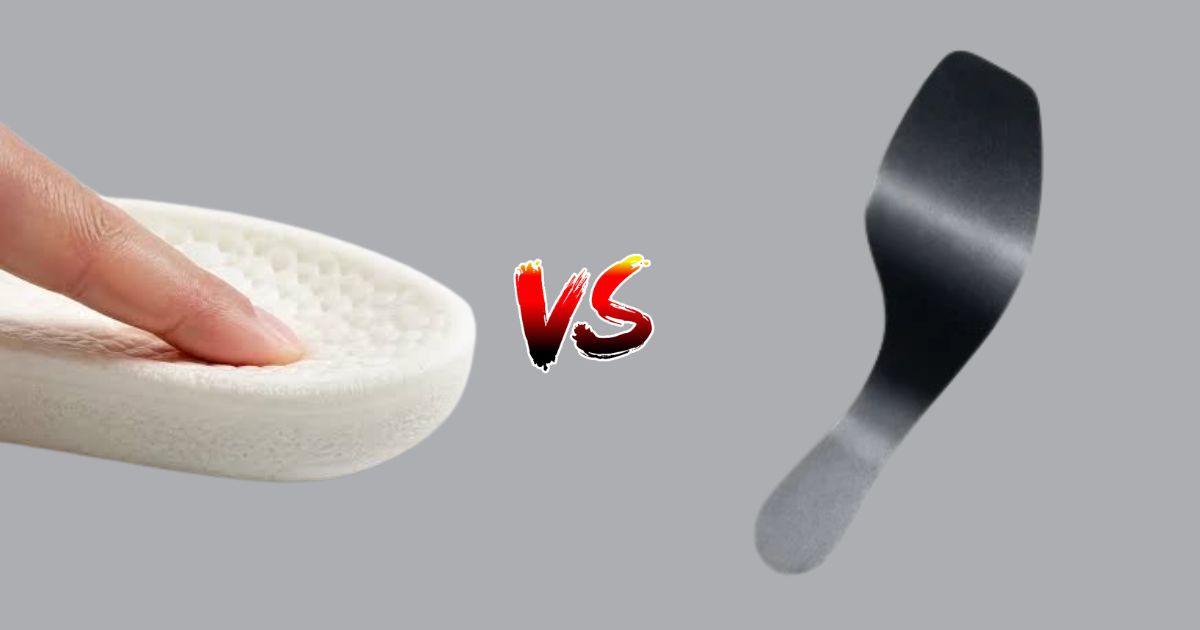
Carbon Fiber Plate
The carbon fiber plate gets a lot of the attention in a super shoe, mostly because they’re a novelty and have been around for less than a decade now.
The plate provides the longitudinal stiffness to a shoe, limiting flexibility as a runner transitions through their stride. In ideal conditions a carbon fiber plate will act as a lever, hastening that transition and adding some propulsion at the toe-off phase of a runner’s gait.
But there’s an important misconception here.
The carbon plate isn’t simply a spring launching you forward.

Research on the Nike Vaporfly suggests the plate’s role is more complicated. It can change the mechanics at the toes and foot and work with the curved geometry of the shoe, while also providing structure to today’s extremely soft and thick super foams.
And not all brands utilize a traditional carbon plate. Adidas uses carbon EnergyRods in the Adios Pro line, which allow for a bit more independent movement. The concept and end result are similar.
Rocker Geometry
The rocker of a shoe is also a big factor.
Some shoes have an aggressive heel rocker to assist the heel strikers who make up the majority of runners.
The forefoot rocker is where a lot of the magic happens. In many shoes with a steep forefoot rocker, or toe spring, the geometry helps create a rolling sensation through toe off.
Combine responsive foam, the right stiffness and rocker geometry with a lightweight and breathable upper and you have the basic recipe for today’s super shoe.
But which ingredient actually makes you faster?
Is the Carbon Plate What Makes You Faster?
This is where the research gets really interesting.
A study by Healey and Hoogkamer looked specifically at the longitudinal bending stiffness of the Nike Vaporfly 4%.
Researchers compared an intact Vaporfly with a modified version where cuts were made through the carbon plate to dramatically reduce its effectiveness in the forefoot.
If the stiffness of the carbon plate were responsible for a large portion of the Vaporfly’s running economy advantage, we’d expect reducing that stiffness to make the shoe noticeably less economical.
It didn’t.
Reducing the forefoot stiffness had minimal effect on overall running economy.
The researchers concluded that forefoot longitudinal bending stiffness alone likely has minimal effect on performance. Instead, the advantage appears to come from an interaction between the foam, shoe geometry and other effects of the curved plate.
That’s a pretty important distinction.
It doesn’t tell us carbon plates don’t work.
It tells us the plate doesn’t work in isolation.
Does the Midsole Matter More than the Carbon Plate?
This may be the most compelling evidence that a carbon plate alone doesn’t create a super shoe.
One of the earliest studies we came across regarding the benefits of super shoes pitted seven carbon plated racing shoes against a classic racing flat, the ASICS Hyperspeed.
All of the test shoes had plates.
But they didn’t produce the same results.
You can see the summarized results of Dustin Joubert’s (@labratrundown on Instagram) study in the graphic below: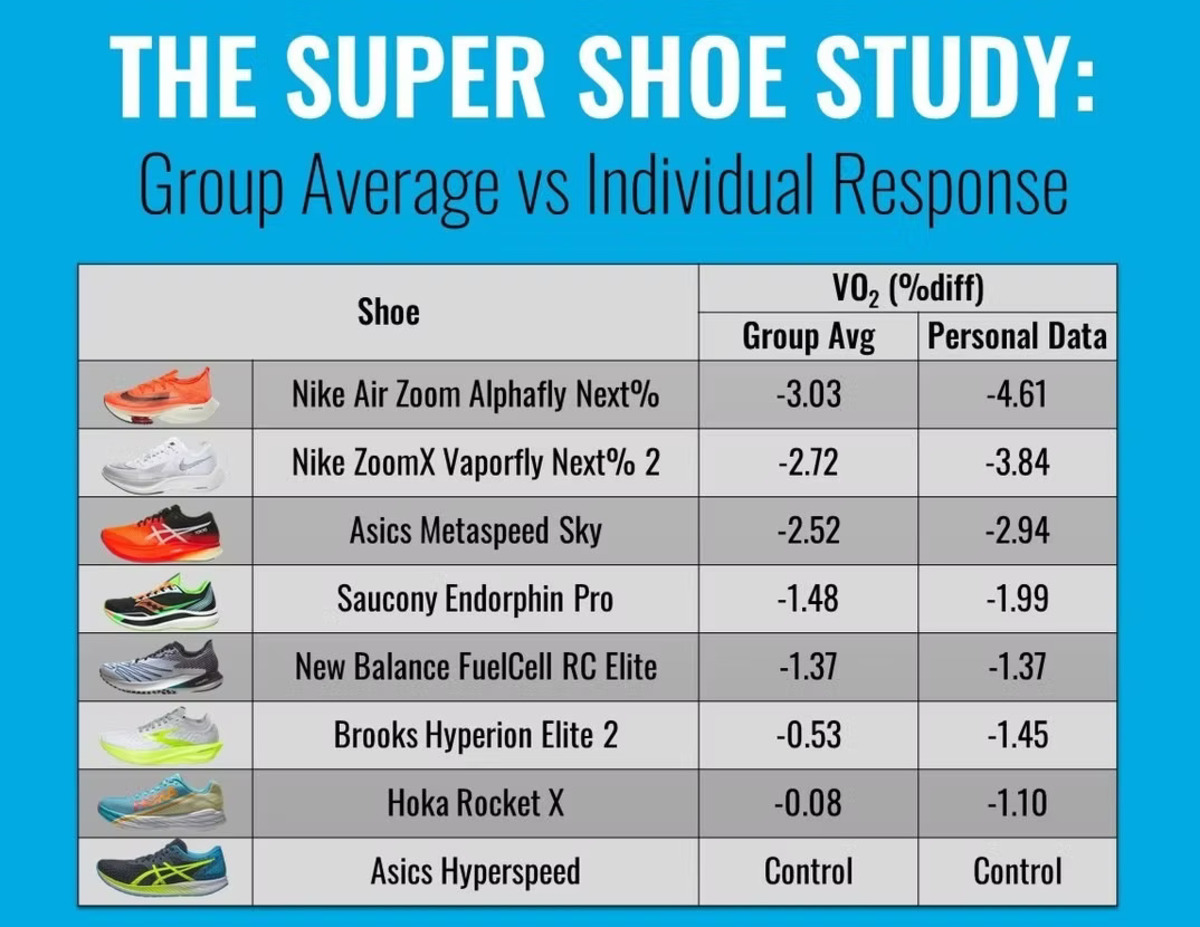
As you can see, the Alphafly 1, Vaporfly, and Metaspeed Sky (all PEBA foams) showed the greatest improvements. The Saucony Endorphin Pro (beaded PEBA) and New Balance RC Elite (Supercritical EVA/TPU) showed slight improvements. The Hoka Rocket X (EVA) and Brooks Hyperion Elite 2 (Supercritical EVA) showed the least measurable improvements in the study.
If simply adding a carbon plate made a shoe significantly more economical, we’d expect all of those shoes to produce similar improvements.
They didn’t.
Instead, the results pointed toward the importance of foam and the interaction between foam, plate, stack height and shoe geometry.
Do Carbon Plated Shoes Work for Every Runner?
Here’s where things get more complicated.
No running shoe works equally well for every runner, and super shoes are no exception.
The study did, however, fail to isolate the benefit of the carbon fiber plate from the shoe’s foam and rocker profile.
This study also showed that runners over 165 pounds do not experience the same benefits as runners who weigh less. The increased downward forces push the foot deeper into the foam, diminishing the midsole’s rebound and nullifying the effect of the carbon fiber plate.
Our anecdotal experience as a team of testers and coaches doesn’t support that specific weight number, but again a reminder it was 1 study and we still need a lot more.
What the research does increasingly suggest is that the optimal combination of foam, stiffness and geometry may differ between runners.
We’re already seeing brands move in that direction.
ASICS, for example, created two versions of its Metaspeed racing shoe around different running mechanics: one designed around runners who primarily increase speed through stride length and another around runners who rely more heavily on cadence.
It wouldn’t be surprising to see brands continue experimenting with different stiffness profiles and geometries for different runners.
A Real World Example: Brooks Hyperion Elite
The aforementioned Brooks Hyperion Elite is a prime example of a super shoe reaching new heights once a super foam was introduced into its build.
Its first four version were built with EVA and Supercritical EVA midsoles. It wasn’t until the Brooks Hyperion Elite 4 PB that we saw PEBA used in the midsole. Reviewers finally praised the Hyperion Elite, after almost 5 years off Brooks hanging on to out-dated midsole technology.
They didn’t suddenly add a plate, they found a combo of plate, foam and geometry.

So, Are Carbon Plated Running Shoes Overrated?
No.
The evidence that advanced racing shoes can improve running economy is becoming increasingly difficult to argue with.
What’s probably overrated is the carbon plate as the sole reason these shoes work.
Research shows that increasing longitudinal stiffness alone doesn’t necessarily improve running economy. We also have examples of carbon plated shoes producing substantially different economy benefits despite all containing plates.
Meanwhile, the best performing shoes tend to combine premium foams with carefully designed plates and rocker geometry.
A premium foam without a plate can still make a fantastic fast shoe.
A carbon plate surrounded by plain old EVA?
That’s mostly just a stiff shoe.
The lesson for runners isn’t to stop buying carbon plated shoes.
It’s to stop buying a shoe just because it has a carbon plate.
What to read next?
- Checkout all of our carbon plated running shoe reviews
- Our list of the best carbon plate running shoes right now
- The Best Non-plated Race Day Shoes



 On Didn’t “Fix” the Cloudboom Strike 2. They Made The Original Better.
Leave a Reply