
Foam rolling can speed up recovery, loosen tight muscles, and help you run pain free, but most runners are doing it wrong.
 The biggest mistake?
Aggressively rolling the IT band, which doesn’t actually relax it and can make pain worse.
This guide covers exactly how to foam roll as a runner, which muscles to target, how long to hold each spot, and the one area you should stop rolling immediately.
What is Foam Rolling?
Foam rolling (also called “self-myofascial release”) is a form of self-massage that people often use to release muscle tightness or trigger points. Using a cylindrical foam roller, you apply pressure to specific points on their body, rolling back and forth to massage the muscles.
Stretching doesn’t send the same signal to your brain that foam rolling does. Much of the benefit comes from relaxing your central nervous system, not from physically breaking up tissue.
What does foam rolling actually do?
Foam rolling increases blood flow and circulation to soft tissue, improving flexibility and reducing soreness.
It calms the nervous system, which allows for increased blood flow and an easier range of motion. It’s a staple for runners, but anyone dealing with everyday aches and stiffness can benefit too.
How often should you foam roll?
Daily. I know that sounds like a lot, but if you foam roll before every run, you’re both warming up the muscles and breaking up adhesions to keep you running injury-free.
Also, by working those muscles daily, you will quickly find it becomes less painful.
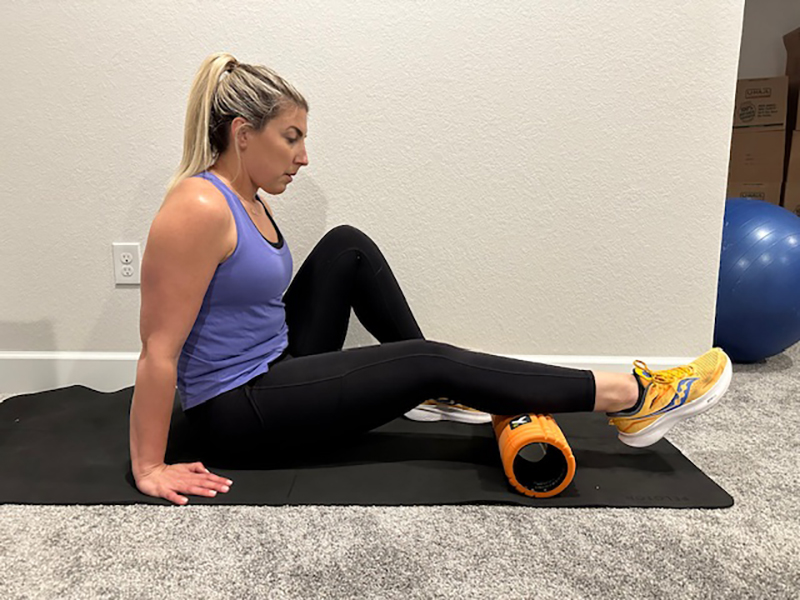
Should Foam Rolling Hurt?
As with running, discomfort is ok, but pain is bad. On a scale of 1-10, stop before you hit an 8.
As with physical therapy, you may feel discomfort at the time which is designed for long term healing. More pain is not better though!
The more consistently you roll {a few times a week} the less knots you will have and the less painful in general it will be over time.
Top Tips for Foam Rolling
#1 Stop Foam Rolling Your IT Band
Contrary to popular belief, your IT Band is not evil and does not need to be beaten into submission.
In fact, you really shouldn’t be using the roller right along your IT Band when it’s inflamed at all.
Read a lot more on this topic!
You can’t relax the IT Band, that’s a fallacy. Its tightness is caused by other muscles, from the glutes to misaligned hips.
What should you do instead?
- Work on activating the glutes while running
- Stretch the hip flexors
- Roll the thigh, the inner thigh, the glutes to release fascia (see video below)
- IT Band exercises part 1, part 2, part 3, part 4
#2 Stop Over Rolling
You’ve probably heard: “find the spot, hold for 30-45 seconds, wait for the knot to release”
That’s not always the right call. If something hurts, you don’t keep pressing on it hoping to speed up healing, the same logic appear here.
If a spot is tender but not actively causing pain on your run, 30 seconds of body weight pressure is fine to try to release it. Don’t go longer and don’t repeat it all day. The goal is to release the area, not irritate it.
“If the pressure is on the right point, 20-30 seconds max should hydrate that tissue and encourage the trigger point to disappear. More time won’t help; more accuracy of placement will.” – Tom Myers
Muscles are connected; the pain location is often just the downstream result of an imbalance elsewhere. Most runners with knee pain, for example, turn out to have weak hips or misfiring glutes.
#3 Slow Down
A quick roll over your legs isn’t going to yield results.
In fact, this is one of the biggest things I’ve found from all the studies, practitioners, and articles out there.
You need to slow down and really spend some time on your rolling to ensure you are using good posture (a strong core) and actually working on tight spots rather than just quickly rubbing over the muscles.
Set a timer on your phone to make sure you’re slowing down but also giving the same amount of time to every muscle.
What Are the Benefits of Foam Rolling for Runners?
From preventing injuries to reducing muscle soreness, there are a number of benefits that come with foam rolling for runners—IF you do it correctly.
Range of Motion
One study showed that foam rolling increased range of motion by 4.3%, which of course, leads to better stride and flexibility as runners.
Pre-Exercise Warmup
It’s a fantastic way to wake up the muscles and increase blood flow before your workout, which ensures your muscles react better. I use it simply to feel a little be less stiff.
Injury Prevention
Regular foam rolling can help identify tight spots and imbalances in the muscles, potentially preventing injuries. Addressing these issues early can lead to a more balanced body, reducing the risk of strains and overuse injuries.
Increased Oxygen Flow to Muscles
The pressure created by the foam roller increases blood flow to the targeted areas. Better circulation means more oxygen and nutrients are delivered to the muscles, promoting quicker healing and reducing fatigue.
Less Muscle Soreness
A 2019 review in Frontiers concluded that foam rolling does accelerate recovery after strength. Again, this seems to be due to relaxing the CNS and allowing recovery to begin more quickly.
After a long run or intense workout, muscles can become stiff and sore, foam rolling provides a method of helping the body to relax and get out of that stressed state.
Foam Roller Exercises for Runners
Remember that foam rolling is something you might want to do at the end of the day to help the body relax, not something you MUST do immediately after a run.
A thorough session takes about 5 minutes, once you’re rolling daily and have fewer knots, it drops closer to 3.

Should You Do Foam Rolling Before Running?
You can use a foam roller both before and after a run as part of your regular routine.
Foam rolling before a run can increase blood flow and loosen up the muscles. This leads to enhanced flexibility and range of motion, preparing your body for a great run.
It helps in warming up the muscles, reducing stiffness, and can contribute to a more efficient and comfortable run. A shorter session focusing on key areas like calves, hamstrings, and quads is usually sufficient.
Remember that before a run you are not holding on a spot, it’s continual movement.
Is It Better to Stretch or Foam Roll After Running?
The truth is that science doesn’t show you need to do either immediately after running.
Post run you should walk around for a bit to allow the heart rate to return to normal and you should focus on your nutrition, but when you spend time rolling or stretching is up to you.
As for which is better? It depends on what feels good to you! I love these post run stretches to help me slow down, relax and they simply feel good.
But foam rolling is sending that relaxation signal to the brain which relieves muscle tension in those trigger points, and aids in the removal of waste products like lactic acid. This reduces muscle soreness and speeds up the recovery process.
Want to understand more about the science behind rolling? Check out our Tread Lightly Running Podcast:
All right I hope this guide was super helpful, but that means you need the next part….Best Foam Rollers for Runners.
Looking for what to read next?
- The Truth About Waking Up Your Glutes | What Runners Get Wrong About Glute Activation From a PT
- Best Bodyweight Workout Moves for Runners: Complete Guide
- How Many Steps Are in a Marathon and Why That Number Is Different for Every Runner



 5 Must Do Hip Stretches for Runners: Releasing Tight Hips
I have never tried rolling my inner thigh, but I can only imagine how badly it needs it! Definitely need to pick up a massage stick!
To me, foam rolling is a great way to relieve muscle soreness and tension. It’s a bit painful, (torturous, actually) but that’s part of the process of releasing the pain. I feel much more relaxed and much less tense after rolling.
i love rolling my calves on a foam roller with a trigger point or any type of roller that has ledges so that the intensity changes within my calves. It hurts alot more than I thought though!