

When is it too cold to run outside? Let’s look at what the data says from studies on when it cold weather will impact performance, when it becomes too dangerous and what you need to know to run safely through most winter temperatures. When the cold winds start to blow and the snow starts to fly, many athletes head indoors to continue their training, whether it’s to swim, strength train, hit the treadmill, or ride a stationary bike.
Continuing your training through the cold weather months, regardless of where you do it, is great dedication. But for those who keep heading out in the winter or for those who would like to avoid the potential monotony of indoor training, how cold is too cold to train outdoors?
In this article, we’re going to dig into not only how cold is too cold (if there is a definitive temperature), but also the impacts of cold weather on performance, the risks of running in the cold, and how to be prepared to minimize those risks.
When is it Too Cold to Run Outside?
The American College of Sports Medicine says, ”…exercise can be performed safely in most cold-weather environments without incurring cold-weather injuries.”
MOSTLY is the key here folks, that doesn’t say you should go out in all conditions.
However, they do recommend that athletes take proper precautions at all temperatures but specifically when the wind-chill temperature is below -27 degrees Celsius or -18 degrees Fahrenheit.
Even in the Winter Olympic ski sport’s rules state that races must cancel with temperatures below -20 Celsius or -4 degrees F, but that does not take in to account wind chill which we know makes a massive difference.
When it’s windy there is an increase of body heat loss, which starts to become dangerous.
Additionally, at -4F the air actually holds less water, making it very dry and harder on your respiratory system. So especially those athletes running with asthma are at an increased risk of issues. For those athletes around 5F is a potentially good line to draw for outdoor exercise.
But even if it’s safe to run outside, how does cold weather impact performance?
At What Temperature Does The Cold Impact Performance?
In reviewing studies for this, what became apparent is that while there is no hard and fast temperature that athletes should avoid training in, there does come a point where performance is impacted.
Each study looked at a variety of things, but in general assume that at 10F or -12C you’ll likely be slowing down to maintain your normal easy effort and a hard effort is going to need to be adjusted.
As we reach these temperatures, it becomes increasingly important that you know how to stay dry and take precautions with the wind. We will talk about specific tips below, but first let’s look more at performance.
Read my detailed guide on winter gear what to wear at every temperature to be prepared!
Remember that while we want to dress for it to be 20 degrees warmer because we will feel warmer the longer we run, that changes at extreme temperatures and with wind.
Just because we some folks doing it, doesn’t mean that everyone should or even that you have to! You don’t have to prove something in the winter by going out in dangerous conditions, instead of using the treadmill. (ok coaching rant over).

Is It Ok To Run in 30 Degrees?
Absolutely, you shouldn’t see much impact on your performance at this temperature. Just follow the rules for dressing in the article above and take in to account wind. You may surprise yourself with a pretty great performance at this temperature.
Is It Bad For You To Run In The Cold?
Unless you’ve hit the temperatures listed above, then no. There are actually some serious benefits to exercising in the cold weather!
I’ve written all about them, but a quick review: improved mood, boost your immune system and of course simply staying on track with your training.
Exercising in Cold Weather Impacts on Performance
Our ability to perform is dependent on a number of things, including the function of our cardiovascular system, nutrition and glycogen storage, our muscular system, and even our brains.
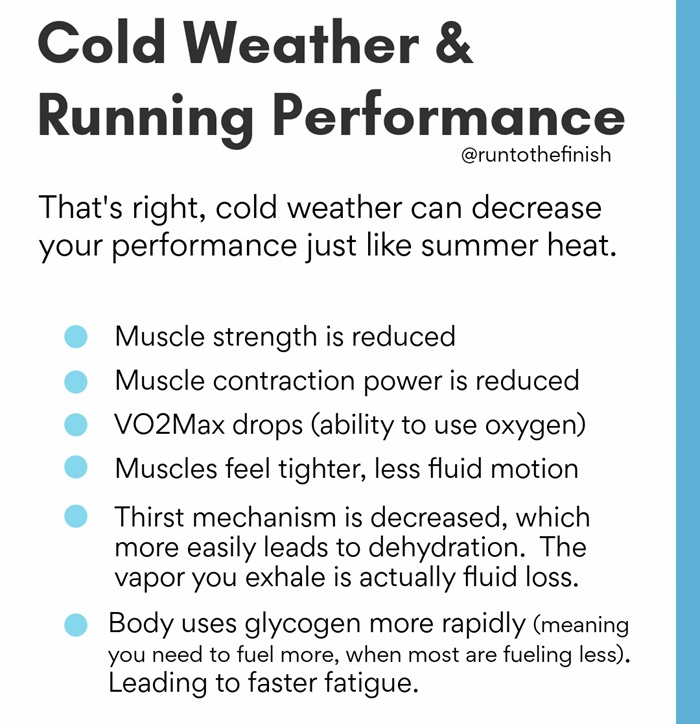
However, just like hot weather can impact performance, so can cold weather! No one seems to talk about this, but it’s true.
While cool temperatures can positively impact our running performance when it’s 30-40 degrees F, according to this review of studies looking at cold weather performance impacts, when temperatures get too low our endurance can be negatively impacted.
Cold stressors like temperature, wind, and precipitation can impact our ability to maintain our body and muscular temperature. The body suddenly needs to start working harder or has trouble doing the same work as when muscles are warmer.
You may feel like you’re lungs are burning from the colder air but there’s things you can do to help diminish it.
To put it simply, our muscle strength and their ability to contract is lessened. I’m sure you can imagine how that would make us run a bit more slowly.
Other impacts of cold weather on performance, include:
#1 Muscles Feel Tighter
Starting the run your muscles may feel tighter, which can simply make the run feel a little bit off. Depending up your layers and the temperature, if you don’t warm up then the tightness could lead to changing your gait or require that you pull back from any hard speed that would over work a tight muscle.
#2 Increased Risk of Dehydration
Did you know that the little puff you see when you exhale is actually liquid. Yup, that cold air comes in and your lungs warm up it up before you exhale, which means you’re pushing out hydration with all of those breaths.
Additionally, your thirst mechanism isn’t triggered like with hot summer running, you don’t realize how much you’re sweating and so it’s easy to no stay on top of hydration.
You absolutely MUST drink just as much in the winter when doing really cold runs.
#3 Increased Metabolism and Glycogen Use
Exercising in colder temperatures actually utilizes more carbohydrates. It’s not to say that you’re burning more calories, but what your body is seeking for fuel is shifting a little bit from using mostly fat during easy runs, to using way more carbs.
A military study found that unless Navy Seals ate more carbohydrates during events, even they saw a drop off in performance. If they need it…you need it!
Make sure you are eating before your run and then starting fueling sooner and more often during cold winter runs. This will help to improve your performance and prevent hitting the wall.
#4 Decreased VO2 max
It becomes harder to run as efficiently, which means that your body struggles to send oxygen to all of your muscles the way it would normally.
This is why you may need to slow down both easy days and hard effort when the temps are below what we noted above.
Cold Weather Exercise Risks
There are also a number of risks to consider when heading out in the cold. We’ll explore those here before delving into how to mitigate those risks later on.
Can You Get Sick from Jogging in the Cold?
Just like you don’t get sick from going outside with wet hair, the cold itself won’t make you sick. Germs and viruses are what make you sick.
That being said, if you don’t take precautions to remove wet clothing, dress correctly and fuel your body well then there are many ways to be injured from running in extremely cold weather. We’ll note more of those below.
Hypothermia
One of the main risks of cold weather running is hypothermia. Hypothermia is basically when our body loses heat faster than it can produce it so our temperature lowers dangerously. One of the first symptoms of hypothermia is shivering.
You may be wondering how we could get hypothermia while running since when we run, even in cold weather we tend to warm up?
Well it could be the result of a lot of things, including sweat or precipitation. Inadequate clothing or the wrong types of fabrics that don’t allow sweat to evaporate or protect us from the wind, rain, and snow can also increase susceptibility.
Frostbite
Another concern for outdoor athletes is frostbite. This injury occurs when the skin and underlying tissues freeze.
Frostbite, like hypothermia, occurs in stages. The earliest stage has symptoms including cold skin, prickling feelings, numbness, and then inflamed or discolored skin. While uncomfortable, it doesn’t cause lasting damage and can be treated simply by getting warm again.
However, should skin continue to be exposed, the signs of frostbite will progress in severity and need medical attention because last damage is likely.
Areas of the body most susceptible to frostbite include our nose, ears, fingers, and toes.
Exercise-Induced Asthma
One other risk of running in the cold is the possible development of exercise-induced asthma, also known as exercise-induced bronchoconstriction.
If you’ve ever complained about your lungs hurting during or after running in the cold, you may be wondering why that happens?
This goes back to how dry cold air is. When you inhale such cold air, it evaporates the moisture in your airways, which can change the tissue, cause inflammation, and eventually even affect your ability to breathe well when exercising.
While experiencing this once in awhile is probably not a big deal, it can worsen over time if you repeatedly expose your airways to extreme cold.
Underlying Medical Issues
While I don’t want to discourage anyone from running outside in the cold, there are folks with certain medical conditions that should be extra careful about cold weather running. These include:
- Raynaud’s syndrome
- Diabetes
- Cardiovascular disease
- Arthritis
- Respiratory illnesses
- Asthma
Even with these conditions, you can still run outside in the cold, but it’s important to be aware of your specific limits and sensitivities.
Precautions Runners Can Take to Prevent Cold Weather Injuries
There are a number of precautions you can take to mitigate the risks of cold weather training.
If you decide to run outside, there are a few things you can do to ensure you both enjoy it and are protected from the cold.
Learn How to Layer
To keep warm and wick sweat, you’ll want to wear layers and also cover your extremities with hats, gloves or mittens, and good socks. Your body will first try to protect your organs, which means fingers and toes will get cold much faster.
I have tons of great posts on the right gear for winter running. Some that I recommend checking out include:
- Best Running Gloves for Any Temp
- 10 Best Winter Running Hats and Headbands
- 6 Best Winter Running Socks
- 10 Best Long Sleeve Running Shirts for Every Temperature
- Cold Weather Running Gear Must Haves
- 10 Women’s Winter Running Tights
There are more, just search the site.
It’s important to pay attention to fabrics. Merino wool is a great option for a base layer adding warmth and insulation with sweat-wicking and quick-dry capabilities.
It’s also important when layering to keep in mind the temperature. When running, it’ll start to feel at least 10 to 20 degrees warmer than it actually is as your body and muscles start generating heat. You may find you want to shed some layers after a mile or two.
Enhanced Warm-Up Before You Start
You know I never miss an opportunity to remind you to do a warm-up. This is especially important in cold weather.
Maybe do your warm-up indoors so you’re in a place where you’re comfortably warm. This is the one time, where I’m adding in more intensity to the warm up so that you are absolutely ready to walk out the door and get started right away, no need for the additional walking warm up.
Checkout my cold weather warm up routine for some ideas to go with your dynamic stretching.
Change Quickly Post-Run
After you’re done your run, head indoors and change into dry clothes as quickly as possible. This is even more important if you’ve been out in any sort of precipitation.
A warm drink like tea is a great way to help warm back up and start rehydrating.
A nice hot shower or warm bath can also help warm back up and soothe any post-run soreness.
Refuel
Just as important as with your summer runs, we want to start getting calories from carbs and protein back in the body to help kickstart recovery.
Remember that your body was using more carbs that normal, so if you don’t replenish them you are likely to feel sluggish the rest of the day and possibly for your next workout.
All right, now we have finally answered the question when is it too cold to run outside! Hopefully, you’ve gotten some tips to help make your winter runs more enjoyable.
Looking for more training tips?
- Treadmill vs Outside Running – what’s better
- Tips for Running in Snow and Ice
- Best Winter Running Shoes
Other ways to connect with Amanda
Instagram Daily Fun: RunToTheFinish
Facebook Community Chatter: RunToTheFinish
Sign Up to Receive a Weekly Newsletter with Top Running Tips and Laughs



 Couch to Half Marathon – 20 Week Plan