

After years of hearing we need to take 10,000 steps a day, I started to wonder ‘how many steps in a mile running, or walking are there?’
It sounds simple, but there’s actually a lot that goes in to trying to answer this!
Sure, there are averages, but the correct answer for you depends on whether you’re walking or running, your height, sex, and even your age. Age?! I know, right, but keep reading.
If you’re wondering how many steps are in a mile, you’ve probably heard of some daily step goals to help with your overall health and fight against chances of heart disease, obesity, and even depression.
So, if you’re curious to know the answer read along to find out! We’ll also consider the different factors that can affect this number and how to get the most accurate steps in a mile.
How Many Steps in a Mile?
Here’s the short and sweet answer: there are approximately 2,000 steps in a mile on average. But oh boy, there are a lot of variations in that number!
The keyword here being on average. That equates to an average step length of about 2.6 ft to 2.7 ft.
You’ve probably heard of the magical 10,000 steps in a day step goal, and that would mean that there, on average, 5 miles in 10,000 steps.
But this isn’t the case for everyone, and it’ll differ from person to person based on certain factors.
5 Factors that Affect How Many Steps in a Mile
Here are the five main factors that affect how many steps there are in a mile. In following sections, we will give examples of how each of these impact your steps per mile.
1. Running or Walking
Whether you’re running or walking changes the length of your step. Even your running speed has an impact on these numbers.
2. Height
Your height, or more specifically leg length, can also affect this answer since the longer your legs are, the bigger the steps you most likely take.
3. Step Length
This is by far the most accurate way to determine how many steps in a mile there are for you since the bigger your stride, the fewer steps you need to cover a mile.

4. Sex
This is more specifically for when you’re walking since men and women’s biomechanics affect their gait and this, in turn, changes their step length. An adult male usually strides out farther than an adult female.
5. Age
There’s actually evidence that there is a slight relation between your age and stride length. In general, the older you get, the shorter your stride becomes.
How Many Steps in a Mile Running – An Approximate Answer
Now that we’ve gotten the most basic answer for how many steps in a mile, what about how many steps in a mile running?
There are anywhere from 900 to 2000 steps in a mile depending on pace, which averages out to roughly 1450 steps in a mile running.
So, you’re now probably wondering why there’s such a big range.
It all depends on your height as well as your running speed, which is the distance covered in a given time.
On the higher end, a 5’ 0” individual running at 12 minutes per mile would cover 1997 steps in a mile or approximately 2000 steps to round it off.
On the lower end, a 6’ 4” individual running at 6 minutes per mile would cover 920 steps in a mile or approximately 900 steps to round it off.
While these are the two extremes, you’re probably going to lie somewhere in-between!
How Many Steps in a Mile Walking – An Approximate Answer
There are approximately anywhere from 1700 to 2400 steps in a mile walking, which averages out to roughly 2050 steps in a mile walking.
The big range all boils down to your walking speed, height, and sex as they all inadvertently affect your walking step length.
On the higher end, a 5’ 0” woman who’s walking at 20 minutes per mile would cover 2371 steps in a mile or approximately 2400 steps to round it off.
So, this would be a woman, with a relatively shorter height and slower walking speed.
On the lower end of the steps, let’s look at a man, who’s taller and walking at a faster, more brisk speed.
So, a 6’ 4” man walking at 14 minutes per mile would cover 1731 steps in a mile or approximately 1700 steps to round it to the nearest hundred.
You can scroll down to get a more accurate idea of your steps in a mile by checking out the table and looking up your height and walking pace in it.
Average Steps Per Mile Walking and Running
Here’s a table for you that shows the average steps per mile for different range of distances.
These numbers are based on the averages we discussed above. To get a more accurate idea of your own step count based on whether you’re running or walking, scroll down to the table below this one.
Miles | Steps Walking | Steps Running |
1 | 2050 | 1450 |
2 | 4100 | 2900 |
3 | 6150 | 4350 |
4 | 8200 | 5800 |
5 | 10250 | 7250 |
6 | 12300 | 8700 |
7 | 14350 | 10150 |
8 | 16400 | 11600 |
9 | 18450 | 13050 |
10 | 20500 | 1450 |
How Many Steps in a Mile Running – Based on Your Height
A study by the ASCM Health and Fitness Journal gathered data on how many steps per mile there are while running. The data below shows the findings from that study. At first confusing, but then it makes total sense.
The faster you run the less time you’ll be taking steps even with a higher running cadence.
Note that the results both consider men and women.
Height | 12 min/mile | 10 min/mile | 8 min/mile | 6 min/mile |
5ft 0in | 1997 | 1710 | 1423 | 1136 |
5ft 2in | 1970 | 1683 | 1396 | 1109 |
5ft 4in | 1943 | 1656 | 1369 | 1082 |
5ft 6in | 1916 | 1629 | 1342 | 1055 |
5ft 8in | 1889 | 1602 | 1315 | 1028 |
5ft 10in | 1862 | 1575 | 1288 | 1001 |
6ft 0in | 1835 | 1548 | 1261 | 974 |
6ft 2in | 1808 | 1521 | 1234 | 947 |
6ft 4in | 1781 | 1494 | 1207 | 920 |
How Many Steps in a Mile Walking – Based on Sex, Height, and Speed
The same ACSM Health and Fitness Journal study also gathered data on steps per mile walking for men and women based on their height and walking speed.
An interesting finding that the researchers found during the study was that individuals took more steps while jogging a 12-minute mile than they did while walking a 15-minute mile.
The conclusion they came up with to explain this was that this was likely related to the smaller distance between steps people tend to take while jogging at a slower speed than walking.
Interestingly, data shows there’s a difference in the biomechanics of walking between men and women, which is why you’ll notice a separate table for each sex.
Here are the results the researchers came up with:
Steps in a Mile Walking – Men
Height | 20 mins/mile | 18 mins/mile | 16 mins/mile | 14 mins/mile |
5ft 4in | 2282 | 2155 | 2028 | 1901 |
5ft 6in | 2253 | 2127 | 2000 | 1873 |
5ft 8in | 2225 | 2098 | 1972 | 1845 |
5ft 10in | 2197 | 2070 | 1943 | 1817 |
6ft 0in | 2169 | 2042 | 1915 | 1788 |
6ft 2in | 2141 | 2014 | 1887 | 1760 |
6ft 4in | 2112 | 1986 | 1859 | 1732 |
Steps in a Mile Walking – Women
Height | 20 mins/mile | 18 mins/mile | 16 mins/mile | 14 mins/mile |
5ft 0in | 2371 | 2244 | 2117 | 1991 |
5ft 2in | 2343 | 2216 | 2089 | 1962 |
5ft 4in | 2315 | 2188 | 2061 | 1934 |
5ft 6in | 2286 | 2160 | 2033 | 1906 |
5ft 8in | 2258 | 2131 | 2005 | 1878 |
5ft 10in | 2230 | 2103 | 1976 | 1850 |
6ft 0in | 2216 | 2089 | 1962 | 1836 |
Calculate How Many Steps in a Mile
There are different ways that you can accurately calculate how many steps in a mile there are for you.
Let’s look at three of the most accurate methods.
1. Pedometer or Fitness Tracker
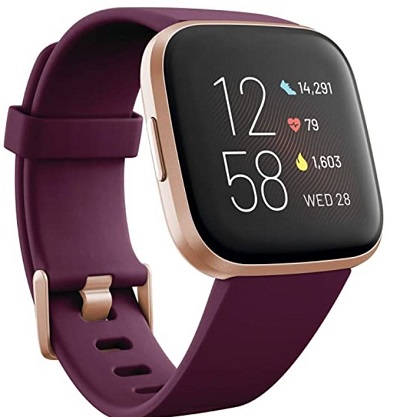
One of the most common ways to measure how many steps you’re walking in a mile is by using a pedometer (aka your GPS running watch or your Apple watch). You can also get a fitness band that is worn around your wrist or ankle to track your steps.
Research also shows that wearing a fitness tracker on your non-dominate wrist is better for accuracy as it reduces the risk of your arm motions being counted as steps.
To compare the number of steps you take with the distance you’ve covered, you can head over to your local 400-meter track or flat path that uses exact mile markers.
Start by walking or running a mile at your normal pace and then check to see how many steps you covered.
A mile = 2050 steps, so take four laps around the track and then run or walk an additional 9 meters. This would be a very accurate method of calculating exactly how many steps in a mile there are for you.
If that sounds tricky, then go around the track four times and multiple the number of steps you get by 1.009 to get your exact steps in a mile.
2. Mobile App
Another way you can measure it is by using an app. You can download a mobile app such as MapMyWalk that will count your steps and also measure a mile with your phone’s GPS.
The issue with this is that your mile distance can be off by approximately 10 percent while using a GPS from your phone. To get the best GPS signals, make sure to do this outdoors away from any buildings and trees.
3. Step Length
Your step length is by far one of the most accurate measures of how many steps in a mile there are for you.
This takes into account your age, sex, height (or more specifically leg length), as well as whether you’re running or walking.
Your step length is different from your stride length. So, your stride length is the distance covered during two steps.
Fitness bands such as a FitBit also allow you to adjust your stride length through the Edit Profile function to get a more accurate number if you choose to use it. Your stride length will simply be your step length times two.
How To Calculate Your Steps Per Mile Based on Step Length
You can calculate your step length without a pedometer or fitness tracker. All you need is a place that uses exact mile markers like a track and field.
If that’s not possible and you just want to do it all in the comfort of your own home, then place two markers as far as possible indoors or outside in your backyard.
Now start running or walking between these two markers and count the steps. Note that you’re measuring your steps and not your strides.
Once you’re done, divide the number of feet walked by the number of steps you took. The longer the distance covered, the more accurate your results will be.
Steps Per Mile – Based on Your Step Length
Now that you know your step length, you can check the table below to find the number of steps in a mile running or walking.
It’s based on an easy formula so that you don’t have to do the math. But if you’re curious, there are 5280 feet in a mile, and it’s divided by your step length (in feet) to come up with the steps in a mile.
Step Length | Steps in a Mile |
2.0 | 2640 |
2.1 | 2514 |
2.2 | 2400 |
2.3 | 2296 |
2.4 | 2200 |
2.5 | 2112 |
2.6 | 2030 |
2.7 | 1956 |
2.8 | 1886 |
2.9 | 1821 |
3.0 | 1760 |
Does My Age Affect My Stride or Distance?
A few studies have indicated a slight relation between your age and stride length. The first such study was published in 2000 in the Journal of Applied Physiology.
In this study, Professor Paul DeVita along with his colleague Tibor Hortobagyi examined the joint torques and powers of young and elderly adults walking at the same speed.
They discovered that the older a person gets, the less they use the muscles in their ankles to make each stride and the more they use the muscles around their hips.
In turn, stride length was found to be 4% shorter in the elderly, compared to young adults.
Dr. DeVita published a follow-up study in Medicine & Science in Sports & Medicine in 2016. They set out to examine the biomechanics of a set of healthy recreational runners between the ages of 23 to 59.
This study of theirs demonstrated that both stride length and speed of a runner decrease by 0.33% each year.
This appears to indicate that by the time you reach the age of 80, your stride length would have decreased by 20% compared to when you were 20.
Simply put the older you get, the more steps your miles will take.
How Should I Set My Personal Daily Step Goal?
We’ve all heard of the 10,000 daily step goal, but is that the right one for you? Your personal daily step goal should be something you can incorporate into your daily routine easily.
Start by finding out how many steps you take in a day, and then set an approximate daily target. Next, increase your mileage by 10% each week.

So, starting off, your daily number of steps could be 6,000 for the first week. If that’s the case, set a target to increase it by 10% and so your target will be 6,600 daily steps for week two.
It’s always better to slowly increase your mileage than to set unrealistic goals that will leave you disheartened.
Note how you feel as you keep increasing your daily step goal each week. It’s absolutely okay to start slowly at first, all that matters is that you keep improving.
Tips to Hit Your Personal Daily Step Goals
Walking truly has great benefits for your physical and mental health. If you’re looking to hit your personal daily step goals, then these 4 tips will come in handy:
1. Find a Walking (or Running) Buddy
According to a research study, participants had a 65% chance of achieving a goal if they told someone else about it. If they committed to meeting that person in person, their chances of success increased to a whopping 95%. Having a walking buddy can make the activity less isolating and provide someone to hold you accountable for achieving your daily goals.
2. Make Walking Part of Your Routine
Habits are can be tricky to form, but even more difficult to break. Make walking a regular part of your routine to guarantee that you always meet your daily step goal.
Morning walking is one of the best habits you can form, but it can be done at any time of day! You should try to maintain your daily walking routine at the same time until you no longer have to give it any thought and simply begin walking.
For more detailed tips on how to establish exercise as a habit, check out my complete guide.
3. Break It Into Chunks
Going for a walk for a full hour may be a lot in one go, but breaking it down into chunks throughout the day can make it a lot easier to meet your personal step goal for the day.
In fact, a new research has found that 5 minutes of walking every hour can undo the negative effects of an hour of sitting. So even if you have a desk job that involves a lot of sitting, you can undo the effects by breaking your walking goal into chunks.
4. Walk Faster
If you walk faster, the number of steps you take per mile will go down but you’ll get a more intense workout and burn more calories, even if you don’t entirely meet your step goal.
So if you don’t have a lot of time, consider increasing the intensity of your walks and doing some power walking. Read my complete guide to power walking to learn the correct form and techniques to stay injury-free.
How Many Calories Do You Burn in a One-Mile Walk?
The answer to this depends on person to person, in the same way it differs in how many steps in a mile walking or running.
It’s said that an average person will burn between 80 to 140 calories per mile. But the exact number of calories you’ve burned will depend largely on your weight, time spent walking, and your speed.
The faster you walk, the more hills or resistance the more calories you burn. In other words, the more effort it takes, the more calories you’ll burn.
For this reason, as it becomes easier and easier to walk a certain distance, you’ll start burning fewer calories.
You can change things up by switching up the terrain or walking more briskly. Always remember to listen to your body and slowly increase any and all kinds of physical activity to avoid injury.
Some Standard Miles per Step Counts
If you’re hitting a certain number of steps daily an curious how that converts, checkout these commonly asked questions.
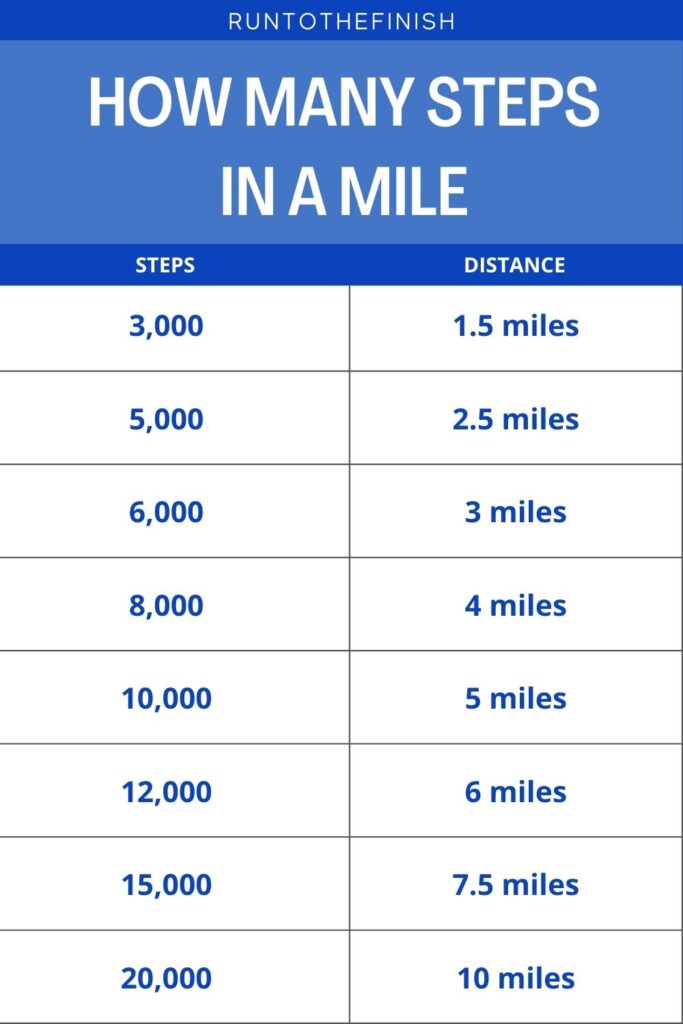
How Many Miles is 3000 Steps?
Like I mentioned above, the exact number depends on several factors including your height, step length, and sex.
Since there are about on average 2,000 steps in a mile, 3,000 steps make about 1.5 miles.
If we assume an average stride length of 2.2 ft for women and 2.5 ft for men, then 3,000 steps would equate to 1.25 miles for women and 1.42 miles for men.
If you know your stride length (step length x 2), divide it by the number of steps to know how many miles it converts into.
How Many Miles is 4000 Steps?
Keeping the same average constant, 4,000 steps make about 2 miles.
If we assume an average stride length of 2.2 ft for women and 2.5 ft for men, then 4,000 steps would equate to 1.66 miles for women and 1.89 miles for men.
If you know your stride length (step length x 2), divide it by the number of steps to know how many miles it converts into.
How Many Miles is 5000 Steps?
Keeping the same average constant, 5,000 steps make about 2.5 miles.
If we assume an average stride length of 2.2 ft for women and 2.5 ft for men, then 5,000 steps would equate to 2.08 miles for women and 2.36 miles for men.
If you know your stride length (step length x 2), divide it by the number of steps to know how many miles it converts into.
How Many Miles is 6000 Steps?
Keeping the same average constant, 6,000 steps make about 3 miles.
If we assume an average stride length of 2.2 ft for women and 2.5 ft for men, then 6,000 steps would equate to 2.5 miles for women and 2.84 miles for men.
If you know your stride length (step length x 2), divide it by the number of steps to know how many miles it converts into.
How Many Miles is 7000 Steps?
Keeping the same average constant, 7,000 steps make about 3.5 miles.
If we assume an average stride length of 2.2 ft for women and 2.5 ft for men, then 7,000 steps would equate to 2.92 miles for women and 3.31 miles for men.
If you know your stride length (step length x 2), divide it by the number of steps to know how many miles it converts into.
How Many Miles is 8000 Steps?
Keeping the same average constant, 8,000 steps make about 4 miles.
If we assume an average stride length of 2.2 ft for women and 2.5 ft for men, then 8,000 steps would equate to 3.33 miles for women and 3.78 miles for men.
If you know your stride length (step length x 2), divide it by the number of steps to know how many miles it converts into.
How Many Miles is 9000 Steps?
Keeping the same average constant, 9,000 steps make about 4.5 miles.
If we assume an average stride length of 2.2 ft for women and 2.5 ft for men, then 9,000 steps would equate to 3.75 miles for women and 4.26 miles for men.
If you know your stride length (step length x 2), divide it by the number of steps to know how many miles it converts into.
How Many Miles is 10000 Steps?
Keeping the same average constant, 10,000 steps make about 5 miles.
If we assume an average stride length of 2.2 ft for women and 2.5 ft for men, then 10,000 steps would equate to 4.16 miles for women and 4.73 miles for men.
If you know your stride length (step length x 2), divide it by the number of steps to know how many miles it converts into.
How Many Miles is 11000 Steps?
Keeping the same average constant, 11,000 steps make about 5.5 miles.
If we assume an average stride length of 2.2 ft for women and 2.5 ft for men, then 11,000 steps would equate to 4.58 miles for women and 5.21 miles for men.
If you know your stride length (step length x 2), divide it by the number of steps to know how many miles it converts into.
How Many Miles is 12000 Steps?
Keeping the same average constant, 12,000 steps make about 6 miles.
If we assume an average stride length of 2.2 ft for women and 2.5 ft for men, then 10,000 steps would equate to 5 miles for women and 5.68 miles for men.
If you know your stride length (step length x 2), divide it by the number of steps to know how many miles it converts into.
How Many Miles is 13000 Steps?
Keeping the same average constant, 13,000 steps make about 6 miles.
If we assume an average stride length of 2.2 ft for women and 2.5 ft for men, then 13,000 steps would equate to 5.42 miles for women and 6.16 miles for men.
If you know your stride length (step length x 2), divide it by the number of steps to know how many miles it converts into.
How Many Miles is 14000 Steps?
Keeping the same average constant, 14,000 steps make about 6 miles.
If we assume an average stride length of 2.2 ft for women and 2.5 ft for men, then 14,000 steps would equate to 5.83 miles for women and 6.63 miles for men.
If you know your stride length (step length x 2), divide it by the number of steps to know how many miles it converts into.
How Many Miles is 15000 Steps?
Keeping the same average constant, 15,000 steps make about 7.5 miles.
If we assume an average stride length of 2.2 ft for women and 2.5 ft for men, then 15,000 steps would equate to 6.25 miles for women and 7.10 miles for men.
If you know your stride length (step length x 2), divide it by the number of steps to know how many miles it converts into.
How Many Miles is 16000 Steps?
Keeping the same average constant, 16,000 steps make about 8 miles.
If we assume an average stride length of 2.2 ft for women and 2.5 ft for men, then 16,000 steps would equate to 6.67 miles for women and 7.58 miles for men.
If you know your stride length (step length x 2), divide it by the number of steps to know how many miles it converts into.
How Many Miles is 17000 Steps?
Keeping the same average constant, 17,000 steps make about 8.5 miles.
If we assume an average stride length of 2.2 ft for women and 2.5 ft for men, then 17,000 steps would equate to 7.08 miles for women and 8.05 miles for men.
If you know your stride length (step length x 2), divide it by the number of steps to know how many miles it converts into.
How Many Miles is 18000 Steps?
Keeping the same average constant, 18,000 steps make about 9 miles.
If we assume an average stride length of 2.2 ft for women and 2.5 ft for men, then 18,000 steps would equate to 7.5 miles for women and 8.52 miles for men.
If you know your stride length (step length x 2), divide it by the number of steps to know how many miles it converts into.
How Many Miles is 19000 Steps?
Keeping the same average constant, 19,000 steps make about 9.5 miles.
If we assume an average stride length of 2.2 ft for women and 2.5 ft for men, then 19,000 steps would equate to 7.92 miles for women and 8.99 miles for men.
If you know your stride length (step length x 2), divide it by the number of steps to know how many miles it converts into.
How Many Miles is 20000 Steps?
Keeping the same average constant, 20,000 steps make about 10 miles.
If we assume an average stride length of 2.2 ft for women and 2.5 ft for men, then 20,000 steps would equate to 8.33 miles for women and 9.46 miles for men.
If you know your stride length (step length x 2), divide it by the number of steps to know how many miles it converts into.
Whew that’s so much great info. But if you’re looking for more to get you going:
Other ways to connect with Amanda
Instagram Daily Fun: RunToTheFinish
Facebook Community Chatter: RunToTheFinish
Sign Up to Receive a Weekly Newsletter with Top Running Tips and Laughs



 Nordic Walking: What It Is and 5 Health Benefits