
If you’re looking to improve your overall running speed, while ensuring you reduce your chances of injury, you want to pay attention to your running cadence. Don’t get sucked in to trying to make every single run hit a cadence of 180, but let’s look at how to increase your running cadence when it makes sense. Running cadence, simply put, refers to the number of steps you take per minute while running. While it may seem like a minor detail, mastering your cadence can have a profound impact on your running efficiency, speed, and injury prevention.
For many years, people have been told to aim for 180 SPM (steps per minute), but is that really our ideal step count?
The latest studies suggest that maybe we’ve been focusing too much on the 180. Instead, we need to understand how it truly affects our overall running form while considering our individual height, strength, and running mechanics.
This is all that we’ll be answering and more in this article!
What is Running Cadence?
Running cadence (aka stride rate or stride frequency) is the number of steps per minute (SPM) you take as you run.
To put it more simply, it’s the number of times your foot hits the ground in a minute while you run. To quickly calculate your running cadence, follow this formula:
- Try counting your foot falls on one side for 10 seconds
- Multiply that by 2 (to account for both feet)
- Multiply that by 6 (to account for 1 minute)
To understand this better, let’s look at an example running cadence calculation.
Example Running Cadence Calculation
If I counted 15 footfalls… 15 x 2= 30.
30 x 6 = 180… boom perfect cadence…maybe.
Let’s understand how our running cadence affects our overall running performance to see what’s a good running cadence for you.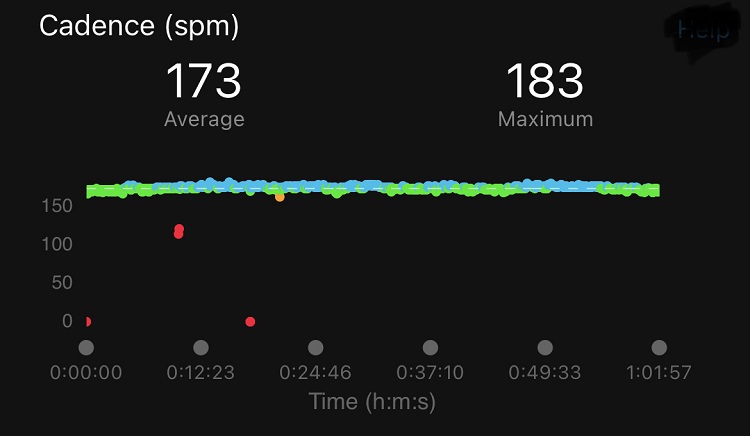
You’ll see some silly things that say beginning runners have a lower cadence than more advanced runners.
It’s not true.
What is absolutely true is that the faster you run, the more likely you are to have a higher cadence. For example, elite marathon runners are often well over 190 to hit that 5 min mile! But running a 12 min mile, you might be just fine with a cadence of 163.
How Does Running Cadence Affect My Running?
When considering running cadence, it’s essential for us to also consider our stride length. These two combined make up our running speed.
Running speed = Stride Length x Running Cadence (SPM)
As you can see, since these two metrics affect our running speed, two different runners with different running cadences could might run the same pace. But one could be working harder and more prone to injuries as well..
- One runner could have a short stride, but a faster cadence.
- The other runner could have a long stride, but slower cadence.
- Due to this you can have the same cadence at many different paces.
So then, what’s the best way forward? Should you have a faster cadence or a slower one? We all tend to have a natural cadence, but there are certain advantages to increasing your cadence, while shortening your strides.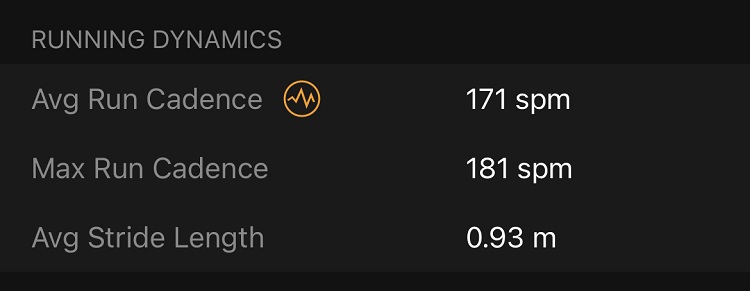
This combination of running cadence and stride length plays a big role in your speed and the reduction of injuries.
A combination of a faster cadence with a shorter stride length is optimal. This is backed by a research study published in 2014 in Sports Health – a bi-monthly, peer-reviewed journal involved in the training and care of competitive or recreational athletes.
A faster cadence leads to:
- less heel striking and less runners’ knee pain
- higher turnover rate means less ground contact time (faster runners spend less time on the ground)
- more momentum moving you forward
- less wasted energy, especially for distance runners
How does a faster cadence reduce injury risk?
Again without pinpointing the perfect number, for a lot of runners there is a benefit to increasing their cadence.
Improved Running Economy:
Higher cadence is associated with better running economy, meaning you can cover more ground with less effort. By taking shorter, quicker strides, you reduce braking forces and energy wastage, leading to more efficient movement.
Reduced Ground Contact Time:
Cadence is closely linked to ground contact time—the amount of time your feet spend on the ground with each stride. A higher cadence typically correlates with shorter ground contact time, which minimizes the risk of overstriding and lowers the impact forces exerted on your body.
Distribution of Weight: Maintaining an optimal cadence helps distribute the workload evenly across your muscles and joints, reducing the likelihood of overuse injuries such as shin splints, IT band syndrome, and stress fractures.
It may feel that counterintuitive to strive for a shorter stride versus a longer one – especially if you want to get faster. But step one is a good cadence, then there are things that will help you get a big beautiful stride without overstriding and creating injuries.
What is a Good Running Cadence?
You may have heard of the magical 180 SPM – but where did it originate from? Should you be striving towards it? And is it really the optimal cadence?
Legendary Olympic coach Jack Daniels counted the stride rate for 46 athletes at the 1984 Olympics and determined that all but one had a stride rate of at least 180 spm.
Later, he also concluded that in his 20 years of coaching college athletes, not once did he see students with a stride frequency lower than 180.
This revelation led to the belief that 180 spm is the magic number for all runners to achieve.
However, several factors, including height, fitness level, and mobility determine stride rate for every individual. Some would say that taller runners with longer legs are going to naturally have a longer stride and therefore lower cadence (debatable).
The truth is, the average runner has a stride rate ranging between 150 and 170. While sprinters are often going over 200 SPM.
- For long or easy runs, you may not need to hit 180
- Aiming to progress to 160-170 for those runs could be enough
- For speed workouts or shorter races like a 5K, you’ll end up aiming for 180 or even over that in the final push
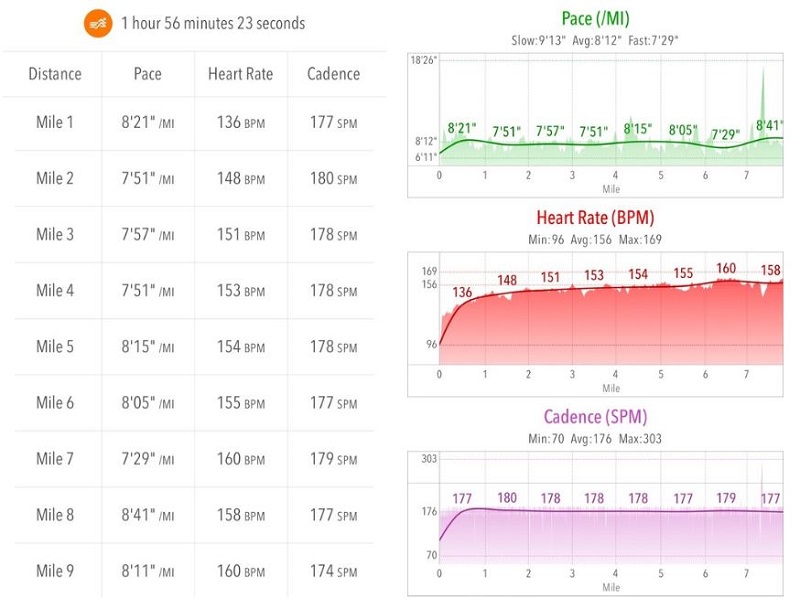
I like this cadence chart from Indie because it helps explain what I often see in my own running. Now that I have adapted to roughly a 175-180 cadence most of the time, I can run a lot of different paces at that cadence.
So cadence alone is not a predictor of speed, but a component that helps.
See below for ways to increase your running cadence correctly.
See below for ways to increase your running cadence correctly.
Is Higher Running Cadence Better?
A cadence lower than 160 strides per minute is often seen in runners who overstride.
Runners who overstride land with a heel strike that halts the forward motion required for running and means the hip and knee joints take in a lot of force with every step.
In other words, overstriding needlessly magnifies the impact forces with each step a runner takes.
HEEL STRIKING (ok and weak hips and not warming up) are what tend to lead to a lot of the most common running injuries.
Checkout this video for an example drill that will help you get your brain used to your feet landing UNDER your body, which will force you to improve cadence.
Why Should I Care About Running Cadence?
There are many advantages that come with improving your running cadence. A higher cadence has been shown to result in:
- More efficient running form
- Increase in running speed with form efficiency
- Less impact on the hip and knee joints
- Correcting overstriding
- Fewer injuries caused by heel striking
- More air time, which means softer landings with each step
- Less braking force with ground contact
All that said, it’s important to note that a faster cadence doesn’t necessarily make someone a better runner. Everyone runs differently as noted above.
What is My Running Cadence? And How Do I Measure It?
These days, most runners own a GPS running watch with a built in sensor that tracks our cadence. See my screen shots above from recent runs with a Garmin.
If you don’t have a watch to do the work for you, there’s a quick formula (that I also mentioned above) you can use to calculate it yourself!
It’s very easy to do on a treadmill, but it can also be done quickly outside as you get used to checking in with your body.
- Count your foot falls on one side for 10 seconds
- Multiply that by 2 (to account for both feet)
- Multiply that by 6 (to account for 1 minute)
I will often do this quick check to make sure what I’m seeing on my watch is accurate, so that I’m not incorrectly changing my stride.
Is 180 the perfect cadence? Maybe not, but here's why you need to pay attention to yours and how to improve! #runchat #running Share on XHow to Improve Running Cadence
Let’s talk about my best tips for making a change without wrecking your enjoyment of the run or overthinking every step.
1. Improve in 5% Increments
Just like increasing distance, you’ll want to work slowly as you increase your stride rate, aiming for no more than 5-10% at a time.
- Don’t spend your entire run focused on it, that can make you crazy
- Instead after you’ve been running a bit, check in with your stride
- Start doing running drills before your run to help cement that stride in your subconscious
- If you currently run at 160 spm, then aim for 168 over the next week or so before increasing by another five percent.
- Include running strides at the end of an easy run each week
- Reaching your desired stride rate can take anywhere from six to eight weeks.
- Go slowly in order to avoid injury and soreness.
2. Use a Running Cadence App or Metronome
One of the most commonly recommended running apps to help with cadence is a metronome. Running to a metronome set to a specific beat is a great way to increase your cadence slowly.
An app I prefer for this is called Smart Metronome, but I hear good things about Run Tempo as well. Here’s an ideal drill to help you use a metronome.
Metronome Drill
This drill will help you to see what it feels like to quicken your foot turn over and different rates. It’s a drill and not meant for you to go from 150-190 for your entire run.
- Start by matching the beat to your current running pace and do short bursts at that speed in order to get accustomed to running with the beat.
- Next increase it by 5-10 beats and run a quarter to half mile using that cadence.
- Next increase it by another 5-10 beats and repeat
- Do this until you’ve actually done run at 190 beats
Once you know your current cadence, you an also use the metronome to help you increase by just 5% during your next easy run. Set the metronome accordingly and allow yourself to naturally adapt to that beat.
Work toward building your stride rate at this speed over longer distances and at different speeds before increasing again.
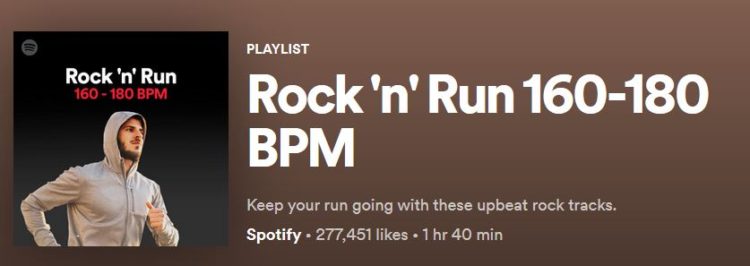
3. Run to Music at 120-150 BPM
Another far more fun thing to use during your run is find the right music. It turns out you actually don’t want a 180 BPM song, as that will push you too fast. So your footfall goal might be 180, but you don’t actually match that with your music.
Find out what BPM is best for different types of runs!
Once you know the beat that’s best, you can find a few different options for this by Googling and maybe some of your favorite songs will popup so you can create your own playlist.
Alternatively, the JogTunes app allows you to select music based on a certain number of beats per minute. JogTunes also has playlists on Spotify and Apple Music, as well as YouTube playlists and a podcast.
4. Use Speed Drills to Increase Stride Rate
As mentioned above, the real key to improving cadence is to increase your strength, fitness, and speed.
Practice the exercises below 2-3 times per week during your strength training sessions or as part of your warm up.
Marching Drills to Improve Knee Drive
To increase your cadence, you need to first change where your foot lands with each step. Ideally, it should be landing directly below your center of gravity, which will increase turnover rate. You can retrain your stride with marching drills.
Start by marching in place. Pump your arms in a 90-degree angle as you raise your legs straight up. Keep your focus forward and try to avoid looking down. Eventually, you can progress to a marching jog.
A number of variations on this are demonstrated in the video above!
- Not only are we getting the foot under the body, we’re working on knee drive
- Your knee should come up in front of you during the run, not push behind you
- It’s more efficient and more powerful overtime
✅Checkout our new video guided running technique program..
Easy, quick drills to implement that will progress you over the course of a month to naturally increase cadence and improve your stride.
Take Advantage of Downhill Sprints
After an easy run, find a 200-meter long hill with a gentle grade and run 4-5 running strides down the hill, reaching top speed toward the bottom. Walk up to recover.
Because running downhill can be harder on the knees and quads, DO NOT overdo this. Instead, just remember this a drill to work on turn over, not a long drawn out run.
Jumping Rope for Ground Force
You don’t even need an actual rope to benefit from this childhood fun. (See video below for best form)
- Keeping your legs straight
- Focus on the press off the ground
- We’re working on the power in your feet and ankles to push away
- Start with 30 seconds, keep increasing it as far as you’d like
Because of the straight legs and impact, definitely start with the smaller time and work up allowing your knees to adapt.
Beyond that drill, any kind of jump roping will add additional benefits as you’re forced to pick up your feet and speed.
Try Four Square Hops for Additional Power and Stability
Beyond jumping rope, there are other jumps we can add in to help improve our ground contact force, as well as the power in our lower legs.
Imagine a large plus sign on the ground (you can also visit your local elementary school and look for the four square box, bust out some chalk, or use tape to draw your own) and hop on one leg counterclockwise for the given reps, and then on the other leg. Repeat the pattern in the opposite direction. Do 2-3 sets in each direction for 8-12 reps.
Utilize Skips for Runners
I believe this drill has been one to make the biggest difference for me recently and it’s a big part of the Running Technique program.
I started with the marches to improve knee drive and then progressed to A and B skips, followed by a butt kick drill I’ll be sharing soon.
Fast Feet for…Fast Feet
You may remember something like this from PE class.
You’re literally standing in place and then moving your feet super fast while pumping your arms. You’ll be keeping your feet low to the ground in this movement.
Ideally if on grass you can be using those fast feet to move you forward, this is harder on concrete because your feet are staying so close to the ground.
Take Your Time When Improving Your Running Cadence
Your running cadence is not something that will magically improve overnight. It’s something to work on consistently, but strategically.
Like all other types of training, it’s important to take it slow so you can work on your form and also let your body adjust and adapt to your new cadence.
It may take you anywhere from six to eight weeks before you start feeling comfortable and well-adjusted to your faster cadence.
Commit to these speed drills I listed above, keep tracking your cadence and you’ll keep improving it slowly but surely. This is also the best way to make sure you don’t risk any injuries.
Other ways to connect with Amanda
Instagram Daily Fun: RunToTheFinish
Facebook Community Chatter: RunToTheFinish
Sign Up to Receive a Weekly Newsletter with Top Running Tips and Laughs



 Parkrun Records Eliminated – Inclusive or Short Sighted?
Ha, I have so many memories of my coach making me run around central London wearing a metronome, I was sure people were going to worry I was about to detonate! It did improve my running though, so worth the strange looks!
ha!! that’s a hilarious image in my mind now
Wow, what an awesome article! I’ve been working on increasing my cadence over the past few months and it really has made me focus on improving my form. As a bigger runner, I know it’s important for me to do whatever I can to reduce the impact force on my joints (and bottom of my feet), so improving my cadence has been an important goal for me!
I include a lot of trail running in my running routine, so I already focus on footwork drills with a speed ladder and speed hurdles. I think that working on my foot speed and explosiveness has really made a big impact on being able to improve my cadence.
Anyways, thanks so much for this article, I’ll be following your blog!
Thanks Jake! Definitely harder to maintain cadence when also watching footing!
This is such good information! Is it possible to have too high a cadence? I was surprised to find that my cadence is about 195. I’m 5’4″ and my stride length is .8-.85 according to my Garmin. I’ve been told I should lengthen my stride since my cadence is so high. I run 30-40 miles a week without injury, and I’m concerned about overstriding if my focus is to lengthen my stride. Instead I’ve just been trying to engage my glutes more and it does seem to lengthen my stride a bit. Is too high a cadence something I should worry about?
Great question Liz, if you’re doing easy and long runs 195 might actually be over doing it. You could be pushing the pace and your HR up on days where you should be going easy.
Thanks for the advice! I’ve actually been thinking about paying more attention to HR after readiing your info on HR based training. I think most of my runs are at an conversation pace, but my pace is pretty similar on all of my runs-it doesn’t usually vary more than 30-45 sec per mile. I’m going to work on varying my pace more and see if slowing down affects my cadence.
When I first started running, I had a slower cadence and thought 180 was the magic number. So, I used a BPM analyzer and created playlists in the 175-190bpm range (or 90bpm for slower songs); then, all I had to do was run to the beat of the music. More recently, after an injury, my PT asked me to strive for a 180bpm cadence, and I turned to the same technique. It definitely made it really easy, since I didn’t even have to think about it during my workouts as long as the right tempo song was playing!