
The marketing machines at electrolyte and sports drink companies would have us believe that those replacement beverages are necessary everyday, all the time, for everyone. Health professionals may have different opinions though on high sodium options, so we’re here to bring you a well-balanced and nuanced LMNT review.
Honestly, the first time I tasted this drink I thought “nope”. But all around me were athletes saying “I love this!!” Which as we all know means, I was intrigued.
What’s the deal with this booming drink that boast far more sodium than others and was I missing the boat or were they taking in something unnecessary? We decided to dig in to the research and of course like so many things as a running coach, the final answer is: It Depends.
So let’s dive in to an LMNT review.
What is LMNT?
LMNT, pronounced element, is an electrolyte powder designed to help replace what’s lost during endurance training and exercise. Compared to most other electrolyte powders, which contain 50 to 500 milligrams of sodium, LMNT contains 1,000 milligrams per stick.
It’s magnesium (60 mg) and potassium (200 mg) are comparable to what other products on the market currently offer.
Each stick of LMNT contains 43% of the daily recommended amount of sodium, leading to their theory that optimal health outcomes are actually achieved at levels 2 to 3x higher than what’s currently recommended.
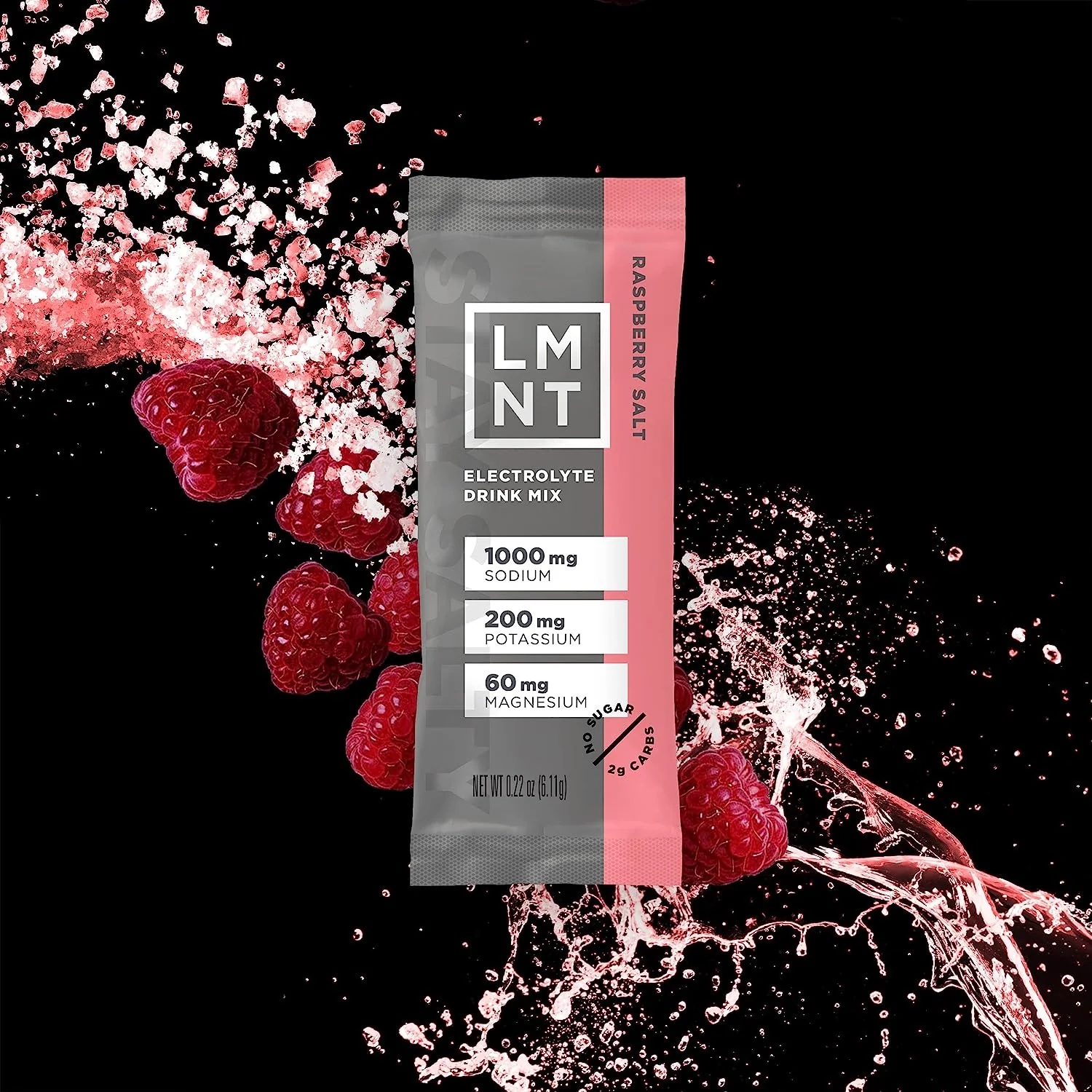
- LMNT is available in individual sticks – $38 for 20 sticks
- LMNT is also available in cans (less practical for while you’re running) – $30 for 12 pack
- Has a variety of flavor options including hot chocolate and coffee flavored for a hot beverage option
If you’ve never tried LMNT, it tastes like you might expect, salty. For those who are depleted this can be absolutely delicious and for others is simply way too strong. One easy remedy is to mix it with a lot more water than recommended which will dilute the overall flavor and amount of sodium per serving.
Is 1000mg Of Sodium Too Much?
The American Heart Association would probably raise a red flag at this point in our LMNT review, given that they advise keeping one’s sodium intake below 1500 mg daily to reduce the risk of heart disease.
However, there is some scientific evidence that supports ingesting higher amounts of sodium – a 2024 study found that consuming 3,000 mg of sodium every day could maximize health benefits without raising the risk of heart failure, for example.
LMNT claims to interpret current evidence to support a daily consumption that is as high as 4,000-6,000mg of sodium per day.
So is LMNT too much salt? That comes down to your sweat rate, activity and own personal health history.
Understanding Sweat Rate
What becomes extremely important in this discussion is understanding your own sweat rate.
If you’re an endurance athlete like a distance runner, it would be a good idea to understand your sweat rate before diving into high-sodium products. The truth is that, even if the brand wants you to believe they’re good for everyone, that’s just not the case.
The amount of sodium excreted by a single person depends on an array of factors, like body mass, training level, temperature, clothing, gender, and acclimation to the heat/humidity.
Some athletes are predisposed to be “salty” sweaters, so if you find white streaks on your skin or clothing, that might be a clue you fall into this category. Coach Amanda has often shared that she falls in the salty category and yet still finds this drink to be too intense for her needs.

Beginning runners and men, due to mass, in general are more likely to lose more salt while exercising.
For these reasons, it’s hard to pin down an exact number of milligrams that endurance athletes need to consume. Some studies show that football and tennis players can lose up to 8500 mg of sodium in 2 hours – or as low as 800 mg in 2 hours.
Most athletes don’t have access to the kind of lab tests required to know exactly what they need to aim to replace over a period of time, so experts have crafted a baseline recommendation of replacing 500-700 mg per hour.
This recommendation can increase to more than 2000 mg per hour if you’re untrained, exercising in the heat, are a heavy sweater, or exercise for long periods of time.
Note: This is where we also want to say, don’t go out and buy one of those arm monitors that tells you what electrolytes to replace. They’ve proven very unreliable! Instead, let’s pay attention to how you’re feeling during and post run:
- Feeling sluggish – did you take in enough total water? Salt can encourage that thirst mechanism.
- If you took in enough, then you might need additional salt.
- If your diet is really high in sodium, you might see white marks on clothing, but feel totally fine and thus would not need additional high sodium drinks.
- Getting headaches or muscle aches post run is another time to consider increasing your sodium.
Why Sodium in our Electrolyte Drink Matters?
An LMNT review wouldn’t be complete without a rundown of benefits, but also a quick discussion on whether or not your average person – even your average active person – really requires this amount of daily sodium.
We’ve done a deep dive on the benefits of electrolytes for runners, but a quick review of sodium.
Improved Hydration
Electrolytes like sodium, potassium, and magnesium help regulate fluid in the body. If your diet is low in sodium or you’re losing a lot through sweat or sickness, potential dehydration could be a real issue.
This leads to fluid shifting into cells and causing them to swell. Symptoms include fatigue, headaches, muscle cramping, and dizziness.
LMNT reduces your risk of these symptoms, plus it boasts no added sugars. This is another controversial piece as there is a benefit to having sugar with your drink while exercising to help with both absorption AND energy.

Increased Energy
Loading up on electrolytes before an endurance exercise or event could lend you more energy and power, and athletes who are well-hydrated show improved performance across the board.
That said, dietician Kelsey Kunik said in her LMNT review that when she heard an advertisement claiming “everyone should add it to their water to boost hydration,” she cringed a little.
“I like this supplement, but the suggestion that it’s suitable for everyone is misleading – LMNT isn’t necessarily the right choice for all.”
She wrote an article for Eat This, Not That where she stated that for people with low sodium, live in a warm climate and are a heavy sweater, are physically active, or consume a low-sodium diet, LMNT could be a great supplement.
However, for people who are not physically active, aren’t big sweaters, have high blood pressure, or already eat a high-sodium diet, you’ll probably want to steer clear.
Guidelines for Electrolytes
All right, so now that we’ve said it’s an option…but maybe not for everyone, what are the guidelines around fueling with electrolytes?
2-3 Hours Before Training
Consume 16-24 ounces of fluid, like water and an electrolyte drink. You want to pick a sports drink that has at least 150 mg of sodium per 24 oz, but more would be even better.
If you know you’re a salty sweater or fall into those other high-loss categories, you can also include foods that are high in sodium.
Keep in mind that you’ll want to implement this routine every time you work out, not just on race day, so you can tweak it so you know how to feel your absolute best.
30 Minutes Before Training
Drink another 8 oz of fluid, preferably a sports drink but water will do.
During Training
Snacks like pretzels, popcorn, or crackers are good ways to ingest some more sodium, but often unrealistic when running hard or needing to take in enough calories. Instead, checkout some of our favorite energy gels and opt for ones with higher sodium levels or balance the sodium in your energy chews with your electrolyte drink.
Try drinking 4.6 oz every 15-20 minutes. It’s a good rule of thumb to start with 500 mg of sodium an hour and then increase or decrease from there, depending on your performance.
After Training
Since sweat rates vary so much, you can try to determine yours by weighing yourself before and after training. You should consume 16-24 oz of liquid for every pound of weight lost during training, and if you lose more than 4 pounds, increase your fluid intake before and during training.
Our final LMNT review is that it’s a fine choice for athletes looking to boost or maintain their sodium levels before, during, and after a workout or race.
That said, you might not need or want to use a whole stick in one go. Or you might decide to dilute the product in more water than recommended on the label.
Just remember that both sodium and sugar are necessary for runners to perform! Your needs are different from the general less activity population around whom guidelines are built.
Thank you to contributor and researcher Trisha Leigh for helping to find all the info to bring this together. Hopefully it gives you a better idea of if this is the right drink for you or at least if you want to test it out!
Looking for more training advice?
Other ways to connect with Amanda
Instagram Daily Fun: RunToTheFinish
Facebook Community Chatter: RunToTheFinish
Sign Up to Receive a Weekly Newsletter with Top Running Tips and Laughs



 Brooks Launch 11 Review | A Budget Friendly Choice
Thank you for this! LMNT didn’t work well for me and after reading this, I’m thinking it’s because I’m not a heavy sweater. I like less sodium and more of the other electrolytes.
You mentioned briefly that sugar helps with absorption and that has been my experience as well. I like Liquid IV for the effects, but didn’t like how sweet it is. I tried their sugar-free version and it doesn’t work nearly as well for me in relieving sluggishness and thirst. I’ve gone back to the original Liquid IV and just use half a packet at a time dissolved in more water. Seems like the sweet spot for me.
Kudos to you for continuing to test! That’s such a huge part of getting our fueling right.