

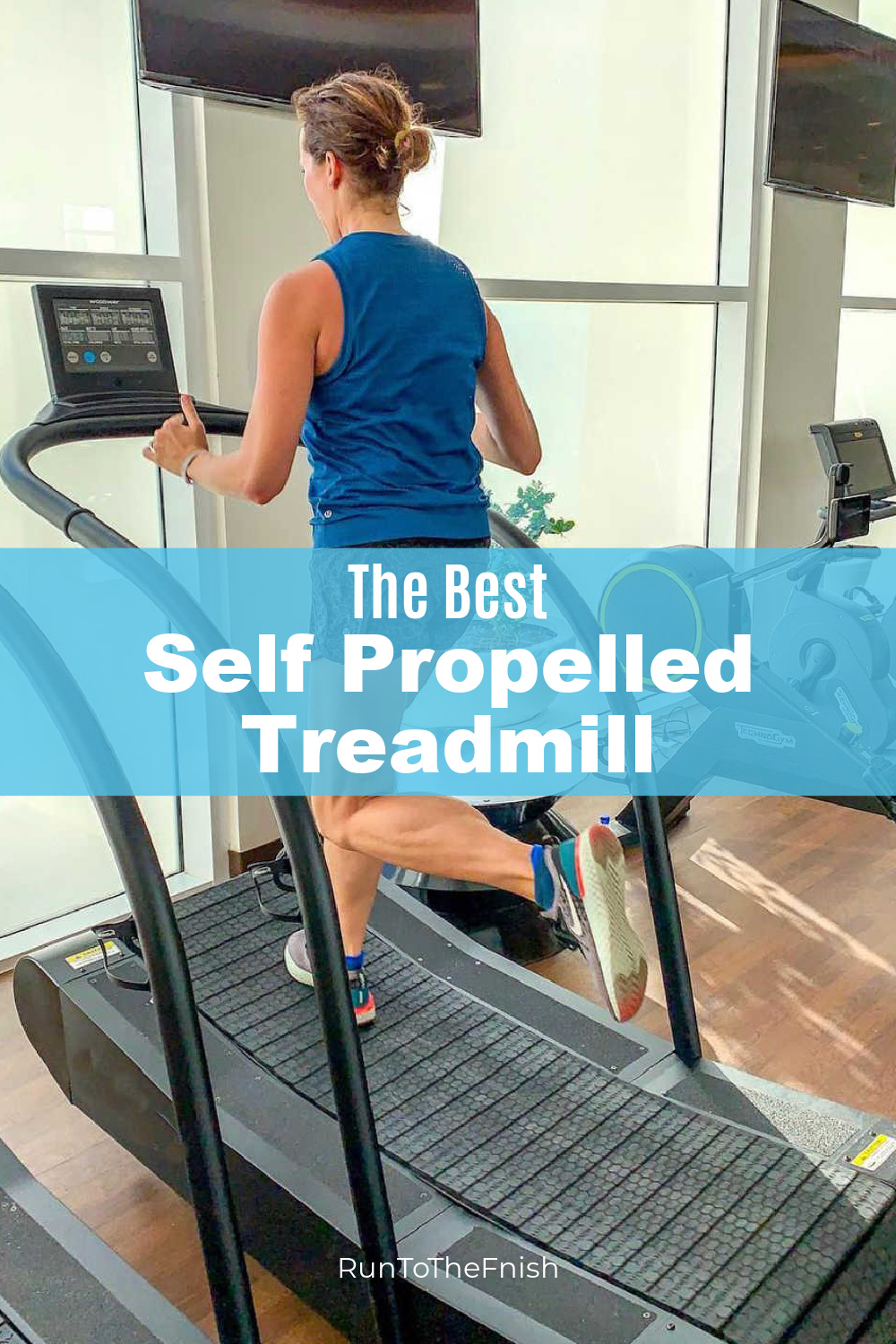
Many CrossFit gyms helped to popularize self-propelled treadmills, as part of their sprint and HIIT workouts. It led to an explosive growth in Woodway curved treadmills, but when is it the right choice for your home workouts?
This isn’t a debate over whether you should run outside or use the treadmill. Both are incredible options to get fit and stay healthy and active.
Instead, we’re looking at who is going to get the most out of non-motorized treadmill at home.
Is it the “walk while you work at home” person, the distance runner, the sprinter, or the just starting out exerciser?
I’ve used treadmills as part of my training since day 1, way back in 2002. Whether you need them to avoid running on ice, to be close to the kids, for the added cushion, or simply because you enjoy, it they play a big role in enhancing your race day performance when used correctly.
If you’re thinking about buying a treadmill, a self-propelled treadmill might be a better fit than a traditional motorized machine based on your goals. Here are some factors to consider as you make your decision, along with my recommendations for the best manual treadmills.
What is a Manual Treadmill?
When most people hear the word “treadmill,” they think of the motorized exercise equipment where you walk or run on a belt that is pulled across a platform. The treadmill belt moves with the assistance of an electric motor, and you can adjust speed and incline/decline settings from the console.
A self-propelled treadmill (a.k.a., manual treadmill or non-motorized treadmill) is exactly what it sounds like: a treadmill that relies on your own bodyweight and effort to move the belt.
Usually there is a slight incline or a curve that will help you to start the belt moving, but after that it’s entirely up to you to keep the machine moving.
Many self-propelled treadmills still have a battery-powered display to track speed, calories, etc., although the display is more basic than a you would see on a standard treadmill and way less than the Peloton Treadmill.
7 Benefits of a Manual Treadmill Over Motorized Treadmill
Electric treadmills may be more common in gyms and homes, but there are some distinct advantages to buying a manual treadmill!
Discover how they can help you achieve your fitness goals, save you money, and provide a workout experience that’s both invigorating and environmentally friendly. We’ll also cover some of the drawbacks to choosing a manual treadmill, so that you’re fully informed to make the best decision.
1. No Power Source Needed
There’s no need to set your treadmill up near an electrical outlet – convenient! This often allows for easier placement in a garage, basement, or small apartment where you have limited space for your workout equipment.
Plus, you’ll save money on your electricity bill while still getting a terrific workout.
2. Affordable At-Home Treadmill
One of the major advantages of a manual vs electric treadmill is the price. Flat-bed, self-propelled treadmills are significantly cheaper than motorized treadmills. This is one reason they can be a good option for those who simply need an at home option for walking when the weather is bad and you want to get in a workout.
Or for those who are looking for stand up desk option that allows you to move a little bit as well, an under the desk manual treadmill is incredible. So much cheaper and smaller.
Note: Curved-belt treadmills have more bells and whistles and are comparable in price to motorized treadmills.
3. Better for Small Spaces or Storing Away
Motorized treadmills have bulky motors that take up space, and they’re heavy! Self-propelled treadmills are more compact, lighter, and many even fold up for easy, out-of-the-way storage. Note we are talking self-propelled and not curved treadmills when it comes to space saving because curved treadmills are LARGE.
As noted above there are great under desk treadmills designed to slide under a bed or easily fold up. They’re going to require a lot less space.

4. Potential for Workout Efficiency
When you use a motorized treadmill, the motor does some of the work for you. You’ll expend more calories per mile using a manual treadmill, which means you may be able to get away with shorter workouts every now and then.
Do you burn more calories on a manual treadmill? Maybe.
The immediate answer is that you could burn up to 30% more calories per mile, but most people will also not go as far or often as fast as they would on motorized treadmill which means their total calorie burn is far less.
5. Improved Stride
One study showed that running or jogging on a non-motorized, curved-deck treadmill improved gait mechanics. It forced runners to pick up their knees and learn to land under their body for the best control.
I’ve seen no data that shows the flat models will improve stride.
6. They’re Safer for Those with Balance Issues
Because a manual treadmill won’t move without you specifically working to make it move, there’s no risk of the belt moving unexpectedly and causing injury. Or flying off because you hit a button and the speed has increased beyond your capacity.
It’s also going to immediately slow down or stop when you stop moving. This decreases the chance of becoming one of those viral videos where someone slides off the back or steps on a moving belt. (Yes, this is a very real safety hazard and happens more often than you may think.)
Note: Again, a curved manual treadmill is a slightly different story. It can actually be more dangerous for those who don’t know who to utilize their body to slow down the machine.
7. You Have Full Control of the Workout
Go the speed you want to go at any time. With a manual treadmill, you get to control the pace by exerting extra force instead of trying to keep up with a speed you set on a screen.
As a coach, I love this because it means you’ll ease in to your workout. Start out at an easy pace and then slowly progress as you feel good.
And just like my favorite running treadmill, you’re going to get some cushioning which can help to soften the impact and reduce strain on your joints from your workouts.
6 Drawbacks to Manual Treadmills
There are a few manual treadmill disadvantages that could matter based on your needs.
Less Features
Manual treadmills are often much more “bare bones” than electric treadmills. Which means you may not have all the bells and whistles you’re used to on the treadmill at your gym. (Think features like heart rate monitoring, bluetooth connectivity, and built-in fans to keep you cool.)
Pacing Issues
The American College of Sports Medicine notes that it can be harder to regulate your pace on some manual treadmills because there is no consistency from the motor.
In the case of curved treadmills this often means going too fast, but on flat manual models it often means going slower than you planned and thus decreasing the impact of the workout.
May Cause Joint Issues
Using a manual treadmill can potentially lead to joint problems if not used correctly. Since they require more effort to operate, the extra work can result in more joint stress in areas like your knees, hips, and ankles if you’re not careful.
Fatigue for Long Distance
Flat-bed manual treadmills really aren’t built for long endurance sessions. They are not as sturdy and since extra effort required, it will drain your energy faster, making it harder to hit any long distance goals. So many don’t plan your marathon training around a manual treadmill.
Is it Harder to Use a Manual Treadmill?
Yes, manual treadmills typically require more physical effort compared to electric ones, since onn a manual treadmill, you’re the engine. Your leg muscles have to work harder to move the belt, which can be more taxing on your body.
Can you get a good workout on a manual treadmill?
You can definitely get a solid workout on a manual treadmill. Because you’re the one powering the belt, you engage more muscle groups, especially in your lower body. It can be a more strenuous workout in terms of cardio and muscle engagement. The lack of a motor forces you to maintain your own pace, which can make the workout more challenging.
3 Types of Self-Propelled Treadmills Available
Even when it comes to manual treadmills, there is no “one size fits all” option. Instead, you can choose from several different options on the market to find exactly what you want.
When it comes to self-propelled treadmills, you’ll find various categories:
Standard Manual Treadmills
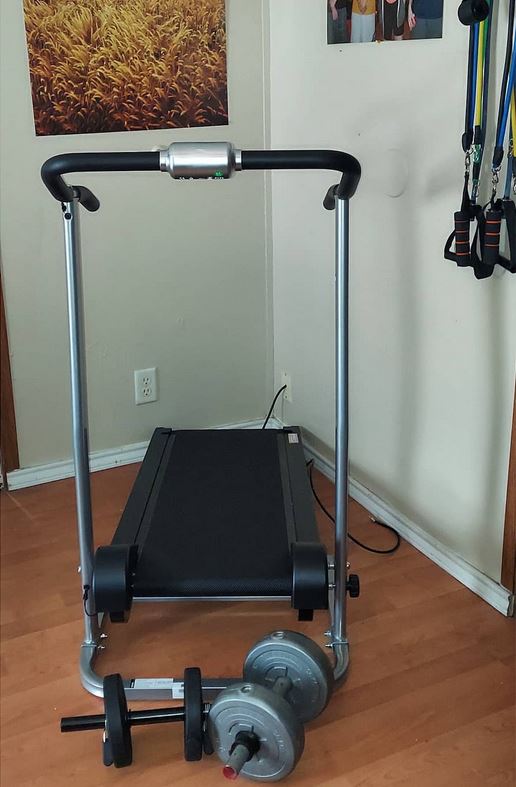
These look like scaled-down typical treadmills and are intended for people who want a basic machine to use at home. These machines don’t have a motor or large screen. Some don’t have a screen at all!
They use a standard deck with a belt running surface. And they typically have short belt lengths because they’re geared towards users who just want to walk.
Curved Treadmills
Curved treadmills (as the name indicates) are self-propelled treadmills that have a slightly curved base and use the biomechanics of running to propel the belt forward. Also, instead of a solid belt, you walk or run on a slat belt.
Curved treadmills provide a training experience that’s more similar to ground running because it reduces friction as it requires more muscle engagement in the posterior chain. So get ready to feel those hamstrings and glutes!
Additionally, these treadmills are terrific for high-intensity interval training and act as a great trainer for athletes.

Hybrid (Self-Propelled & Motorized) Treadmills
These treadmills have a motor along with a manual option. You can find both flat and curved versions. There are also versions that work only for walking and others that allow running. They have all the technology you would expect on a motorized machine with an added manual option.
This type of treadmill is great if you have multiple users in the house who condition at different levels.
Factors to Consider When Purchasing a Manual Treadmill
Before you look at what models are available, take a little time to think about what you need. Take these considerations into account:
- What’s your budget?
- Do you need a self-propelled treadmill that you can fold up and store out of the way?
- How do you intend to use your treadmill? (walking, running, or both)
- Do you want a curved treadmill for training or one of the flat-belt models?
- How long is the belt? (Many self-propelled treadmills have short belts which can make running impossible.)
- Will multiple people use it?
- What is the maximum user weight capacity?
- Do you need built-in workout programs?
What’s the years parts warranty look like? While there is less maintenance needed, you still want a good warranty.
Amidst the sea of motorized counterparts, manual treadmills have carved out a niche for themselves, capturing the attention of fitness enthusiasts, cost-conscious consumers, and eco-conscious individuals. They offer a unique set of benefits that set them apart from their automated cousins, making them a top choice for those looking to stay fit without the fuss.
Read Next: 6 Best Manual Treadmills for At Home Use >>
Looking for more treadmill help?
Try a search in the top right or check out one of these helpful posts:
- 7 Boredom Busting Treadmill Workouts
- Benefits of Treadmill Training
- Treadmill vs Outside Running
- Treadmill Training Guide – Tips and Workouts to Maximize Your Time
- NordicTrack vs Peloton: Which Treadmill is Better for You?
- Why Do I Run Slower on A Treadmill?
Other ways to connect with Amanda
Instagram Daily Fun: RunToTheFinish
Facebook Community Chatter: RunToTheFinish
Sign Up to Receive a Weekly Newsletter with Top Running Tips and Laughs



 9 Exercises for Glute Warm Up Before Running