
Comparing Mizuno vs ASICS is like pitting two very talented experienced runners against each other. Both have had the stamina to go the distance, but who will win can change by the day.
Both brands are known for their quality and offer a variety of models to suit different needs like overpronation, cushioning, and various styles of running. You’ve likely seen them in the running store and wondered why one would be better than the other.
It is going to come to do fit, technology and comfort.
The Main Differences Mizuno vs ASICS
Mizuno and ASICS offer similar features and models for all kinds of runners, from the casual runner to extreme marathoner to the flat-footed or high-arched. I break down the differences in more detail below, but here’s a quick overview:
Mizuno Running Shoes
- Overall shoe fit is in line with other traditional shoes like Asics, Brooks
- No shoes lower than 8mm heel drop
- Has stuck to some tried and true models
- Famous for the Wave technology
- No trail running shoes
- Well known across a variety of other sports from golf to swimming to volleyball
ASICS Running Shoes
- More narrow fit, especially in the heel and midsole
- Most ASICS are 8mm to 10mm, but they have a few that are 5mm
- Famous for its GEL technology, which provides shock absorption
- Designs a variety of shoes for many different sports
I’ve worn both brands and will add some personal thoughts, along with links to detailed reviews.
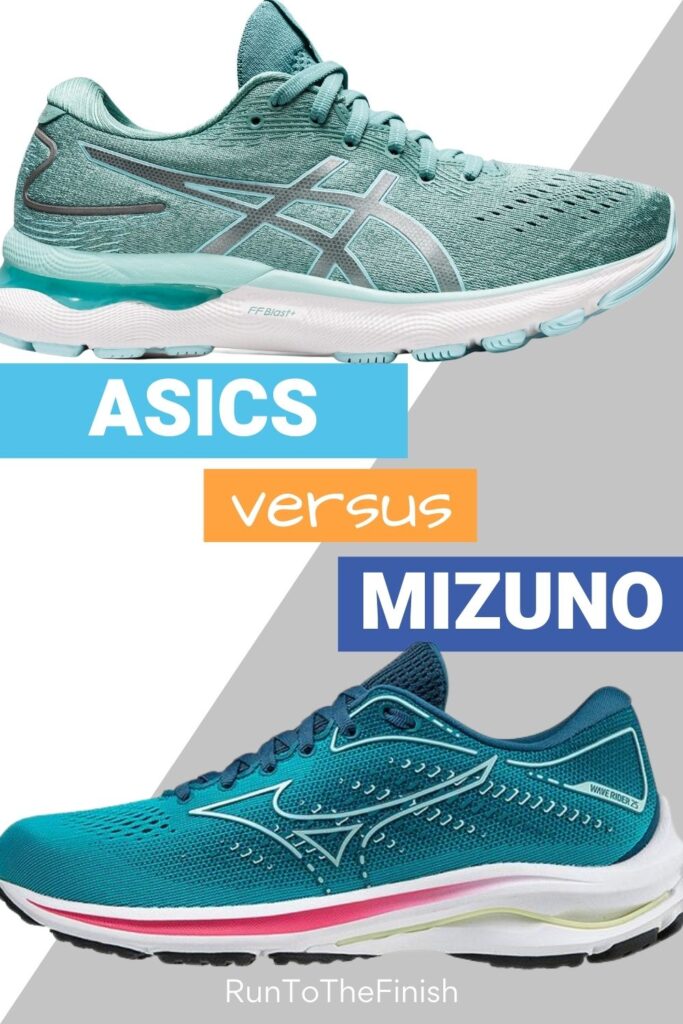
Mizuno vs ASICS Feature Comparison
Both brands have been around for a very long time and are leaders in running shoe design. They both offer various technologies to aid with comfort, support, stability, and cushion. Where they differ most are in the fit.
The following breaks down each shoe based on the components buyers need to consider when purchasing a running shoe.
It’s gonna get a little TECHY…so you can just skip on down to the specific model comparison if you want, but personally if I’m shelling out $150 for shoes, I kinda want to know why.
Durability
The lifespan of shoes from both companies is fairly comparable.
- Mizuno says a casual runner of 20MPW should get about 6 months out of the shoes.
- ASICS recommends swapping out for new shoes every 450 to 500 miles.
Determining when to replace running shoes, of course, all depends on your gait, weight, and whether you run mostly on trail or road.
Breathability
Mizuno uses two different technologies to maximize breathability. The first is their Drylite,which pulls moisture away from the body to keep cool and prevent blisters. The second is the Mizuno CoolTouch which is designed to speed dry time.
ASICS Ortholite Lasting material provides a plush underfoot cushion while managing moisture build up from sweat, allowing for maximum breathability.
Fit
Both brands have a very similar fit. They don’t offer a wide toe box like Hoka, Altra or even some Brooks. They are often described as a bit more snug or for a narrow foot.
ASICS has an external heel clutch for targeted fit and support, while the Gel technology allows for foot movement in various directions as the foot transitions, reducing heel strike.
ASICS also features a shoe fit guide, but it takes a little sleuthing to find (you’re welcome). While I have not been able to find any kind of shoe finder for Mizuno.
 This is an older, yet still very USEFUL graphic from the Huffington Post.
I forget we may not all know the lingo when talking about different components of the shoe and why they matter.
Cushioning
Mizuno is all about their Wave Technology. In fact, it’s visible in every shoe when looking at the midsole from the side. According to the brand, here’s why it’s so amazing “The basic structure of the Wave allows the cushioning midsole to disperse the impact forces of running by spreading it out more evenly through the shoe.
Dispersal of the impact forces over a wider area, allows for a smoother heel-toe-transition and because of the Wave, the foot doesn’t sink into the midsole, allowing for energy savings.”
They actually have 3 different wave styles depending on the desired amount of support or cushion.
ASICS uses Flytefoam technology that provides bounceback and responsiveness with each step. The two technologies are fairly similar, some would say both are a little less cushioned than other brands.
The company has been using their famous Gel technology for more than 30 years. It works well to absorb the shock with each step.
Stability
Mizuno also utilizes the Wave technology to provide support to the shoe. They simply change the type of Wave.
ASICS shoes provide stability through a dual density midsole system called Duomax, which enhances support and stability. That, along with the external heel clutch allow the foot to continue its natural movement while running.
Affordability
The prices between the two brands are fairly comparable. Mizuno prices range between $140 to $170, while ASICS start at a slightly higher price at $110 to $160.
The most popular models for both brands are priced toward the higher range.
You’ll notice that every brand offers a range and this is indeed due to a difference in technology and where they sell the shoe. They know that the big box store can sell the shoe with less in it, while the local running store needs to be best for dedicated runners.
ASICS Vs Mizuno Running Shoe Models
Now that you know more about each brand, let’s look at their top models in each of the main categories. There’s no winner declared here because all are great shoes, it’s just about which one is best for your foot.
Did you notice I even said the brands in reverse order this time…seriously no favorites, I have run in both brands many different times over the years.
Stability Running Shoe
Very few brands still offer such high heel drop, so for those who like that you’ll find both the top models from these brands are higher.
👉ASICS GEL Kayano
The GEL Kayano is now in its 32nd iteration and known as one of the best stability shoes on the market. Great for overpronators seeking stability, the GEL Kayano is an ideal shoe for marathons.
It’s more cushioned than most stability shoes and thus has remained a favorite of many runners for a very long time. To be clear, it’s not that plush max cushion feel, but a moderate underfoot feel that allows for pronation correction.
The fit is in line with most shoes, but you will notice a bit more of a heel lock. This is again to help with that foot pronation without over correcting.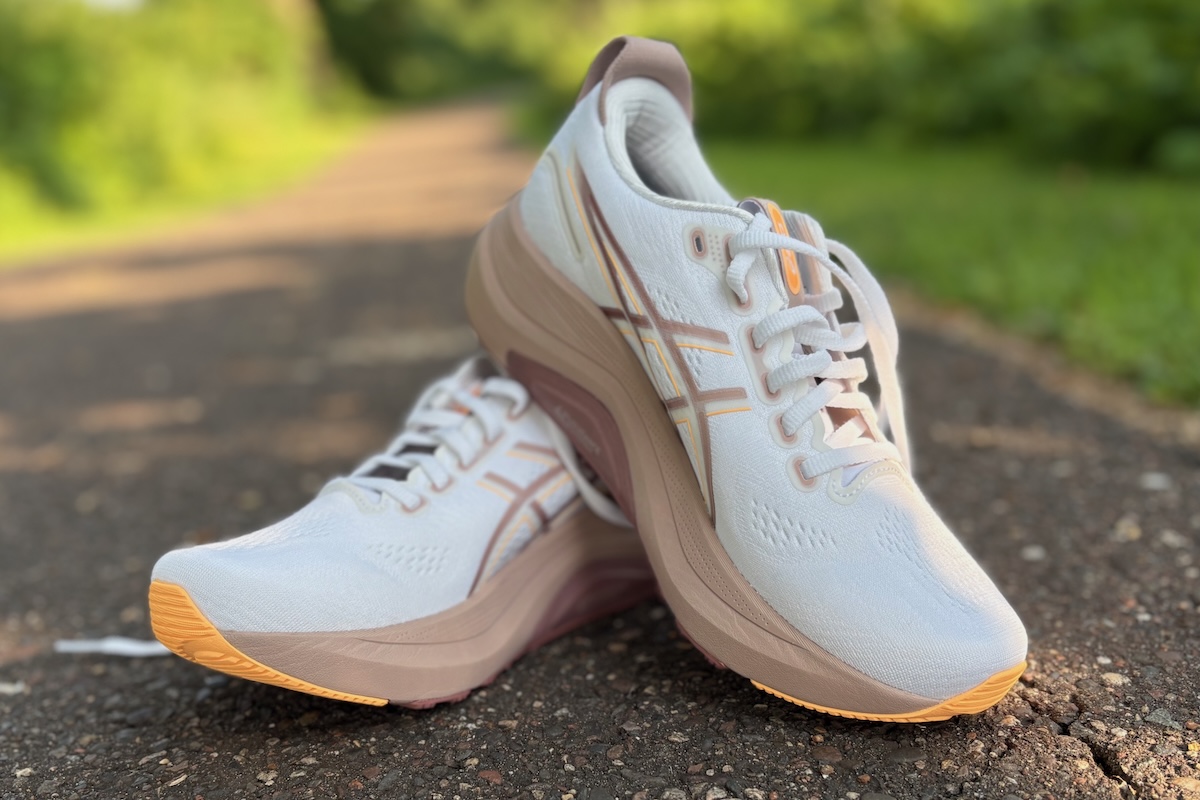
- Weight: 10.7 oz Men’s, 9.1 oz Women’s
- Stack Height: 40 mm
- Heel Drop: 8 mm
- Available in nine colors
- Available in wide and narrow
- Available at Asics.com for $165.00
- Read our full review of the Asics Gel-Kayano 32 here >>
👉Mizuno Wave Inspire
This is one of their long time shoes, which has changed some with technology, but not a ton. It’s a firmer feel as you might find in many stability shoes. This is a stability shoe where you will notice the firm plate helping to keep you in alignment.
Reviewers have said that this shoe provides a slightly wider feeling to the forefoot. It’s designed to be a daily trainer for distance runners. Though you may find the weight and moderate cushioning not ideal for marathon long runs.
- 12mm drop
- 9.1 oz women’s, 10.7 oz men’s
- $140

Neutral Running Shoe
👉Asics Novablast 5
The Novablast has been a winning max cushion shoe from Asics since it first launched and they have continued to increase the amount of cushion in the shoe, while working to drop the weight. It’s not going to be the plush shoe you’ll see below, but it’s a great amount of cushion in a weight that’s going to translate to a lot of miles for the average runner from training even to race day.
The 5 has a completely new full length midsole with their FF Blast Max foam. Again, I like that this shoe is a more responsive cushion and you don’t sink in to it so much.
While this is a neutral shoe, with no guiderails or anything for stability, it absolutely has some of that built in to the design. The width of the platform from toe to heel reduces pronation and provides a really good ride.
- Heel toe drop: 8mm
- Weight: 7.9 oz women’s, 9.1 oz men’s
- Stack Height: 41.5mm
- Read my full review of the Asics Novablast 5 >>
- Available at RunningWarehouse.com $160 (my favorite for easy returns) and on Asics.com
👉Mizuno Wave Rider
If you haven’t caught on yet, they stick to what works. This shoe is currently on it’s 29th model.
Those who are looking for a little cushion and just a smidge of support are the fans that keep this shoe going year after year. Instead of forcing you in to any type of strike, the platform simply helps provide a little more stability.

This can be great for newer runners or those coming back from injury who need to continue building hip and glute strength. It’s not a plush ride, but has enough cushion to make it comfortable for long runs.
- Weight: 9.3 oz Men’s, 8.0 oz Women’s
- Stack Height: 39mm
- Heel Drop: 10 mm
- Available in 4 Colors
- Available in wide (D width for women, 2E for men)
- Available on mizunousa.com for $150
- Read our full review of the Mizuno Wave Rider 29 here >>
Cushioned Running Shoe
👉ASICS GEL Nimbus
This shoe will appeal to most runners looking for a neutral fit and some MAX Cushion.
This is the plushest shoe in their line up with a great big old stack height and we’re here for it. The most recent model feels like a great update to a shoe that will carry a lot of runners over long miles with foam that’s durable and a fit that isn’t overly soft.
 With the 42mm stack height, they did manage to retain a feeling of stability. The firmness that I wasn’t a huge fan of with the last one (because why should a max shoe feel firm) is gone and now it’s just a big cushioned ride. For me personally, I can’t say it’s a shoe I’d wear for anything other than easy runs. I certainly wouldn’t turn to it for tempo work or a race where a PR is the goal.
- Heel toe drop: 8mm
- Weight: 9.2 oz women’s, 10.7 oz men’s
- Available at Asics.com and RunningWarehouse.com $165
- Read our full review of the Nimbus
👉Mizuno Wave Sky
The Sky would be considered one of their newer shoe models with just 5 models. Yet, it’s one that many runners are enjoying because it provides so much more cushion while maintaining the stability they have long loved from Mizuno.
Some reviewers found the fit to be a little more narrow on this shoe than other models. It also has a lot more traction on the sole than other models.
- 8mm drop
- 9.1 oz women’s, 10.7 oz men’s
- $170

Carbon Fiber Plate Shoes
Are they cool new technology, yes. Do they last as long as your other shoes, nope.
So if you want to test these out use them for speed work and then race day!
Watch my detailed video on how Carbon Fiber Shoes work.
More Mizuno Running
Rihachi Mizuno and his younger brother Rizo actually started in 1906 as a store selling things like baseballs in Osaka, Japan.
1910 through the 1970’s they continued to build in the baseball and golfing industries. Finally becoming large enough to enter the stock exchange and open additional factories.
It was in 1981 that the Mizuno Run Bird shoe was first introduced. They continued to have growth including some great success on the track, but the company was still predominantly focused around golf.

In the early 90’s they were focused on setting themselves apart and getting back to simplicity. “This Wave technology was the opposite of what Nike Air was,” continues Le. “Nike Air was a big air bag that cushioned the impact of running but the Wave Plate stretches out upon impact and propels the runner forward as it returns to its regular waved shape.”
The brand continues to focus on sports performance and what they call sports style.
More About ASICS
Founded in 1949, by Kihachiro Onitsuka in Japan, ASICS is an acronym for the Latin expression “Anima Sana in Corpore Sano” (“healthy mind in a healthy body”).
The company released a basketball shoe in 1950, followed by running shoes in 1953. Among those running shoe products included the Onitsuka Tiger, still a popular shoe today, though mainly used as a casual shoe as opposed to a marathon shoe.
Today, Asics designs a wide variety of shoes including: running, tennis, volleyball, wrestling, and golf.
How to Choose the Best Running Shoe?
ASICS and Mizuno are the two long time trusted running shoe brands, but more important than brand is the fit of the shoe.
Your gait and feet will likely change over time and you may need to change shoes.
This is also why I recommend rotating through several pairs of shoes at once.
And remember, just because these are two of the most well known brands on the market, there are still plenty of other shoe brands to select from if neither Mizuno nor ASICS has the right shoe for you.
Keep in mind that shoe design can change, even with the same model, so always assess how the shoe fits every time you replace a pair.
Looking for more running shoe reviews?
For more help selecting the right shoe for you, don’t worry, I’ve got you:
- Best Trail Running Shoes
- Top 5 Marathon Running Shoe
- Nike VS New Balance
- On Cloud vs Brooks
- Minimal or Maximal Running Shoes: Which is Right for You?
Other ways to connect with Amanda
Instagram Daily Fun: RunToTheFinish
Facebook Community Chatter: RunToTheFinish
Sign Up to Receive a Weekly Newsletter with Top Running Tips and Laughs



 Join a Running Group: Tips to Eliminate Fears and Find a Club
It’s been a few years since I ran in Asics, but found I could only put around 200 miles on them before I had troubles, but could easily put 500-600 on Mizunos. I would love to know if others have similar experiences with the newer Asics shoes.
that’s really interesting. I’ve always been able to get around 500ish.