

After another Physical Therapist pointed out that women are more prone to running issues due to our hips, I began to wonder if this was entirely true. Do women run differently? Why are men faster than women? Should we simply accept that this is how it has to be?
There are a lot of variables to talk about when comparing any two runners, let along trying to compare large swaths of the population.
In order to do this, I dug in to the research and reached out to former elite runner Tina Muir, who had a lot of experience training alongside male runners. This allowed us to provide both the research and personal info to help better understand this question.
Male Vs Female Running Times
When Tina considers the differences between men and women, she recalls the many occasions in college where she destroyed some of the guys on the team in every workout. Yet somehow they would run 15:30 5k, and she would run 16:10.
How was that fair?
What are a few of the major differences between men and women that could contribute to those race times?
Unfortunately, women are at a disadvantage from the start due to a few biological factors, but there are also some potential advantages to being a female that you may not have considered. 
Let’s look at some of the top running times to first understand why there is an assumption that men are faster. Currently that’s because at common distances they hold the faster times.
This is likely due to a combination of biology and MORE TIME of men being able to compete in the sport. We see with each passing year that these numbers are being lowered by both genders.
These are the current fastest male and female race times.
[wptb id=63105]This isn’t a post to pit men vs women and find a winner.
Instead, we’re looking at the physiological differences that might help us understand why we ladies can train for months and our male friends can come join us without a single training run and keep up!
8 Gender Differences in Running
Now we try to further explain why males are faster than females in many of the elite and professional runner categories. Of course, all of the physiology applies to the everyday runner.
But there we need to take in to account a lot of other factors like lifestyle, total training time, height, weight, etc.
Heart Size
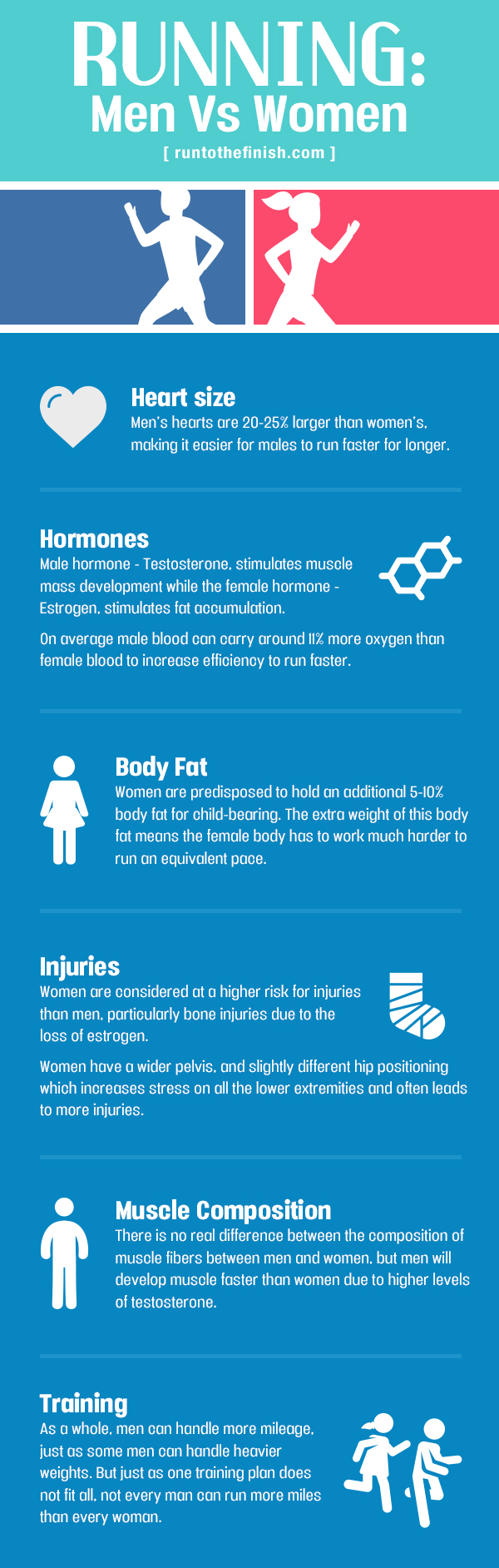
Men’s hearts are 20-25% larger than women’s, particularly in the left ventricle.
This increases the ability to pump oxygenated blood around the body to be used in the muscles, making it easier for males to run faster for longer.
Hormones
Among boys and girls run times are often very similar and this is largely because they have not hit puberty where there is a shift in hormones.
The primary male hormone is testosterone, which stimulates muscle mass development. Testosterone also increases the concentration of red blood cells, and hemoglobin, both critical for transporting oxygen around the body.
This means that on average male blood can carry around 11% more oxygen than female blood to increase efficiency to run faster.
The female primary hormone is estrogen, which stimulates fat accumulation.
Estrogen does have one big advantage over testosterone; it is an antioxidant that fights some forms of free radicals around the body. Unfortunately, our hormones also make women more susceptible to low energy availability. We will notice energy deficits more and can easily find ourselves in what’s known as the female athlete triad when under fueled and overtrained.
Lung Size
Women tend to have smaller lungs. That leads to a lower meaning VO2 max, according to a 1998 study in the journal Medicine and Science in Sports and Exercise.
This means that the amount of oxygen produced as exertion levels rise is higher in males. The more oxygen going to our muscles the better they are able to perform.
Body Fat Levels
Women are predisposed to hold an additional 5-10% body fat for child-bearing. The extra weight of this body fat means the female body has to work much harder to run an equivalent pace.
In fact, the average marathon time for males is 4:22 and the average marathon time for women is 4:47. Entirely due to body fat? NO. But again, part of all the things we’re diving in to here.
Injury Risk
Women are considered at a higher risk for injuries than men, particularly bone injuries due to the loss of estrogen (especially if amenorrhea – loss of menstrual cycle is also present).
Additionally, as Amanda’s Physical Therapist pointed out women have a wider pelvis, and slightly different hip positioning which increases stress on all the lower extremities and often leads to more injuries.
Another good reason to do those hip strengthening exercises!
Ever wondered how running is different for men vs women? What benefits does each gender have? #running #runchat Share on XMuscle Composition
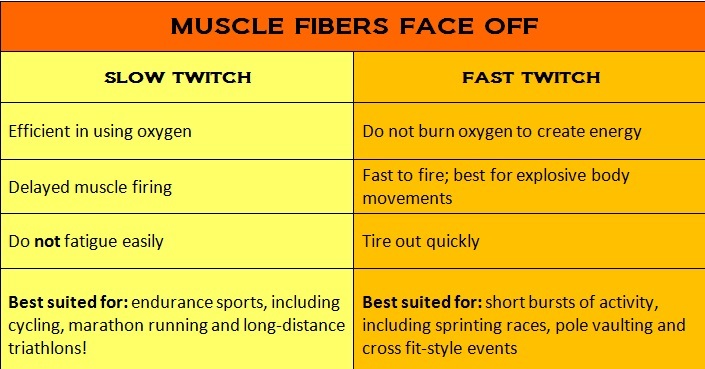
Not only will men will develop muscle faster than women due to higher levels of testosterone, but they have more fast twitch muscle fibers. These are the fibers we utilize for speed.
Meanwhile the female’s higher proportion of slow twitch fibers could explain why we excel at longer races and are less likely to slow down as the race goes on. It’s also why many women can handle MORE volume.
One researcher said that a man’s leg is 80% muscle while a female’s in 60%. Based on the fact that my calf of pure muscle is the size of my husbands thigh, I’m not quite as on board with this theory.
Training Adaptation
Women start from a lower baseline when it comes to strength, which means we have to put in more work to get to the same level of strength and power. However, it does seem that’s doable with a good training plan.
The theory used to be that men could handle more mileage, but as noted above we now see that women can handle as much or more.
But just as one training plan does not fit all, not every man can run more miles than every woman. Tina used to run around 80 miles a week during marathon training, and most men could not handle that kind of volume.
In Tina’s professional running experience, the access to coaches is the same between men and women. Some coaches even prefer to coach women over men, as there are less ego issues!
You can see more of this by looking at the average mile times over the years for men vs women.
Participation Levels
There has been increasing debate in recent years about whether women will eventually catch up with male performance times.
Although the factors I’ve noted may make it seem almost impossible, women currently make up 45.7% of participants in the marathon and 60% in all running events. Even 5 or 6 years ago that number was less than 30%!
In addition to this, the first women’s marathon was only in 1972, compared to the first men’s marathon in 1896! The history of running gives us some insight in to the possibility of catching up simply given more time.
As participation increases and more female superstars emerge, we could see the gap between men’s and women’s world records drop significantly.
Oxford University completed a study that predicted one day (2156) women will consistently beat men over long distances because we are improving at a more rapid rate. Interestingly, there are areas where women are already posting the fastest times.
Women Are Faster Than Men in Long Distance Races
The longer the race distance the greater equalizer!
In ultra events, women may have an advantage over men due to the additional fat stores than can provide an additional energy source for the body. This means that women may in the future be shown to be the better athletes in endurance events.
A new analysis was performed by the International Association of Ultrarunners and RunRepeat, looking at 15,000 ultra running events over 23 years.
Here are a few of the findings:
- The longer the distance the smaller the pace gap
- Women tend to slow down less than men over long distances
- At extreme distances women are faster than men
- Higher volume of slow twitch fibers as noted above
- Multi-tasking abilities may play a role
- Coping strategies that utilize emotion may also play a role
As we work to understand the physiology of the female body, new research will surely discover how to maximize the female physiology, lessen the gap, and continue to take down records at a much faster rate.
Lets close that gap.
I am doing my part, are you?
Thanks Tina!! At least now I feel marginally better about my husband always running faster than me with less training!
What do you think? Will women close the time gap?
Other ways to connect with Amanda
Instagram Daily Fun: RunToTheFinish
Facebook Community Chatter: RunToTheFinish
Get more running tips: Pinterest



 Beginner Speed Workouts And Tips to Get Started Safely
My husband is a physical therapist who has worked with a variety of male and female runners, myself and my twin sister included. Over the years, what he and I have come to understand is that, when it comes running injuries, it’s all about the mechanics. When you watch elite races, no matter male or female, all of the runners at the front of the pack have one of two running mechanics. Those runners are not only faster, but they also experience less injuries than those runners toward the back of the pack, who have very different running mechanics. Yes, we women do have a wider pelvis and a slightly different hip positioning, but don’t fret, ladies. With the proper running mechanics at our arsenal, we can run to our heart’s content and still avoid injury. Here’s a tip: practice, practice, practice agility drills, and remember to stay on the forefront of your foot while practicing the drills. Cheers!
Amazing Article Thanks for Sharing.
Thank you for putting this together! I get so frustrated when my husband *occasionally* decides to go for a run with me. He does little to no training, and then just leaves me in the dust or runs circles around me. During the last 5k we ran together, he actually ran backwards in front of me part of the time: https://runningmybestlife.com/race-recap-sweethearts-5k/. I have to remind him (and myself) that our body types are different and therefore the pace will be different!
Thanks for collecting and sharing these things. It’s good to hear that I’m not the only one with this “problem”.
My boyfriend is running less then half of my training, and he can keep up with me in all our races, which at the beginning made me sad and bit disappointed in myself and in my training. Since he is taller then me, his legs are longer, so we did a small test and counted the steps needed for him and for me to cover 3 meter distance while running: he did it in 2 steps, I did it in 3 steps. Since then we are making jokes about how fast my “tiny” legs should move to run with him. :)