

Running is one of the most popular sports worldwide. In the United States alone, participation peaked around 60 million in 2017, and dropped to around 50 million by 2020. Which is still a staggering number for a sport that has such a long varied history. Which often leads to an interesting question of when was running invented?
Was it really invented at all?
The answer is no, running wasn’t “invented” in terms of an idea someone once had, or it being created by a person.
It began out of necessity for survival millions of years ago and evolved over many years into a sport we now love. It’s simply a natural ability all of us humans have (and even animals do!).
Modern running and races, however, have a long and fascinating history, from the rise in competition to the marathon boom, to the participation of women in the sport.
When Was Running Invented
Let’s look at the many iterations of running. Running was “invented” in different ways depending on the goal…like survival to communication to sport. You’ll see below some key dates like the first running Olympics in 684 BC, but that was NOT the first competitive running event.
Who invented running?
For some odd reason there’s a meme saying, “1784 Thomas Running invented it when he tried to walk twice at the same time.”
I don’t even know what this means, but it’s a lot like when my husband says the game corn hole was invented by a sea captain called Captain Cornhole.
Silliness.

But from what I can tell, Thomas Running is a social media creation that capitalizes on the trend of humorous posts mocking the notion that people invent when they attempt to do two things simultaneously.
But, as you may have guessed by now, no one can take credit or claim the honor for coming up with the idea of running.
Since running wasn’t invented, it’s easier to learn about its history of running by looking at when it started rather than who started it.
Origins of Running
If you’ve read the book Born to Run, that’s probably the first time you heard about the origins of running.
In the book, author Christopher McDougall explained that running likely began some 2 million years ago when our ancestors ran as a method of survival, both to escape predators and to chase down prey.
According to a widely accepted theory based on the idea of persistence hunting, humans developed the ability to run so they could pursue their prey until it was exhausted.
People may seem slow when compared to antelopes, jaguars, or even furry pets but over long distances, athletic humans can outrun antelopes and horses.
And so, persistence hunters would set off in groups and utilize their superior endurance to catch dinner. This was the preferred method because they weren’t as stealth or as strong.
- chases could take hours
- members of the group would switch off as the lead runner to maintain the endurance of the group
- eventually wearing down the animal
Paleoanthropologists have conducted research on fossils that confirm this theory, showing that running shaped our anatomy and that running was born out of a necessity to survive.
Do Humans Have Better Endurance Than Animals?
Some 4.5 million years ago, early ancestors of humans evolved to walk on two legs, giving homo sapiens a body designed for running. But more importantly it’s the sweat glands all over our body that allow us to efficiently cool ourselves for better endurance.
Since we’re on this fun fact of animals and running:
- Did you know Usain Bolt couldn’t beat a cheetah in a 100M dash?
- In Wales there is a 22 mile race of man vs horse each year and the top runner usually finishes only 10 minutes behind!
- Ostriches and household cats can run up to 30MPH!
- All reasons I don’t have to be faster than my non-running friends, my endurance will save me from that bear or Zombie.

When Did People Start Using Running As A Symbol?
Running was used as a symbol by the ancient Egyptians as early as 3100 B.C. in an unusual festival known as the Sed festival.
The Sed festival, also referred to as Heb Sed, was a massive celebration of the pharaoh’s continued reign. Most of the time, they started 30 years into a pharaoh’s rule and happened every 3 years until he died.
This massive festival had several stages. The pharaoh would offer numerous sacrifices to the gods. He would then hold an extravagant re-crowning ceremony to signify the continuation of his reign.
However, the running aspect was a course designed for the pharaoh to run himself. A course was built to represent Egypt’s lands.
The pharaoh would complete four laps. During the first two circuits, he would wear the royal regalia of Upper Egypt. He would wear clothes from Lower Egypt for the last two.
It is unknown what would have happened if someone had dropped out of the race, but many historians have their own theories. Some people believe that the race was merely symbolic, signifying the “outrunning of old age.”
Others argue that it is more practical. If a pharaoh couldn’t finish the race, he might not have been unfit to rule. In that case, they might have been sacrificed right away to make room for a younger, more capable successor.
When Did People Start Running as a Sport?
The first known competitive running events took place sometime between 600 and 1100 BC during the Tailteann Games in Ireland.
These religious festivals honored the dead and included funeral games that included sporting events, like running, swimming, and archery. Can I just say, feel free to play games like that at my funeral…I’d be honored.
King Taharka of Egypt also made his soldiers run 100km to keep fit in the late 7th century BCE. Although the ultramarathon may have originated in Egypt, King Taharka didn’t actually invent it. He just wanted his soldiers to be fit.
First Olympics with Running
In 684 BC, the first recorded Olympic Games took place in Olympia in ancient Greece.
The one-day event was also a religious festival that honored the Greek god Zeus and included mostly track and field events, such as running, long jump, shot put, and javelin.
Running races consisted of:
- the stade race, which covered the length of the Olympia track from one to the other (200 meters)
- the diaulos (two stades or 400 meters)
- the dolichos (between 7 and 24 stades)
History of the Marathon
Ancient Egyptians, Greeks, and Persians used runners as messengers to send messages over long distances.
In the late 7th century BCE, King Taharka of Egypt made his soldiers run 100 kilometers to stay fit. Although the ultramarathon originated in Egypt, it was not invented by King Taharka. He simply wished for his troops to be in good shape.
And when it comes to a marathon (including the name itself), the legend goes a Greek soldier named Pheidippides ran from the battlefields of Marathon to Athens, a distance of 25 miles to deliver news of victory over an invading army of Persians in the battle of Marathon in 490 BC.
Apparently, Pheidippides collapsed on the floor and died immediately after delivering the news.
But really the first marathon was part of an ultramarathon.
Prior to delivering the message about the victory to Athens, Pheidippides also ran 150 miles from Athens to Sparta and back in order to request help from the Spartan troops to help in the battle (they declined as they were celebrating a religious festival).
The 240-kilometer Spartathalon race commemorates this achievement.
- The first marathon race took place at the first modern Olympic Games in 1896, and recreated the historic event, running the 25 miles from Marathon to Athens.
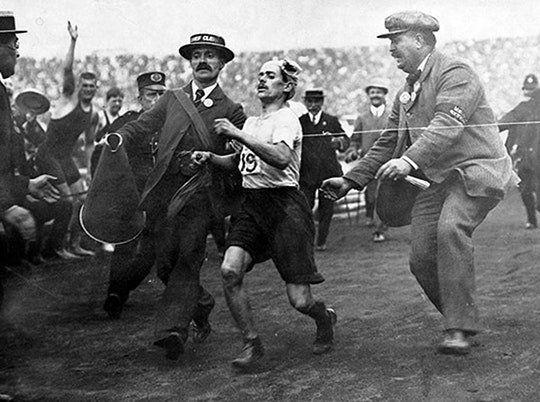
- 1908 London Olympics changed the course of marathon running. To accommodate the request of Queen Alexandra, the race started on the lawn of Windsor Castle and finished in front of the Royal Box inside the Olympic Stadium, extending the marathon distance to 26.2 miles.
- The official distance of 26.2 miles was formalized in 1921.
- 1984 Summer Olympics in LA was the first women’s marathon.
👉Learn even more about why is a marathon 26.2 miles.
Boston Marathon: The World’s Oldest Annual Marathon
The Boston Marathon is the world’s oldest and most respected marathon race, and started in 1897.
Initially called the American Marathon, the original route totaled 24.5 miles and started in Ashland at Metcalf’s Mill and finished at Irvington Oval in Boston.
- Race organizers changed the distance in 1924 to the official 26.2 miles, extending the starting line to Hopkinton, where it remains today.
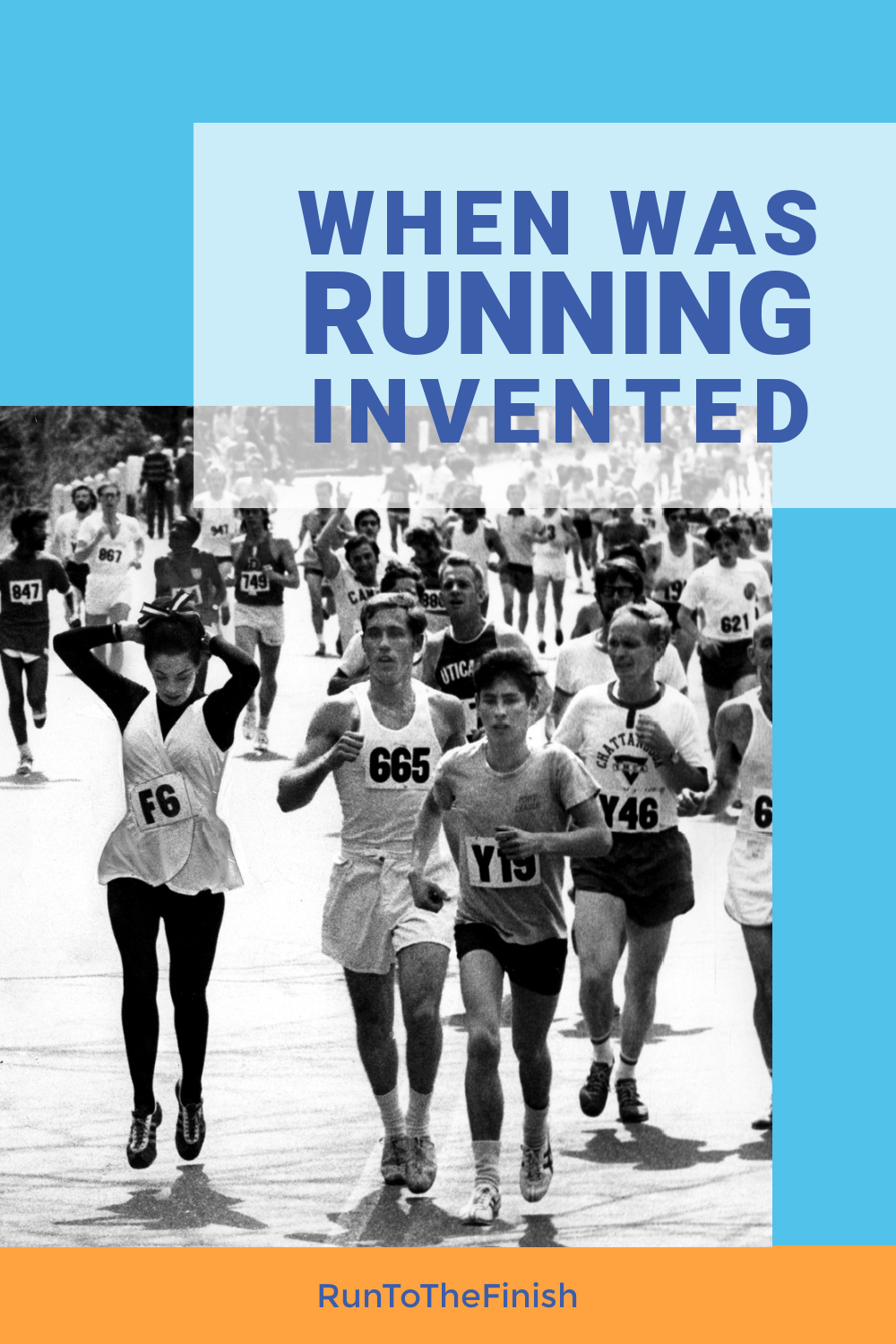
- Katherine Switzer became a household name as the first woman to run though they tried to drag her from the course in 1967.
- Now Qualifying for Boston is a goal that many runners chase. You cannot enter this race without a qualifying time (or a charity spot).
Rise in Recreational Running
Up until the 1960s, road running was mostly something athletes like boxers did to stay in shape.
A regular person who ran was perceived as odd and something to be avoided outside of morning hours because the police found it suspicious.
(Can we all just agree that most of us runners are still odd to our friends??)
1962
Modern recreational running became popularized after Bill Bowerman of Nike fame met Arthur Lydiard on a trip to New Zealand in 1962. Lydiard was an Olympic track coach and founder of the Auckland Jogger Club.
Bowerman was so inspired by what he had seen in New Zealand that he published a best-selling book in 1967, called Jogging.
The book was written when Dr. W. E. Harris suggested that running was a sport not just for serious athletes, but for anyone who wanted a healthy lifestyle.
1967
Soon after the publication of the book, medical professionals noticed the health benefits of long distance running and began recommending the sport as a way to maintain heart health and physical fitness.
1970
The popularity of the sport continued to rise through the 70s with star runners like Steve Prefontaine and Frank Shorter.
When Frank Shorter won the Olympic Marathon in ’72, it resulted in running boom of the 70s as running became popular overnight in the US. Meanwhile, Nike continued to leverage the running boom.
In 1972 the Boston and New York Marathons finally allowed women. NYC mandated that women start 10 minutes before the men, and when the gun went off, they sat down in protest.
1982
NCAA finally included women’s track and field events.
Current State of Running
After all of that where are we now?
- 24% of people say they started running simply as a way to exercise
- The average runner age has increased in the last few years to 39
- Marathon times have gotten slower, largely due to the sport becoming open to more than elite runners
- In 2019, we paid on average $92 for a marathon (sounds cheap compared to all the races I’ve seen!)
- Average half marathon time for women is 2:15 and 1:48 for men.
- Ultramarathons have grown over 345% in the last few years.
- Only 23% of trail runners are women, where in road races women are over 60%.
Stats part of a large study by RunRepeat.
There you have it.
Running was invented by different people at different times in history.
There was the person who first chose to run down an animal, the person who wanted to see who could sprint the fastest and now people who want to see who can run the farthest through crazy mountain towns…sometimes with a donkey.
Looking for more fun running reads?
- 65 Fun running facts
- What is the Fastest Mile Ever Ran
- How many steps in a mile walking vs running
- Why the good old running days weren’t so great
- What are the World Marathon Majors
Other ways to connect with Amanda
Instagram Daily Fun: RunToTheFinish
Facebook Community Chatter: RunToTheFinish
Get more running tips: Pinterest
Get every new post delivered to your inbox



 Vacation Races Global Adventure Review (New Zealand First Hand)