
As you run, many different muscles work throughout the body, and running helps to strengthen and tone them.
It’s not a replacement for strength training, but it will absolutely help you to get muscle definition and power that allows you to move through life with ease.
Understanding what muscles running works allows you to focus on them to:
- Improve your running form (think posture and stride)
- Improve your running technique (think speed and efficiency)
- Improve your running endurance
- Eliminate common running injuries
- Maximize your race day performance
And while running focuses largely on your legs, it’s hitting all your major muscle groups including your core and upper body muscles!
Read this article to learn exactly what muscles running works and to help you understand why they’re important during the gait cycle.
What Muscles Does Running Work?
As humans, we are made to run! The mechanics of our running stride in conjunction with our ability to regulate our body temperature by sweating makes us perfect for running.
Running has two key phases that influence how each muscle is worked:
- Swing Phase: Moving the leg forward and up
- Foot Strike Phase: Creating power off the ground
These two phases make up the gait cycle. The swing is when your foot is in the air, and your foot strike or stance is the phase when your foot is on the ground. And of course, none of your muscles work alone.
This is why having a weakness, tightness, or muscle imbalance can throw off your stride. Check out what each muscle does while running and what you need to know to prevent injuries.
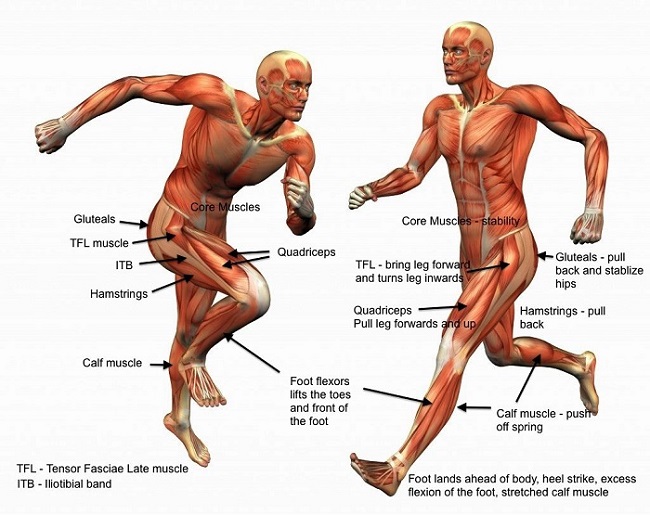
1. Quadriceps
The quads or the quad muscles are often one of the most overworked muscles in runners. They consist of a group of four muscles that run along the front of your thighs between the pelvis and knee.
These four muscles that running works include the rectus femoris and the vastus lateralis. The rectus femoris runs down the center of the thigh from the hip to the kneecap, while the vastus lateralis is situated on the outer side of the front of the thigh.
The other two muscles are the vastus medialis and the vastus intermedius. The vastus medialis runs along the inner part of the front of the thigh, and the vastus intermedius runs down the middle of the front of the thigh.
These muscles are a key part of bringing your leg forward and assisting in the knee drive during the swing phase of the leg swing.
They also help us run downhill and protect the body while working against gravity and our body weight. Otherwise, we could suffer from an injury trying to flex the knee.
And so, weak glutes and tight hip flexors mean that the quads start to take on too much of the running load. This often results in runner’s knee and fatigue in distance running. Your glutes need to be taking on the bulk of the work.
Tips:
- Stop Overstriding (learn to land under your body)
- Learn how to activate your glutes
- Check out this running technique programto improve knee drive for speed
2. Hip Flexors
In conjunction with the quadriceps are the hip flexor muscles which are a group of muscles that connect the pelvis to the quadriceps providing a key piece in moving you forward and stabilizing your body.
There are three main muscles that make up our hip flexors, namely the iliopsoas, psoas major, and iliacus. These run along the front of the hip. The rectus femoris that makes up part of the quads also help in hip flexion.
During the footstrike phase, they help your feet push off as they flex and extend while you run, and so drive your leg forward for the next stride and assist while you transition from the footstrike phase to the swing phase.
Hip flexors run into two common issues:
- Tightness that inhibits the glutes
- Weakness that limits leg swing power
If your hip flexors are weak that can cause low back pain, groin pain while running, IT Band syndrome, and even shin splints.
Tips:
- Hip flexor stretches— try adding some each day
- Glute bridgesfor total hip strength — do this prior to running
- Bird Dog movement(stability ball adds more core) — do this prior to running
3. Hamstring Muscles
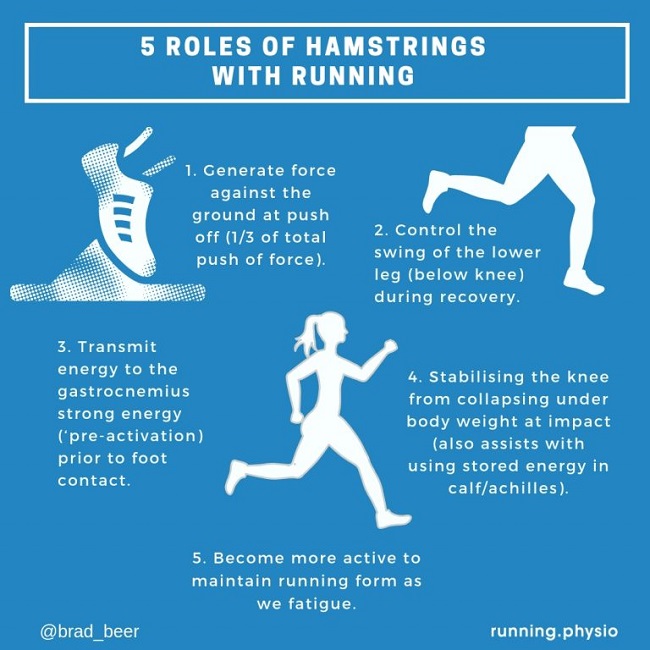
On the back side of the thigh is your hamstring is your powerhouse for pushing off the ground and preventing the knee from hyper-extending during this movement.
We get so focused on the knee drive, that we often forget about the power that comes from the quick ground push-off.
If you’re looking to learn to run faster and more efficiently, having strong hamstrings is key.
Many women are quad-dominant which makes our quadriceps overcompensate. This is why it’s essential for all runners, and especially women, to work on strengthening their hamstrings and increasing the range of motion.
Tips:
- Stop overstriding — this places more work on the hamstrings
- Hamstring curl with stability ball– improve muscle strength
- Resolve hamstring painor tightness
- Best post run stretches
4. Calves
Located in the lower leg, the calves take on a lot of load during each stride of the run. They consist of two main muscles, namely the gastrocnemius and the soleus right underneath it.
The muscle that runs down the front of your shin is called the tibialis anterior, and helps lift the heels off the ground during the swing phase.
The calf is part of absorbing the impact through your foot, then lifting the heel to push onto your toes and power off the ground. In fact, your calves may lift your heel up to 1500 times per mile!
Our calf muscles will fatigue faster than other muscles due to their size, which is why it’s not uncommon to have calf cramps from running or tightness if our form is wrong.
Additionally, any weakness in this area can lead to ankle or Achilles tendon pain or even shin splints. And when your hip flexors are tight or you have weak glutes, your calves will overcompensate for them.
- Stop running on your toes and overtaxing the calves
- Stretch calves after runs
- Calf raises on a stair or holding weight – 1 or 2 times per week
- Improve your shin strength
5. Glutes
The glutes are a primary force in injury-free running. They are made up of three muscles, namely the gluteus maximus, gluteus medius, and gluteus minimus.

All three are important for helping to raise your leg during the swing, push off the ground and stabilize your hips to prevent knee, ankle, and hip pain.
These muscles also work together as a group to help stabilize the hips and pelvis in all three planes of motion.
Weak glutes lead to a host of problems and are one of the most common issues cited by Physical Therapists when runners come in with issues!
For example, when your glutes are weak they allow your knee to fall inward during every step of your run which leads to knee pain or ankle pain.
Stop neglecting them in your strength training or your warm-up routine. Having strong glutes can assist you in having a powerful stride and even help you when running uphill.
- Continue with the glute activation exercises
- Resistance band exercises for hips and glutes
- Utilize a PT ball to release tight glute muscles
- Do more incline walking or running to force glute work
- Try the 30 Day Runner Core Programfor hip, glute, and core exercises
6. Core Muscles
If you think you’re legs are doing all the work then you’re missing out on a big piece of your power in running. Your core muscles are more than just about having six-pack abs.
A strong core will improve your speed and prevent all kinds of pain. Core muscles worked when running include the rectus abdominis, internal and external obliques, pelvic floor muscles, and also diaphragm.
Since your core is essentially your entire trunk, it allows your body to work efficiently together. They stabilize and support the trunk and spine while you’re running.
Having a strong core not only improves your running form by helping with your posture, but also improves breathing mechanics, and helps provide a stable base for our arms and legs.
We’ve partially covered many of these muscles in other areas, so a few more things are specific to the core.
- Consistently include core workouts (try this 10 minute pre-run system)
- Utilize a dynamic warm upto ensure muscles are engaged and firing
- Work on not swinging arms across the body while running
- Think about engaging the core when running hard, do not keep your abs tight during all runs
- Learn exactly what muscles are involved in your core
Can You Get Abs From Running?
Yes, but not just by running more.
There’s actually a process that’s going to make abs from running more likely:
- Strength training with heavy weights
- Consistent core workouts (even with weights)
- Running sprints and intervals
- Less distance running (too much running increases cortisolwhich leads to belly fat)
- Lose weight – I mean honestly getting body fat to a certain level through nutrition really is the biggest factor
7. Upper Body Muscles
Even though running primarily works the lower body, your upper body also plays a significant role in the whole process. Upper body helps you drive forward and your arms move while running.
They help build momentum and maintain pace. The upper body muscles that are most involved in running include the latissimus dorsi, deltoids, and shoulders.
Strength training for runners allows you to maintain good posture as you fatigue over long miles, stabilize the core, and find power on your uphill.
Of course it’s not working your muscles like a bicep curl, but if your muscles are weak and begin to fatigue then that will mentally work against you!
- Strength train at least twice a week while base building
- Alternate between heavy weights for muscle building and light weights for endurance
- Work on posture correcting exercises while working all day
That’s right, a strong arm swing means you can power uphills better and a strong back means you maintain form as you fatigue, so running is not just focused on the legs.
I think what we’ve learned today is that running is a full body exercises which is one of the reasons it can be useful when people are looking to lose weight!
But we’ve also learned that running alone does not work.
You have to cross train. You have to spend a little time on pre-hab movements. You will develop injuries if you don’t utilize these tips.
✅Instead of getting overwhelmed with what to do, remember that many of these moves recommended can become part of your warm up routine or are already laid out for you in the 30 Day Runner Core Program!
Other ways to connect with Amanda
Instagram Daily Fun: RunToTheFinish
Facebook Community Chatter: RunToTheFinish
Sign Up to Receive a Weekly Newsletter of Tips



 Apple Ultra Watch Review | Is it Good for Running?
Fascinating article. Thanks for explaining how all those muscles help us run.
Hi, thanks for this grwat article. I feel frequently my shoulders and upper back after running, as if they worjed a lot. Is it normal or due to a wrong posture (or weakness in these area)? Thanks ! Claire
Hey Claire,
It can 100% happen when running because we tense up, especially when wearing a hydration pack. During your run, try thinking to yourself relax and drop my shoulders away from my ears. Do it each time your watch buzzes for a mile. You can also do a few upper body exercises like back flys to help reinforce that posture of chest up.