
Have you ever wondered if it’s worth the investment to do a running gait analysis? I LOVE data, but it’s so easy for us as runners to have too much data and make ourselves crazy. So where does this fall?
“I saw you running.”
Errrr…
“You have a very distinctive stride.”
Still creepy.
“It’s very determined and strong.”
Oh, my gosh you are the sweetest, let’s be friends for life! Funny how you can go from skeptical to love in mere seconds. But this conversation was one that stuck with me as I’ve talked to different running experts and coaches.
Should you change your running form? Should you use orthotics or go barefoot? Cushioned? Minimal? ChiRunning? Chuck it all and run however you want?!
Running Gait Analysis Benefits
After mulling it all over, I’ve come to the conclusion that there are some components we should all incorporate to prevent injury, but I also think your stride is like a fingerprint.
It’s a little different for everyone and uniquely works for you.
This was a great article about it prior to the 2008 Olympic marathon:
“The notion that there is one way to run is not, in my opinion, correct,” said Peter Cavanagh, a professor of orthopedics and sports medicine at the University of Washington.
Constantina Tomescu, the Romanian runner who won the women’s marathon last Sunday, ran with her arms wide, elbows out. Paula Radcliffe of Britain, who finished 23rd here but set the current world record for the women’s marathon in 2003, running in 2 hours 15 minutes 25 seconds, has a head-bobbing style.
Cavanagh said there were only a few aspects of running style that could be modified to improve performance. Each can add only a quarter- to half-percent to a runner’s economy in a race like the marathon.
When to change your running form?
They two key take away from this an other articles is that:
- Changing your form when everything is working is going to have a very minimal impact on speed and possible negative impacts
- Changing your form if you are injured repeatedly can be extremely helpful
My stride has been pointed out to me numerous times, but never so amusingly as after a run with David. He proclaimed it baffling that whether I am running at 10K pace or marathon pace my stride looks well 100% the same.
While this is a little strange because there is a 2 minute per mile pace difference it’s also an indicator that I’ve found a style which seems comfortable to my body and so long as I’m staying injury free and making progress, it’s not worth continuing to over-analyze it.
I asked Sam Khamis, of the Physiotherapy Department at Tel Aviv University, some of the most common questions I receive:
Should I change my stride length?
To increase our running speed we need to increase our stride length or cadence, and even better, both.
Increasing cadence is easier achieved and will not increase the load on our musculoskeletal system compared to increasing stride length.
“Each athlete has an optimal stride length, so there is no one-size-fits-all rule.”
Using a longer step length requires adequate range of motion especially hip extension.
Running injuries can often be due to limited range of motion due to short muscle length such as hamstrings and iliopsoas which limits increased stride length, or weak muscle support of the calves, quadriceps-hamstrings and hip extensors.
Therefore, before deciding to change your stride length, be sure you evaluate your ability and your body limitations (see below).
How to choose my running stride length?
The best tip I can give which does not include a sophisticated running analysis lab, or any app is to follow these basic concepts:
- If you are hitting the ground with your heels you might be using excessive stride length.
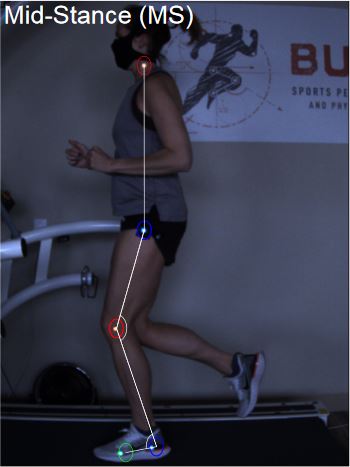
- Knee above the foot when you hit the ground should indicate good stride length.
- If you have mid-foot or forefoot landing, you should be running with adequate stride length.
- Run forwards and not upwards (in other words stop bouncing) with minimal vertical body displacement. Excessive center of mass movement will cause energy waste
- Run with a shorter flight phase. The longer the flight phase the higher the ground reaction force will be when you hit the ground.
Spend more time thinking about your running cadence and you won’t have to worry so much about your stride length.
Where do I land on my foot?
We often say that the ideal landing is mid-foot or forefoot. But the truth is you can even land on your heel IF you are landing under your body, which is the biggest injury prevention piece.
This technique requires strong muscle control absorbing the impact phase and muscle power generation at push off. If we choose to increase our running speed by increasing our step length as well, additional muscle control is necessary.
The further we extend our foot reach at foot strike in front of the body center of mass, the more muscle support is needed in order to control the impact phase of absorbing the forces at landing and then pulling the body mass forward.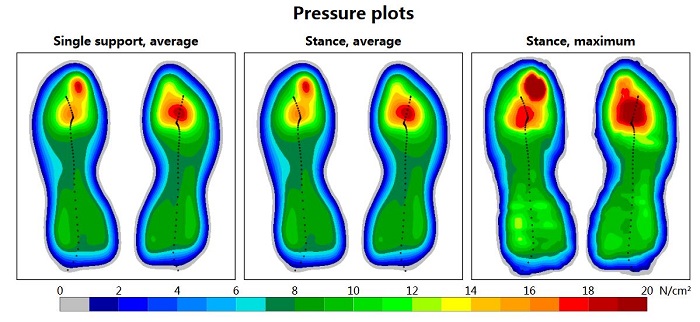
During a gait analysis you’ll find out things like:
- How much pressure do you land with
- Where are you landing with the most pressure
- Are you landing with more pressure on one side than the other
- Is your foot rolling too much inward or outward
- Are you kicking out your foot
All of these things can help to identify muscle weaknesses or mobility issues that will lead to injuries.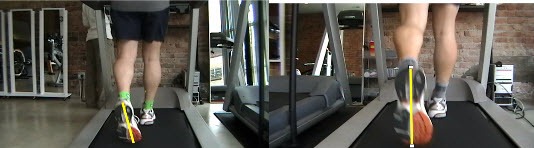 Obviously not my feet here, but wanted you to see an example of what they can find and help you correct.
RUNNING FORM ANALYSIS
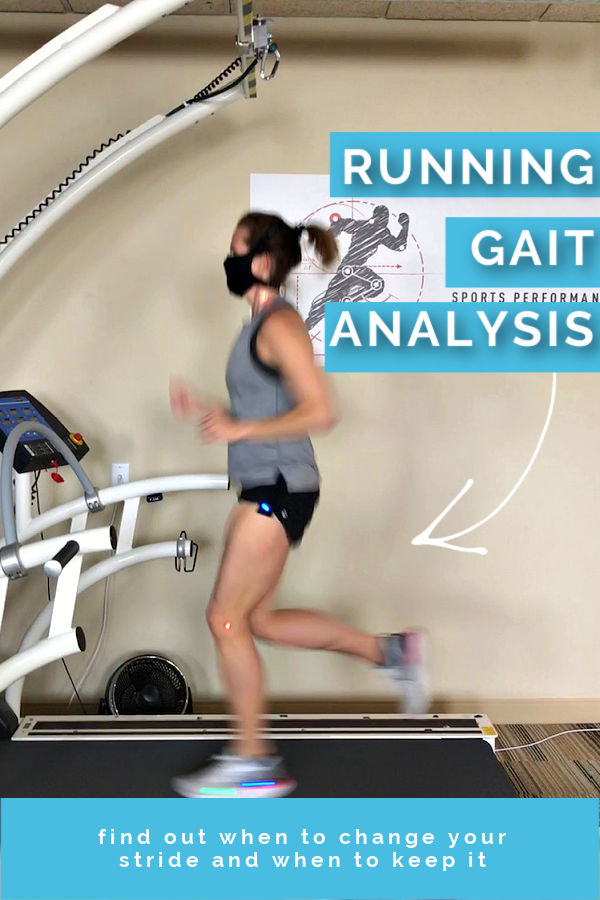
Recently, I booked full running gait analysis with the fun electronic sensors and pressure plates and all because I was curious about my own stride as I start focusing on speed for marathon training again.
Run geeking out 100%.
I’ve done others and this was by far superior, so if you are in the Denver area I can’t say enough about Build Labs PT and Caitlin.
Things I would expect in a full analysis is a review of the entire form from the front, side and back. Don’t rely on just the ankle shot provided by many running stores, that doesn’t take in to account a whole host of other things that could be happening {since you run with your whole body, not just ankles}.
What do they look at in a running gait analysis?
Before you get on the treadmill, they’ll run through some movements with you to understand your basic movements and any current limitations or areas of weakness. And then placing sensors on you, they’ll record your run and watch your run.
It’s amazing what they can see just looking at you before even pull up all the data!
FRONT:
arms cross mid-line | head alignment | heel strike or foot strike | elevated shoulders | hip rotation | ankle rotation | tibial rotation
SIDE:
Same as above plus arm position | hands | torso alignment | knee height • turn-over rate | stride length
BACK:
Best angle to look for pronation or supination | stride | knee drift | hip drop
No time for an analysis, checkout four simple tips for improving your running form>>
What really matters in a running form analysis Share on XSummary:
The data from my session was really useful because I found that one reason my low back has been hurting after speed sessions is a slight change I make in form. It was also great to hear that the work I’ve done on cadence has paid off, I land under my body and for the most part everything is flowing just fine.
DO NOT OVER THINK ALL THIS.
The more brain power you are putting in to focusing on your form, the less you are allowing your body to simply flow which for many people takes away the joy of running and slows them down.
Focus on identifying your weak muscles or potential areas of injury and work on creating strength there instead of worrying so much about forefoot, mid-foot, long stride, short, stride, etc.
Is a running store stride analysis good?
No. Stop relying on them to look at your whole body.
Just because your foot is rolling inward doesn’t mean you need a stability shoe. Maybe it’s dropping in because your hip is weak and your glutes aren’t firing.
Resolving Weak Runner Hips
One of the more common things pointed out is either pronation at the feet or what’s called knee valgus, particularly in women runners, which results in runner’s knee, IT Band pain and other issues.
Yes indeed this is another result of WEAK HIPS which is something I’m sure you’re quite tired of hearing me talk about.
In fact, I found that still have this during our visit to the Wingate Institute where a machine watched my movements in slow motion. 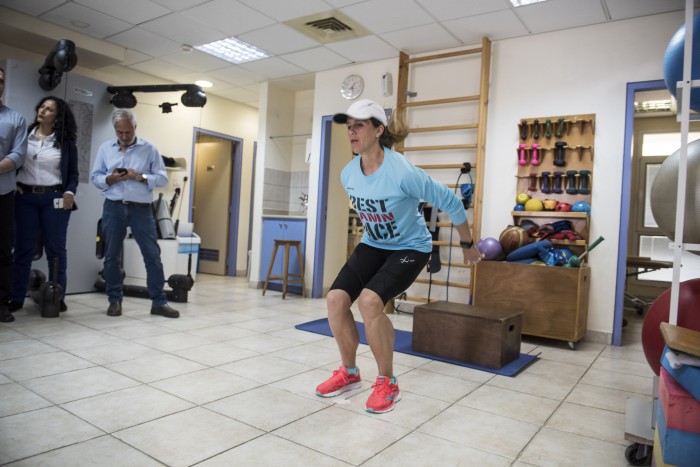 Since this is so common, I actually addressed it in detail in this post on resolving IT Band.
If you notice when lunging in front of a mirror that your knee is falling it at all or you’re having ITB issues check out this post >>
Knees and hips are the cornerstone of issues for most runners, so are there moves we should all be doing?
A couple of moves that will build strength and help us to see any imbalances include lots of stability. Do these in front of a mirror or with a trainer so you can spot when your knee is falling in!
- squat with band around knees and don’t let them fall in (see video example)
- training on unstable surfaces such as wobble board, wobble cushion in order to strengthen our proprioceptive control (in other words our subconscious will learn the RIGHT movement)
- balancing on one leg and squatting while standing
- exercising the impact/ landing and push off/ power generation phases with plyometric exercises such as jumping and controlling our landing
- progress the jumping exercise by landing on something like a Bosu
Have you ever had your stride professionally analyzed?
Ever tried changing your stride?
Want to keep working on your stride?
Checkout these posts!
ChiRunning vs Pose Method
Running Drills to Improve Speed
Hip Extension and Mobility for better stride
Other ways to connect with Amanda
Instagram Daily Fun: RunToTheFinish
Facebook Community Chatter: RunToTheFinish
Sign Up to Receive a Weekly Newsletter with Top Running Tips and Laughs



 Vitamins and Minerals for Athletes: Sport Performance Needs
I really appreciated the distinction you made on when to change form – if it's not causing injury, don't fix it! I'm never had my stride analyzed but I am a stomper so over the past years or so I've worked a bit on increasing my cadence and landing lighter. Oddly enough, when I changed from the Brooks Pure Flow to the Saucony Kinvara my stomping improved even more.
My recent post The Pros and Cons of Negative Splits in Racing
I definitely think finding the right running shoe can make a big impact!
Like you, I'm a big believer in letting form flow and not fixing what isn't broken.
Since I've been dealing with injuries, my PT and I are working on strengthening my weak areas which should lead to better form and fewer injuries.
My recent post Accounting for Bloggers: FAQ
Yes – I have had my form analyzed but a PT who is also a runner. She recorded me running from every angle and looked at my form from top to bottom. Weak hips is also my problem area and pretty much the source of all my issues.
Interesting timing! I just saw a biomechanics expert because I am chronically injured on the left side of my body. He found some form issues that stems back to guess what? Weak hips (and some other weak muscles on the left side). I’m working with some very specific exercises now to fix the imbalances. Thanks for sharing!
If it ain't broke, don't fix it, but at the same time, get it checked out before it breaks, if you know what I mean! I have certain things that I have worked on with my stride, and those changes have made me a much stronger runner, but I didn't change my stride outright. I more enhanced it.
My recent post The 80 20 Diet for Runners (80 Fresh Review + Giveaway)
I've been thinking of getting an analysis at a local PT place that offers it and that has a lot of running experts on staff. I am definitely injury prone so I really have to wonder if it's something in the way I run. That said, personally, I am all about going with "the flow." It's not at all fun for me to think about all the moving pieces while I'm running, but if there were little things I could do improve then I think it would be worth the effort.
Thanks for another great post :)
My recent post Healthy Snacks For Satisfying Your Sweet Tooth