

As runners, it’s hard to convince ourselves to slow down for a gentle yoga class. So I want to introduce you to active stretching as a great way to add strength and ensure that you’re getting a full range of motion. For my time these are the best stretches for runners.
You’ll quickly realize that if you’re running with tight hips, hamstrings or other muscles, you aren’t getting a full leg swing. Which means, yup, less power!
Research shows that muscles do not become more flexible just by stretching alone. Rather, flexibility comes from resistance stretching, which builds strength while stretching the muscles at the same time.
Benefits of Active Stretching
- Restores balance
- Increased strength and flexibility
- Better range of motion
- Improved posture
- Greater stamina
- Faster muscle recovery
- Reduces injuries
Olympic Swimmer Dara Torres has said “Ki-Hara (a form of resistance stretching) is my secret weapon.” She credits the style of these movements with allowing her to make an amazing comeback when the rest of the world considered her too old!!
5 Types of Stretching
There are generally 5 different types or forms of stretching. Let’s look at each of them in more detail:
Dynamic Stretching
Dynamic stretching is active stretching that utilizes momentum to warm up the muscles. It mimics the movements of running to increase our heart rate, raise our body temperature, warm up the muscles and improve speed and agility in runners.
This would include things like leg swings, butt kicks, or walking lunges that make for a good hip flexor stretch. All the things that as a running coach, I preach EVERY RUNNER should do before a run.
In short, you’re constantly in motion while doing this type of stretching routine. It allows your body to be ready for running and is the type of stretching to perform pre-run.

Static Stretching
Static stretching incorporates the reach-and-hold style of stretching that you might have done in school as a kid.
Unlike dynamic stretching, it is done at the end of your run as a post-run stretch, and involves stretches that you hold in place for a period of time, without movement.
This allows your muscles to loosen up, while increasing flexibility and range of motion.
- Standing fold to reach your toes
- Pulling your arm across your chest to stretch the triceps
- Standing and pulling your foot to your butt to stretch the quads
Active Stretching
Active stretching involves contracting one set of muscles in order to stretch the opposite set of muscles. Unlike other types of stretches, this one does not require the use of external force or a stretching partner.
For this type of stretching, you’ll be focusing on one muscle group at a time to stretch the opposite muscle.
We’re going to go through specific examples below to get you started!
Passive Stretching
While active stretching focuses on using one muscle group to stretch another, passive stretching does the opposite by using an external force to provide the pull for the stretch.
The resistance might be from another part of your body, a partner, or an object.
- Laying on your back, while someone pushes against your foot with the leg bent at 90 degrees
- Laying on your back with legs up the wall, completely relaxed
Ballistic Stretching
Ballistic stretching is movement-based, similar to dynamic stretching. But instead of moving a bodily part to the limit of its range of motion, with ballistic stretching you try to go beyond it.
These stretches frequently involve uncontrolled movements, which might result in injury. As a result, most runners should avoid using this type of stretching unless you’re working with a coach or Physical Therapist and these may become part of your running drills.
- Instead of a hamstring stretch where you place your leg on a bench and lean forward to hold, you’re bouncing your chest forward and back. Theoretically helping to deepen the stretch.
What is Active Stretching?
Active stretching is a way of improving flexibility. It consists of actively contracting one muscle (the agonist) to stretch an opposing muscle (the antagonist) without the use of an external force.
As the name suggests, active stretching is not passive. But what truly makes it active is not that it involves a lot of movement. The active component of active stretching is muscle engagement, which causes opposing muscles to relax and stretch.
This is accomplished by ‘reciprocal inhibition’, the body’s technique for inhibiting, or relaxing, antagonist muscles when opposing muscles contract.
There are a lot of different names for active stretching, which largely comes down to people creating programs. Resistance stretching, Ki-Hara, Moving Stretch, Self-Resistance Stretching and yes as noted above even a lot of mobility work.
The way active stretching works is that rather than holding a stretch for 30 seconds to 1 minute (static), you’ll be moving through a range of motion while providing resistance to the movement.
Instead of going for a DEEP stretch, we’re going for something that will improve performance.
Stretching and Strength in the same movement = better range of motion.
Resistance stretching both stretches and elongates a muscle, or group of muscles, at the same time. This movement breaks down the fascia and lactic acid build up that hinder movement and creates the space for full range of motion.
Following is an example of how to turn a static Pigeon Pose in to a resistance stretch.
Why Should You Do Active Stretches as a Runner?
When you’re thinking of all the benefits that come with stretching, most if not all can be gained from an active stretching routine.
Active stretching reduces muscle tension and enhances muscle extensibility. It retrains muscles to fully relax by utilizing neurological principles of movement.
This makes it possible to eventually achieve a better and more effective stretch. On top of this, it also engages and strengthens the opposite muscles.
What’s best is that active stretching does not and cannot push you beyond the limits of your muscles. This is because it relies only on your own muscle contractions to achieve a stretch since it doesn’t use any external force to help with the stretch. For this reason, the risk of injury with active stretches is notably low.
Active stretching can also be used before or during a run. Plus, unlike with long static stretching, there will be no temporary reduction in muscle strength or power.
In fact, incorporating active stretching into your warm-up before a run may actually boost your running performance. Though for most runners, I recommend utilizing this later in the day as part of your active recovery routine to help your next day of training be even better.
It’s also a lot easier to personalize your active stretching routine according to what your body needs.
For example, to stretch your quads for a downhill run you could do active stretches on your hamstring to relax its antagonist muscle (the quads).
Regular active stretching can also lead to pain relief from improved blood circulation and by reducing muscle tension. This is particularly important for runners that are recovering from an injury, or trying to get back into running after one.
5 Resistance Stretches for Runners:
- Couch Stretch – In the couch stretch, instead of just holding you will first use the leg against the couch to push away and then use the planted foot to push back
- IT Band Stretch – Since you can’t actually stretch the IT Band, this strength move is excellent for fixing issues! I demo this move at 3:20
- Hip Alignment – I shared these movements awhile back and you didn’t even know the squeezes are resistance stretching!
- Glute Stretch – How to take that figure 4 stretch up a notch
- Pigeon Pose – shown in the example video above.
- Mobility work for runners – that’s right a lot of mobility is really similar to resistance stretching
Do You Need a Resistance Band Stretch?
You can do a ton, as seen above, with your own body.
So don’t feel like you can’t get great results without a band! I never use one and have seen massive benefits from including a few of these moves in my workout consistently.
Using a band, can be helpful when you have a limited range of motion to help you deepen a stretch. For example, when laying on your back with legs in the air and looping the strap over your foot to help stretch the calf. Or to lower the leg out to the side. It’s a great tool, but not a must.
Should Runners Do Static Stretches?
While I think they can be beneficial in that post run time for slowing down and sometimes just FEEL amazing, if you’re limited on time then active stretching or mobility for runners is where you need to focus.
Here’s why we want to do active or resistance stretching instead:
“You need to activate the muscle at the end range,” explains C. Shanté Cofield of TheMovementMastro.
“You can lie on your back and hold up your leg, but you want to make sure that you’re also squeezing your quad for 10 to 15 seconds and then contracting your hamstring so that you’re getting some nervous system activation.”
How to do Active Stretching at Home?
While I was lucky to learn about this from the man who actually helped Dara Torres in her Olympic comeback, what he quickly showed me was that you can learn these moves and do them at home on your own!
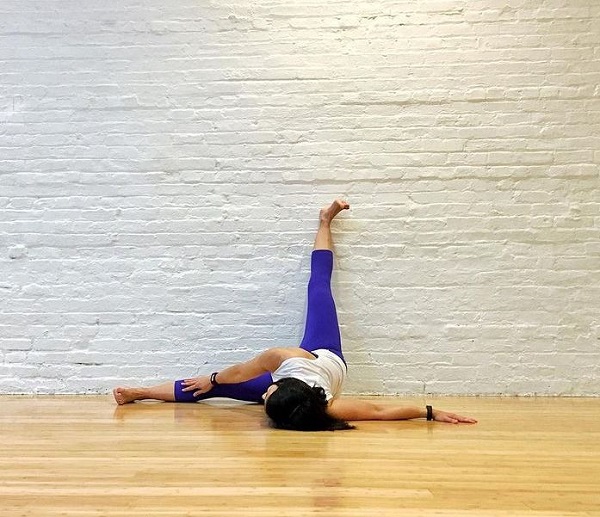 My friend Christine, a runner and yoga teacher.
- Resistance Stretching DVD – this is exactly who I learned from
- Free 20 Minute Class with Bob Cooley for Oprah
- The Genius of Flexibility Book
- Moving Stretch: Stretch Your Fascia to Free Your Body – Kindle
What is Fascia?
We keep mentioning fascia and maybe you’ve heard about it when we mention foam rolling for runners, but what is it?
Fascia is made up of bands and sheets of connective tissue that wraps around and holds pretty much everything in your body—muscles, organs, blood vessels, and nerves, keeping internal parts separated from one another.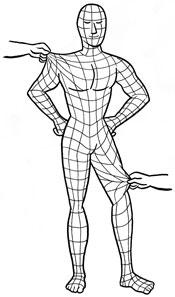
Although fascia is designed to stretch as we move, over time, it hardens and limits range of motion.
Our joints stiffen and compress daily thanks to regular inactivity from sitting at a desk, poor posture, and lack of sleep.
Repetitive moments, such as running, also cause fascia to become stuck in place because stronger muscles take over and tell your brain to stop sending signals to those smaller, supporting muscles.
Fortunately, it is entirely possible to repair the damage.
There are a variety of methods to break down fascia, including:
- Massage (including massage guns)
- Foam rolling for runners
- Yin Yoga
- Heat therapy
And, of course…active or resistance stretching!
The methods listed above work wonders for breaking down some of the fascia, and, when combined with resistance stretching, you can really strip down the scar tissue to enable blood flow, drain the lymphatic system, and regain strength and elasticity.
With free-moving fascia, you can gain better mobility, and thus run better.
My Experience with Active Stretching
Living in Miami, I worked with Steve at Innovative Body Solutions who works frequently with the amazing Dara Torres.
He calls his specific style Ki-Hara.
During our first 90 minute session, I could feel muscles burning that I hadn’t used in a while, but in a completely different way than yoga.
At the beginning of the session we tested my flexibility in a few different moves and by the end of the session I had gained almost 30degrees of movement!
The remainder of the day my legs simply felt like they were vibrating with energy. I assumed this meant I would be horribly sore the next day, but to my surprise I wasn’t and actually found that in yoga I was able to finally straighten my legs and more accurately get in many of the poses!
Ki-hara is not breaking apart fascia in the way that a foam roller does, but it is providing you with another tool that allows your muscles to break free and work more fully.
Looking for additional training tips?
- 13 Keys to Prevent Running Injuries
- Ice vs Heat for an Injury
- Best Compression Socks for Runners
- Pickle Juice for Cramps, does it really work?!
- Tired After a Workout? What’s Normal
Other ways to connect with Amanda
Instagram Daily Fun: RunToTheFinish
Facebook Community Chatter: RunToTheFinish
Sign Up to Receive a Weekly Newsletter with Top Running Tips and Laughs



 5 Essential Oils to Improve Athletic Performance
I subscribe to Ekhart Yoga (they also have a YouTube channel). I found it through YouTube and on their channel they have a collection of practices for runners that really helped my knees and IT Band. Their collection on YouTube focuses on a lot of what you talk about in this article. Pigeon Pose and IT Band stretches have really helped me from these practices. Thanks for confirming that I am on the right track!