
It’s easy to tell yourself that you’re too old to start running. Heck, 20-year-olds find themselves thinking that after that first surprisingly hard mile, but if you’re already receiving jokes about being over the hill, then why bother to start as older runners?
The question you should be asking, however, is whether you can afford NOT to run?
Clearly, I’m I biased because I freaking love what running has done for my health, my confidence, my body and my brain…obviously.
BUT the CDC is on my side as well.
Checkout these benefits of starting to run at any age:
- Lowers the risk of diseases, including heart disease, high blood pressure, type 2 diabetes, cancer, and stroke
- Maintains strength and stamina as we age
- Reduces the risk of falling and breaking bones
- Minimizes symptoms of anxiety and depression and improves mood
- Helps keep those bones, joints, and muscles strong, reducing osteoporosis in older adults
- Controls swelling associated with arthritis
In the last few years, I’ve noticed that our team now has about 50% of our athletes and runners over 50! We have plenty of older runners in their 60’s and 70’s coming through with goals too! So let’s talk more about what running after 50 means for your training.
Are You Ever Too Old to Start Running?
No, you’re not too old to start running.
Do you need to train differently, of course!!
Luckily, now you’re smarter and your mental fitness will in fact make you a better distance runner.
 Don’t believe it?
Here are some quick stats for you then:
- 50% of marathon finishers fell into the 40 or older category in 2016
- The average age for women running the Boston Marathon is 40 and 45 for men
- The 90-99 age group showed the most significant growth during the duration of a study conducted between 2014-2017, with participation increasing by 38.74 percent.
More and more often, race directors have to add new age group categories to races for older runners. Years ago, the oldest age group award went to someone 70+. Now, it’s not uncommon to see 85+.
And I personally am here for the long haul and looking to BQ by 80. :)
What is Masters Runner?
I love the title because it sounds like you’ve really cracked the secret to some special club.
But in reality a masters runner is anyone over age 40.
It changes your award groups and often qualifying times for different races. Your performances start being judged on an age graded calculator (more on this below).
Incredible Masters Running Records
Still have doubts? Let’s take a look at some bad ass older runners:
- Canadian Christa Bortignon began competing in masters track and field at the age of 72 and holds 13 world records in her age group.
- Christa’s mentor and fellow Canadian, Olga Kotelko holds more than 30 world records in various track and field events. She began competing after retiring from softball in her mid-70s and continued to compete until she died at age 94.
- Margaret Webb, author of Older, Faster, Stronger (a must read!) set some lofty fitness goals at the age of 50: Become fitter at 50 than she was as a 20-year-old varsity athlete, race against some of the fittest 50-year-olds in the world at the World Masters Games, and qualify for the Boston Marathon in 3:35, which was the time set for 18-34 year old women (in 2013)
- Pam Reed is an ultramarathoner who has won the 135-mile Badwater ultramarathon twice, at ages 42 and 43. She defeated the remainder of the entire field by five hours in 2002 and smashed the women’s record by 1 hour 51 minutes. People thought it was a fluke to have a woman win the race, so she went back in 2003 and did it again.
I could go on and on and on, but I think you’re starting to get the picture.
Running doesn’t have to stop because we hit a certain age and we aren’t precluded from starting at any point. But we do have to be smart and treat our bodies differently than at 18 to mitigate injury risk and have more fun.
9 Older Runner Training Tips
Are things different if you start running after 60 years old? Yes and No.
Even turning 41, I can’t train the way that I did at 20. And yet, I’m still gaining fitness!
Running over 50 doesn’t mean all your goals and dreams need to be put out to pasture. Instead, it means we start to adapt our training to this different phase of life. Particularly for women who are running after menopause.
How Does a Runners Body Change with Age?
- A decrease in hormones for both men and women
- Easier to lose muscle without specific training
- Takes longer to recover between hard efforts
- Balance, mobility and flexibility decline without focused work
- Muscle imbalances can more quickly lead to injury
- BUTTTTT for someone who continues to run and cross train we can off set much of this
Luckily the tips I’m about to share apply to runners of every age and will allow all of us to embrace the benefits of running as we age.
Don’t you want to be in one of those viral videos of 90 year olds bustling around a track at a masters race?!
Ok even if not, read on for the masters running tips you need.
1. Resetting Goals and PR’s
Running as you age will be different.
While some people can continue to run long distances and train for marathons, some will have better success with finding some moderation in their running.
Everyone is different, so while one runner can stay healthy and uninjured running four days a week, others will have better success with two, three, or even one day a week.
The key is to find what works for you and accept that this is the runner you are now.
- Yes, you can and should do speed work! Just a little differently.
- Yes, you can and should adjust your distance goals based on how YOUR body specifically recovers.
- Cut back on the number of races you’re doing to allow for the longer recovery period.
- Consistency is still a winning formula at any age (with your running, strength and flexibility)
- Remember not to compare to your 20 year old self, instead start using that age graded calculator!
2. Increasing Recovery Time Between Hard Workouts
“Both studies and anecdotal evidence have come to the same conclusion: We masters runners take longer to recover than younger runners,” says Masters coach Pete McGill.
One thing to do initially is plan for a bigger gap in between high intensity sessions (interval training or long runs).
I’m a huge proponent of recovery, no matter your age, but recognizing that you may no longer be able to do twice weekly speed sessions or that you may need to do only those 2 sessions instead of 6 days of running is key.
- Do more low impact cross training activities such as walking, hiking, swimming, or cycling
- Alternating the high impact days of running with lower impact days
- Embrace the benefits of consistent recovery methods like chiropractic care, massage or acupuncture.
- Try things like Low Heart Rate training to build that strong cardiovascular base
- Never neglecting that nutrition is till a key part of recovery
 Photo of the incredible Foxxiruns
3. Increase Focus on Flexibility and Balance
As you age, muscles and tendons lose elasticity, resulting in stiffer bodies and a decline in balance. Did you realize you need good balance to run?? You’re essentially performing a one legged exercise!
Smart masters runners are incorporating this on a near daily basis:
- Dynamic stretching before any run to improve blood flow and release tension
- Post run stretching to maintain the elasticity
- Yoga for runners or pilates classes for a variety of core strength and flexibility
- Stretch before bed, while watching tv, when you wake up in the middle of the night
Just remember that we are not doing static stretches before a run. And you don’t need to spend hours stretching, just a few minutes each day will add up.
This is quite different advice from what we give those who are in their 20’s or 30’s.
4. Carry Heavy Things (Strength Training) Frequently
We naturally lose muscle mass as we age, but the great news for masters running is that we can retain and regain that muscle strength.
An episode on aging athletes on the Science of Ultra podcast discussed strength training at length among four running coaches.
As with any long distance runner, strength training will make you a better runner and will help prevent injuries, which are unfortunately more common as we age due to those changes in muscular power to maintain good form.
- Heavier weights are required to actually build muscle
- Have a personal trainer design a plan to help you build up to those heavier weights
- Don’t neglect consistent core training
- Don’t be afraid of weights if you’ve never really done them before. You’ll be surprised how quickly you adapt and that it can benefit every area of your life (I can carry my own 4 loads of groceries thank you!).
5. Learn What Easy Truly Means
Never before has it been so important for your easy runs to be truly easy. With a decrease in hormones and an increase in recovery time, if you’re spending time in Zone 3 (the dreaded grey zone) then you’re going to be tired, overworked and more likely to get injured.
- Do a full warm up before starting any workout (remember that tightness we talked about)
- Ensure your first mile is your easiest mile
- Pay attention to your breathing, could you speak a few sentences
- Look at HR Zones to better understand what your HR should be on easy days
Caveat to zones. For our athletes over 55 or so, I often find that we need to play a little bit more with HR. This doesn’t mean free reign to be hitting 160 in all your easy runs. Instead it means that if you’re just getting back in to running we may not be as strict about staying at 120.
Remember that you can also start with power walking, progress to run walk intervals and then to running a mile without stopping. All of that will build a base that allows your cardiac system to catch up to your goals.
6. Pay Attention to Your Body Signals
If you want to keep on running well into your senior years, pay attention to your body right now. Small injuries frequently turn serious if they’re ignored or if a runner chooses to “run through” them.
Pay attention to the signals your body sends you, instead of just chalking them up to age.
Frequent soreness means you need to cut back, injury means you need to take time off, and poor performance may signal that you just need to get some rest.
- Visit a Physical Therapist for a movement screening. They can assign exercises to fix any weak areas.
- Don’t neglect the core, hip and glute strength as part of your warm up or strength
- Check with your doctor to rule out low levels of Vitamin D, Iron or Magnesium which are super common and contribute to fatigue or aches.
- Embrace tools like CBD oil or Turmeric which help the body recover faster between sessions.
- Focus on getting enough sleep, unfortunately as we age there’s often trouble with our sleep habits, but this is one of the TOP ways to recover. Checkout these tips to help you get more shut eye.
All of this means being a bit more flexible with your training schedule. Knowing that a recovery day taken today could mean improved running next week and month because you didn’t just keep pushing.
 photo from sixtymillionsheep
7. Don’t Drop the Intensity
One of the things we often believe is that as older runners we’re more fragile and thus need to stop doing things like plyometrics and hard intervals.
Hogwash.
The data says the opposite. We need to be doing these things to help us maintain some speed, power, lose body fat and just feel good! They say that starting at age 40 you’ll lose 1% of your speed each year, BUT that’s only if you stop using it!
We know that over time we’ll get slower, but there are too many females crushing records in their 40’s to believe that it has to happen right away.
Now the key is to adapt to where we are. If you haven’t done anything resembling plyometrics in 20 years, then on day 1 we aren’t going to start with box jumps and burpees.
In fact, here are some great beginner plyo moves.
- Just like you slowly progress your runs, you’d slowly progress the intensity in a workout every few weeks.
- Plyo can be very short and done at the end of a strength session
- Harder intervals workouts should be at least 3 days between or before a long run
- Because of this spacing out many find a 10 day training cycle can work better than a traditional 7 day
8. Embrace The Benefits of Age
Face it, we are all going to slow down as we get older (though there are some ways to hold off the inevitable). That’s why we have age group awards and an entire association devoted to Masters Running.
Don’t worry if you can’t win the race anymore. Your target is that other old guy or gal running ahead of you.
Running over 70 years old used to be an automatic age group award, but more folks are showing up each year so you should have some fun competition to keep you focused on race day!
Now that we’ve got that little mental hurdle out of the way, let’s talk about one area where older athletes excel over the younger runners: mental fortitude.
Compared to a 20-year-old runner, older and wiser competitors have experienced the gamut that life throws our way. Whether it be childbirth, raising children, job loss, divorce, or any other hardship, middle age runners know how to get through the difficult times.
This comes in handy when you’re hitting the wall at mile 20 of a marathon.
You know that when things go wrong, everything will be ok, it’s part of the reason in distance running that many of the champions are women near 40!
“My times continue to get slower and slower. And, therefore, the “me” that I am is different. But the me that I am has developed insights and wisdom that I did not have before. What I have lost I can afford to lose. What I have gained is something I cannot do without.” – George Sheehan
Debunking the idea that running over 50 is too hard on the body Share on X Photo from pp_runs
9. Change Your Shoes
This one might sound a bit random, but guess what it’s important!!!
There are only a few things on us that continue to grow and shift (ok besides maybe our waistlines) and one of those is our feet!
Feet change over time, so be sure to have your size and stride checked out by a running shoe professional every few years. Here are some of my favorite wide running shoes to get you started.
Follow these tips and you should have a long and healthy running life.
✅And remember if you’re looking for a masters running coach, our team is here to help. With coaches who are 40 and over, we’ve got not only experience coaching, but running through different phases of life.
LOOKING FOR MORE TRAINING TIPS?
- How to exercise with knee pain
- Knee strengthening exercises for runners
- Best Long Distance Running Shoes
- How to Runner Faster with Treadmill Training
Other ways to connect with Amanda
Instagram Daily Fun: RunToTheFinish
Facebook Community Chatter: RunToTheFinish
Sign Up to Receive a Weekly Newsletter with Top Running Tips
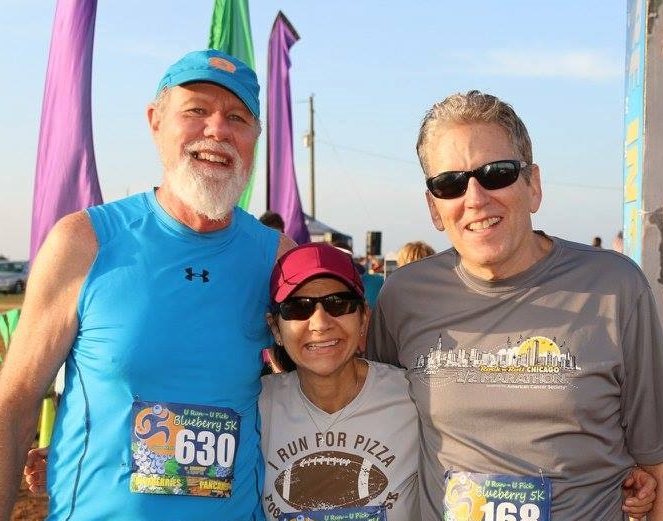
Pictured up top is Denny (70) from Wintergarden Runners in FL. I met him and was thoroughly blown away by his speed, his kindness and his humility…he just does what he does! He is running a half this weekend and another full next month with no signs of stopping.
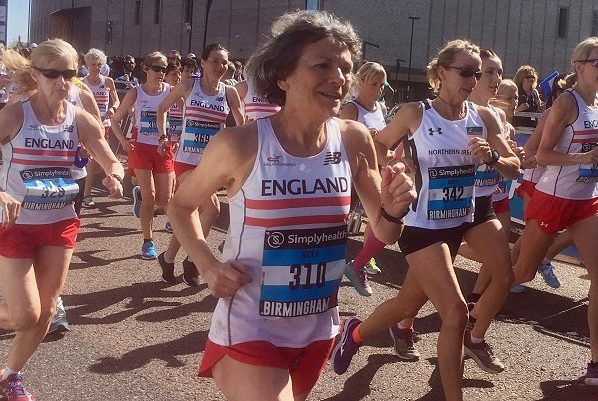
Secondary photo is from the England Athletics road masters.



 How to Train for a 5K (According to a Running Coach)
I am a masters’ runner! And yes, things change after 60 (I’m 61). I definitely need more recovery time, I can’t push to the ends of the earth any more, but hey, I’m still out there and that’s what’s important.
yes!! I love watching you and so many others remind us that we can keep running and loving it and be healthy!
After a break of 50 (yes, really) years I decided to start running again at the age of 70. I was always physically pretty active and when I realised that I was getting lazy I went for it. After 9 months I am doing a 10:28 mile and am entered for a 10 Km in February 2020. I am aiming for under one hour and am thinking about a half marathon in 2021.
The recovery time can be longer for older people, I had to take a 10 day break in June but at the moment I am managing interval training nicely without pain.
Thanks for the article.
yeaaaaa absolutely love hearing this!!! Congrats to you
Great article, thank you! I have never been a runner, but at the age of 53 I found a cause that I am excited to run for, women’s empowerment! It’s a year away which is good because I will need time to learn to run and train. I completed my first 5K a week ago; not much to many people, but huge to me!
I’m a 51 year old first time marathon runner (I’ve done 6 halfs in the past but not for over 20 years and never trained properly for them). I feel I’ve really trained hard for the london marathon in April 2023 this year (been training since October 2022) I have been following a beginners plan but when the plan calls for ‘marathon pace’ and other paces I just can’t move from ‘easy pace’ otherwise I feel like I tire easy and will wear myself out. I’m starting to worry about London already!
I’m looking for a 5K training plan for runners over 70. Can uou help?
Hey Ed! Even in our athletes over 70 there’s a wide variety in what feels good. If you’ve been running consistently then I’d say you can find a general plan you like, choose 3 days to run (1 speed, 1 easy, 1 slightly longer), 2 days for strength training and then an optional 1-2 days of cross training on the bike or pool. If you’re just getting back in to things, checkout the Couch to 5K plan I have.