

I first shared a story about metabolic efficiency in 2014, as I watched a fellow runner slowly transform her body. After listening to her talk about struggling with weight despite being a distance runner for years, I was intrigued by what she was doing. Her response was simple: “burn more fat”.
It wasn’t a diet.
It wasn’t counting macros.
It wasn’t adding in more workouts.
She was learning about metabolic efficiency.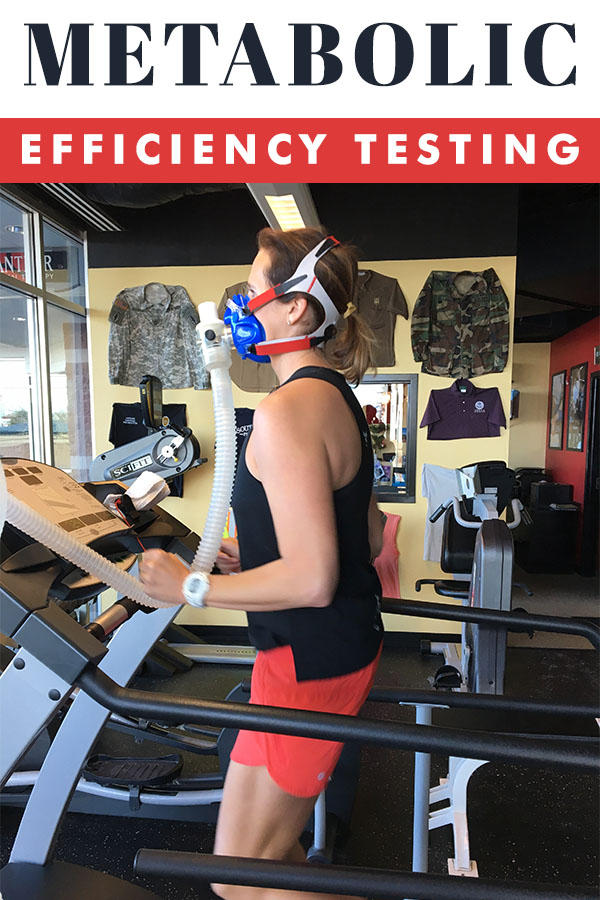
What is Metabolic Efficiency?
Short answer: How to burn fat both at rest and during exercise. It is not the same as improving your metabolism which we’ve talked about previously.
Long answer: Over the last few months I’ve worked with Dr Bob Seebohar of eNRG Performance here in Littleton, Colorado to better understand this and test myself. He’s a Certified Specialists in Sports Dietetics with a list of achievements and other fun letters after his name that would make your head spin…so let’s just call him super smart about what he does.
“What puzzles me as a coach and sport nutritionist is that athletes do not put in half as much effort planning their nutrition as they do constructing their training plan.”
– Bob Seebohar
OH SNAP. While most of us get better over time and amping up the veggies or possibly thinking about more protein, are we really optimizing our fueling the way we do our training?
Everything we put into our body, we have to burn off or it goes in to long term storage (aka your gut, your thighs, your booty).
A runner who can rely more on their fat stores for energy will:
- Improve body composition.
- Reduce risk of GI distress, because they don’t need as much fuel during the run (hello runner’s trots from all those gels)
- Preserve our stored carbohydrates for higher intensities or later stages of the run, again meaning less fueling needed during the workout and better endurance.
- Carry less food weight during training sessions and races that are longer than 2-3 hours, which is helpful especially for triathletes and ultrarunners.
- Stabilize blood sugar levels, which is good for our health and less chance of bonking
- Often results in faster post workout recovery.
- Improving the ability to run faster at a lower heart rate (the whole reason I do Maffetone training!)
- Improved sleep (likely due to stabilizing blood sugars, no waking up ravenous).
But wait, if we teach our body what to burn, why not just teach it to use all the carbs so we can live on sourdough bread and cookies? Trust me this was one of my first sweets loving thoughts.
Well, health.
We want all the other benefits of things like stabilized blood sugar and reducing diabetes and you know helping our hearts work more efficiently. More on that in just a moment.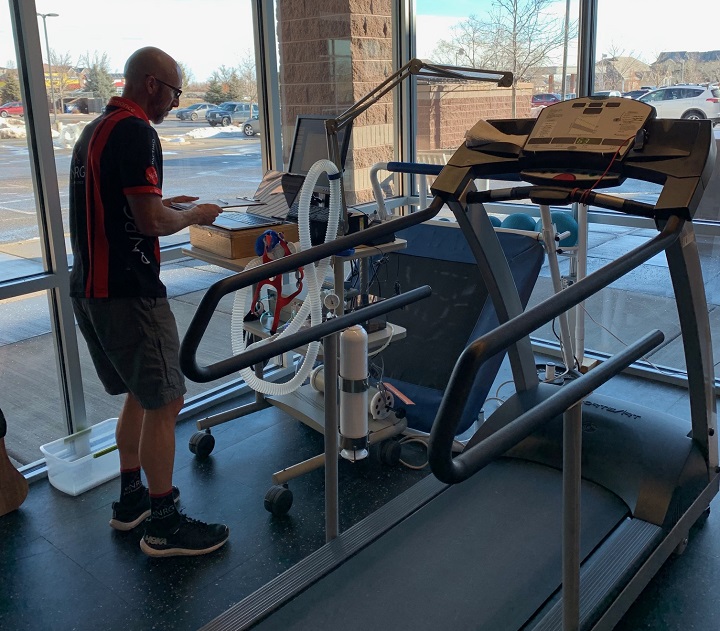
Since we’re talking about fat burning, does that mean we’ll need to follow those little charts on the old school treadmills?? Not exactly. Fat burning exercises include every movement from running to weights, but there is a point where you can maximize that burn and this is our goal.
And yes, while I’ll talk in part 2 about exercise changes like slowing down, that doesn’t mean HIIT or speed workouts have suddenly gone to the wayside. They’re still a key part of training.
But you have to take care of the base building before you move on to that.
How Does a Metabolic Efficiency Test Work?
The best way to know exactly how much fat you’re burning and where you can improve is to measure it! No more guessing how many calories you’re burning, this is going to give you the data to work from.
Step one is to sit completely relaxed in a fasted state and have your RMR measured. This is your starting point for both total calorie burn and to see how many fat vs carbohydrate calories you burn while resting.
I read one article that stated at rest we’re burning 85%… well that sounded great, until my first test showed I wasn’t doing that at all. I was burning almost equal carbs and fat initially.
Why does that matter though??
A lot of endurance athletes have metabolic stress, which is found between the gut, immune system and brain. See if any of these sound like you?
- disrupted sleep
- hitting the wall
- GI distress
- all the workouts, none of the weight loss
- getting sick before races
- poor concentration {hint read how digestion impacts health}
- potential for heart disease (yes even as an athlete)
Once you have your baseline, it’s time to get on the treadmill. You will also do this test in a fasted state, though there are other tests you could do to practice race day fueling this gave me all the info I needed.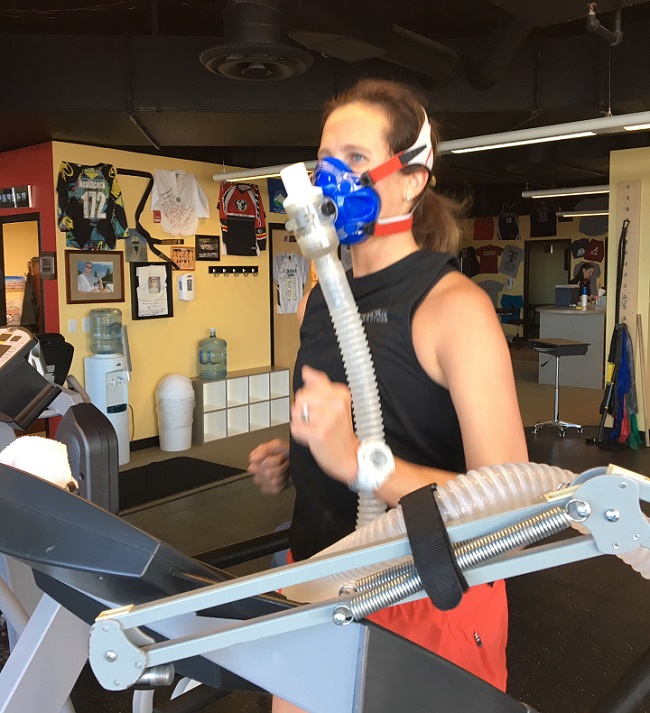 While it looks similar to a VO2 Max test, I can verify it’s immensely less intense. You never have to run to that I could barf stage! Instead, you’ll start at a very easy jog and have the pace increased just slightly every 4 minutes.
While you run, he is analyzing the output to see how many calories you’re burning, what percentage are from fat and what percentage are from carbohydrates.
Technically speaking here is what that means: “RER, respiratory exchange ratio, is the physiological concept that is used to determine %CHO and %FAT oxidation. RER is obtained by measuring the amount of O2 consumed vs. CO2 produced.”
Once you reach your crossover point (if you have one, I didn’t the first time), you’ll go a bit longer so you can keep seeing the percentages at different intensities.
After that, you’ll unmask and then go settle in to review the details. Dr. Seebohar will provide some dietary suggestions to help you improve…depending on your diet this could be hard or easy.
MY METABOLIC TEST RESULTS
According to Dr Seebohar, I had one of the biggest jumps he’s seen in a first round of testing “you had an average of 20% improvement in fat oxidation”, which was likely because I adhered to his guidelines pretty much from the get go and I had room for improvement.
I mean, why pay for advice and then ignore it? Here’s my first test result, followed by my second test result. The black line is how many carbs I’m using at different intensities and the red is fat.
Even at my easiest I was still needing more carbs, which could explain why prior to this I was having trouble getting my endurance back post surgery.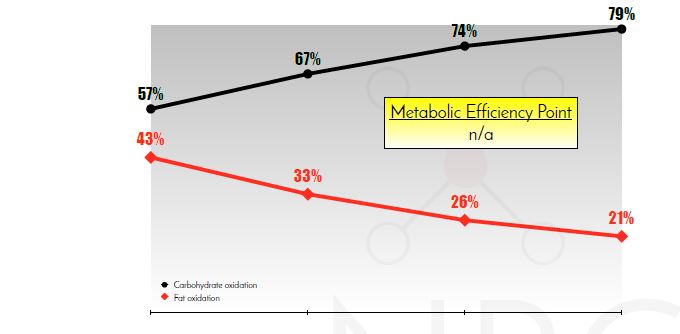
Boom improvements in that whole fat burning zone thingamajiggy.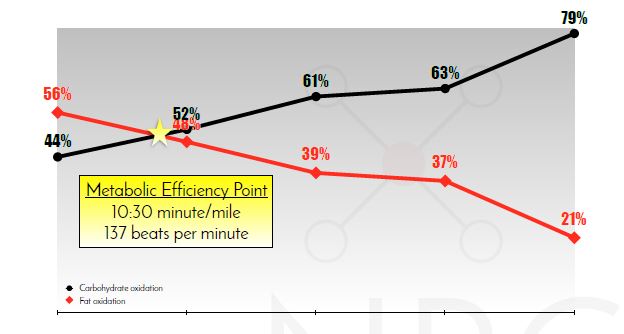 More exciting to me is that I could continue to move the needle for as long as the next year and possibly beyond that as I continue to work on both my speed and fat burning.
All of this means running farther needing to take in less fuel, less bonking and hopefully running faster more efficiently. In part 2, again I’ll tell you more about how I’ve been feeling but the short of it is that I ran my highest mileage week in 3 years after getting going on the tips he provided and improving my metabolic efficiency.
Understanding total calorie burn
The test will also show you, exactly how many calories you’re burning per hour at a different paces. Not estimates from your watch or the cardio machines which can be off by up 20%.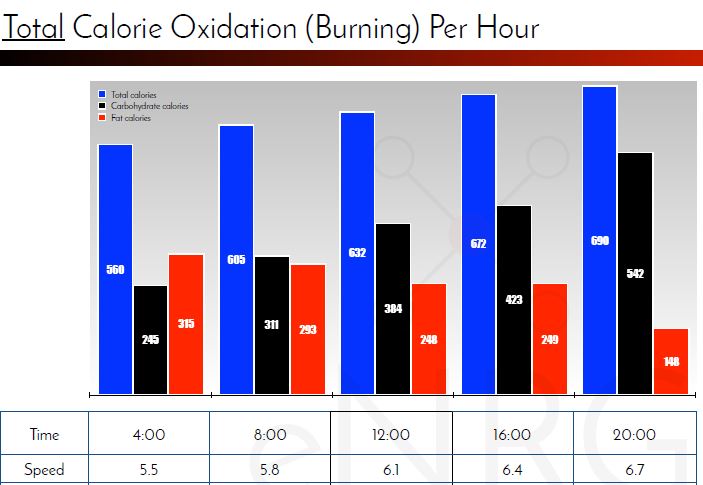
If your goal is running for weight loss, then knowing the exact amount of calories you burn at rest and per mile while running, gives you important information in outlining how much to eat.
Understand fueling needs
Then comes your actual PER HOUR calorie needs based upon your effort level (speed). This will help a lot of runners who are currently overfueling and thus winding up with horrible gut issues before the finish line due to too many gels.
This first chart is specific to the number of CARBOHYDRATE calories, which you’ll notice is less than most gels, meaning if you’re taking in 1 every 45 minutes…that could be part of your issue.(Checkout my tips for better race day fueling.)
In other words here, this shows that at my lowest intensity I would probably do just fine only taking in 24 carbohydrate calories per hour.
Again, these are my charts, based on my test and my current fat burning level.
An elite runner might find that their cross over point is around the 7 minute per mile area, which means then they’d be working to move that needle so they need less fuel while running even faster.
A heavier runner might have higher caloric needs, but mostly this chart proved me to that my strategy of not taking in a lot of fuel, which I came to intuitively, was right on.
How to change your metabolic efficiency?
It’s a pretty basic two part process:
- Start doing more exercise below your cross over point
- Change your eating habits to prevent blood sugar swings (details in part 2)
Basic doesn’t always mean easy, but if you’re willing to do it, then you can actually start to see results within just a week or two of making changes. Of course that means, you can undo those changes just as quickly.
This isn’t a one time change, it’s a long term shift to help you perform better.
Whew now that we have a good understanding of what the process is and why it matters so much to us as endurance athletes, I’ll share with you what happened when I put it in to play and exactly what changes I made.
Find Part 2 with the changes I made and my results (hello weight loss) here >>
Have you ever done testing like this?
Other ways to connect with Amanda
Instagram Daily Fun: RunToTheFinish
Facebook Community Chatter: RunToTheFinish
Sign Up to Receive a Weekly Newsletter with Top Running Tip



 Santa Barbara Wine Country Half Marathon Review and Race Recap
Thanks for this one! I have definitely reached a standstill in terms of trying to get to a better weight for long distance events. Time to severely cut out my refined carbs until I’m running a lot more for the spring season!
Thanks for the interesting post!
Definitely looking into to this test.
xo