
Garmin Training Load and Polar Cardio Load are designed to help runners prevent over training and take in to account their sleep recovery, but should they really be guiding you? How important is training status on your watch?
This topic has come up more and more in the last few years as our watches continue to add new layers of technology tracking our every step, how often we flop around during the night and even reminding us to fuel during our long runs.
It’s important to understand exactly what is being calculated and always remember that YOUR BODY IS NOT A MACHINE.
No runner has a straight line upward of progress, which is what a calculation would expect.
How do you calculate training load?
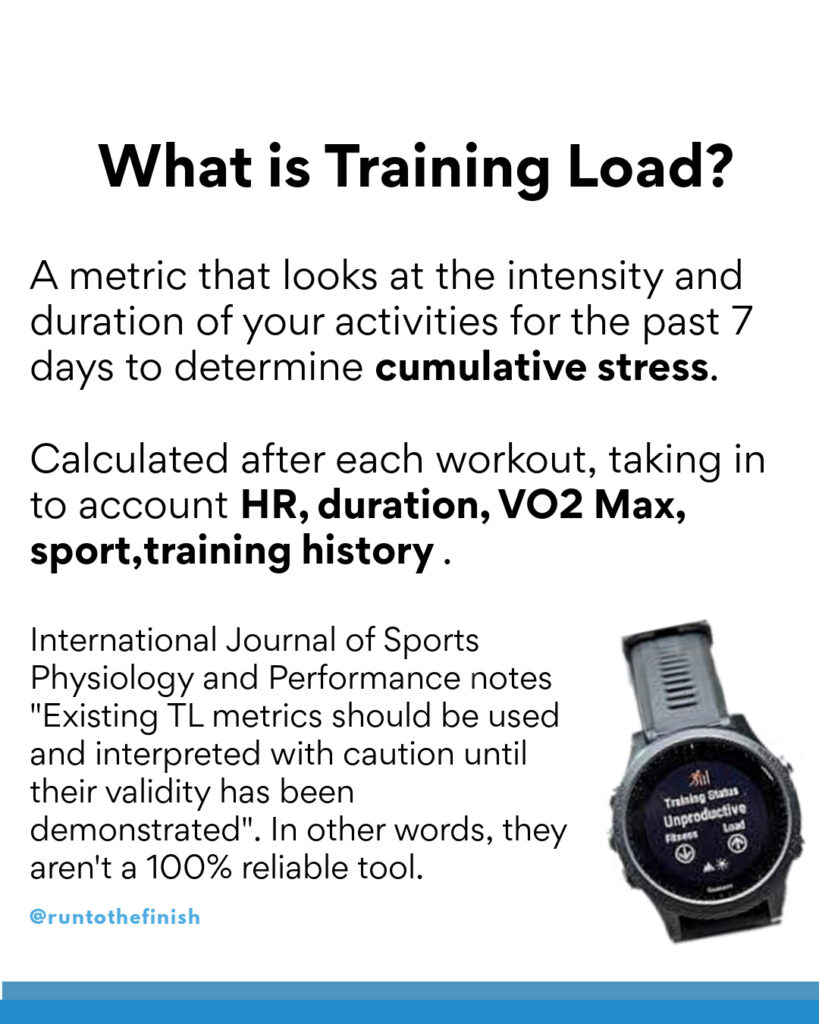
Training load = intensity x duration
Training load is usually looking at the impact of a single workout and with all the technology in GPS watches it now takes in to account HR , VO2 Max, sleep and the type of workout to determine the load, which then goes in to calculating the overall training status your watch displays.
This means that if you want the most accurate data, you should wear a HR chest strap and you need to ensure that your HR Zones are set up correctly.
Additionally it expects that you are using the watch for ALL activities, so it can best track and compile your movements.
What it does NOT take in to account is elevation (hello higher HR running at altitude), higher temperatures, if you’ve been sick, dehydration, fueling, etc.
Instead they created additional statuses on higher end watches for altitude acclimation and heat acclimation, but they are not factored in to the Garmin Training Status.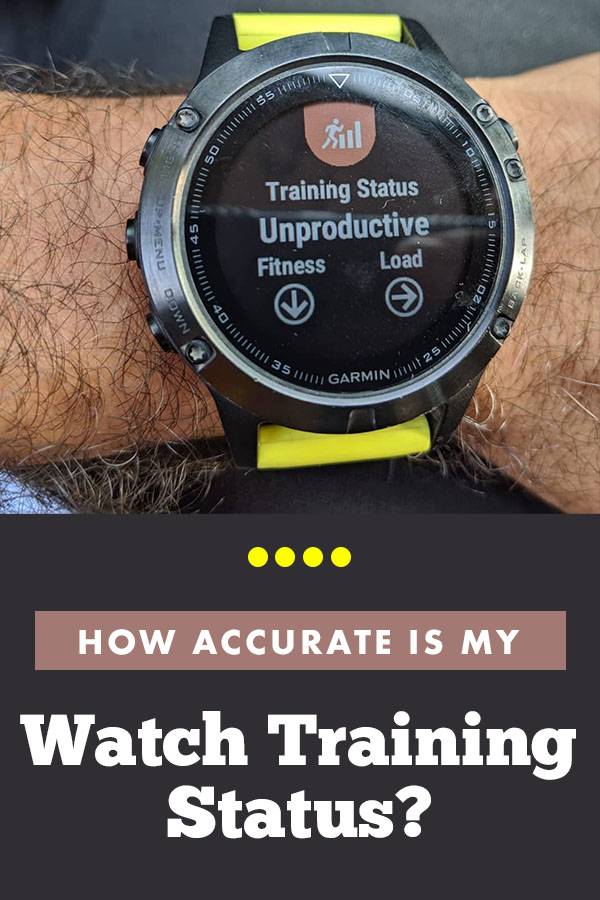
Garmin: Training status uses your average from the past 7 days
Polar: Cardio Load Status uses your average daily load from the past 28 days
Let’s breakdown the Garmin Training Statuses. There are technically 7 for Garmin and 4 for Polar, but a few I rarely to never hear anyone seeing so we are focusing on the big one’s that bring up questions.
- Peaking: you are in ideal race condition. Your recently reduced training load is allowing your body to recover and fully compensate for earlier training. You should plan ahead, since this peak state can only be maintained for a short time.
- Productive: your current training load is moving your fitness level and performance in the right direction. You should plan recovery periods into your training to maintain your fitness level.
- Maintaining: your current training load is enough to maintain your fitness level. To see improvement, try adding more variety to your workouts or increasing your training volume.
- Unproductive: your training load is at a good level, but your fitness is decreasing. Your body may be struggling to recover, so you should pay attention to your overall health including stress, nutrition, and rest.
- Overreaching: your training load is very high and counterproductive. Your body needs a rest. You should give yourself time to recover by adding lighter training to your schedule.
Now we know how they define these status, but how much should you pay attention to them.

How to Use Your Garmin Training Status
If we only continue to increase intensity without ever taking a cut back week, then we may be improving fitness but fatigue also ramps up. This is part of what training load is trying to help you prevent.
Meanwhile, increasing your total activity or intensity beyond the 10% rule is often correlated with injury, which could also be due to fatigue and therefore your watch is attempting to warn you of this.
Why is my Garmin Training Status Unproductive?
Let’s breakdown what could be happening to result in you seeing a status that doesn’t correlate to how you are feeling or your current training.
- Unproductive – shows up as your aerobic fitness improves and your HR starts to go down for the same pace or duration of run. That’s not unproductive at all.
- Unproductive – shows up the day after a marathon because you are sitting with your legs up a wall trying to recover. Yup, also not unproductive.
- Unproductive – show up while running in the heat and humidity because you are running the same effort level at a slightly slower pace. Again it’s productive, just not by a calculation.
- Overreaching – shows up on Garmin if you went on vacation for a week and thus have no workouts, the massive jump when you return looks like overreaching.
- Overreaching – shows up with you are in fact increasing your total workload more than roughly 10%. At some points that’s absolutely ok based on fitness, but other times a reminder not to jump too quick and end up injured.
If the unfriendly status are bothering you, you can pause training load! Then you won’t see it or worry about it!
Which Garmin watches have training load?
Nearly all of their watches now offer training load:
- Forerunner 55, 245, 645, 745, 945
- All of the Fenix Series, Enduro, Instinct
Vivoactive and Venu watches track more lifestyle and therefore include stress monitors, but not training status.
Suunto watches give you a number of scores from sleep quality to fitness level (VO2 Max), but don’t give the same training load daily updates.
Coros Training Load
Coros watches also provide training status after 7 days of workouts. They recently rolled out a new EVOLab metrics system that looks at each workout as part of the whole. They went with a different labeling system which is less offensive than unproductive :).
- Minimal (0-19): Your current training load is light and may reduce your fitness in the long term.
- Performance (20-39): Your current training load has been reduced to allow for optimal performance in races.
- Optimized (40-59): Your current training load is ideal for maintaining or improving your fitness.
- High (60-79): Your current training may be unproductive due to the high recent load.
- Excessive (80-100): Your current training load is excessive and increases the risk of injury.
Additionally they include a Training Effect for each workout, which looks more like the Garmin training status. So now you have 2 numbers to obsess over.
- Inefficient (0-0.9): Minimal effect on fitness
- Recovering (1.0-1.9): Good for recovery but low on fitness improvement
- Maintaining (2.0-2.9): Maintaining fitness
- Improving (3.0-3.9): Improving fitness if repeated 2-4 times per week
- Optimized (4.0-4.9): Improving fitness efficiently if repeated 1-2 times per week
- Overreaching (5.0-5.9): Improving fitness significantly with sufficient recovery or may lead to overtraining
Is Garmin Training Status accurate?
Your body is not a machine. It’s far more than the numbers from a workout.
It’s daily life stress, it’s getting sick, it’s having a week of vacation and then coming back to training feeling energized and strong.
The training status is something that can give you a second to pause and check in with yourself: am I doing too much? Am I feeling fatigued? Am I actually doing less work or is my HR dropping because I’m getting fitter?
But is it the be all end all of where you are in training, no.
Why is my VO2 Max dropping?
VO2 Max can drop for a number of reasons.
- Your watch sees your dropping HR as a sign of overtraining (the opposite of what happens with LHR)
- You are in a recovery period after a race
- Your resting HR is higher because you haven’t been sleeping well or are stressed out
- You’ve switched up your training to add in more weight lifting and fewer miles (fitness is increasing, but may not VO2 max)
- VO2 Max naturally declines with age
More importantly does VO2Max matter for runners?
Not really.
Stop focusing on this number and focus on how your workouts are actually going.
Looking for more reviews to find the best things for you run?
Checkout our full page of my must have running gear reviews and guides to save you time searching and money! I share what’s worked for me and fellow runners, along with what wasn’t worth the price tag.
A few common requests:
- How long do GPS watches last?
- Best GPS Watch for New Runners
- Garmin Vs Polar (why I started using the Vantage V2)
- Garmin VS Suunto (is Suunto really better for trails?)
- How to use all your run data
Other watches you want to know about? Let me know!
Other ways to connect with Amanda
Instagram Daily Fun: RunToTheFinish
Facebook Community Chatter: RunToTheFinish
Sign Up to Receive a Weekly Newsletter with Top Running Tips and Laughs



 Coros Apex Review | Fit, Function and Features You’ll Want
Great information! I tend to take it personally when I feel like I have a great run, then my watch tells me it was “unproductive”. How dare my watch tell me that it was unproductive! 😜
Lol me too. Fastest 5k yet but unproductive.
Longest miles but unproductive
Very helpful article.
I don’t pay that much of a mind to at all. I sense that the those items from farming and polar are not geared to work with low heart rate workouts. I also noticed my running VO2 max had dropped a tone since doing the low heart rate format as well. Keep it moving y’all!