

Have you ever taken a tumble while running? Maybe you clipped your toe on an uneven sidewalk or a root on the trail or you landed awkwardly coming off a step or curb. Whatever the cause of your tumble (a tumble so many of us have also taken), your ability to avoid the tumble altogether or to catch yourself before you fall is linked to your balance and stability.
When we talk about balance, we’re not just referring to the ability to stay upright on one leg.
Balance encompasses a range of factors, including stability, coordination, and proprioception—the body’s awareness of its position in space. When these elements are finely tuned, your running form becomes more fluid and efficient, reducing the risk of overuse injuries.
Think of balance as the strong foundation upon which your running stride is built.
It allows you to maintain proper body alignment, distribute weight evenly, and absorb the impact of each stride with precision. By honing your balance skills, you can optimize your running technique and unlock your full potential as a runner.
In this article, we will explore a selection of the best balance exercises specifically tailored for runners. These exercises target key muscle groups involved in maintaining stability and coordination during running.
Whether you’re a beginner or a seasoned runner, incorporating these exercises into your training routine can make a significant difference in your performance and overall well-being.
What Is Balance?
According to Google, balance is “an even distribution of weight enabling someone or something to remain upright and steady.” Wikipedia writes that “balance in biomechanics is an ability to maintain the line of gravity of a body within the base of support with minimal postural sway.”
Basically, balance is our ability to not maintain control of our body, not fall over, and remain upright with good posture.
Types of Balance
Balance can be split into two categories: static balance and dynamic balance. Both of these are important to us as runners.
When we stand still and our body is over its base of support, we are using static balance. An example would be standing on one leg.
Balance while moving is dynamic balance. We use dynamic balance when we move outside of our base of support and manage to not fall over or sway. Single-leg deadlifts, curtsy squats and of course running are a few examples.
“You have to teach me how you run with both feet off the ground?!”
One of my favorite recent Instagram comments because it was both funny and well…that’s literally the definition of running! Of course we think if we’re slow that one foot must always be on the ground, but that’s walking.
The definition of running is that for an instant both feet leave the ground!
Why is Balance Important for Running?
Running is a high-impact activity that places stress on various joints and muscles. Poor balance can contribute to biomechanical imbalances, increasing the risk of injuries such as ankle sprains, shin splints, and knee pain.
Balance training goes beyond injury prevention—it directly impacts your overall athletic performance. When you have excellent balance, your body can efficiently transfer power and force during each stride, leading to improved speed and agility.
Additionally, enhanced balance helps you navigate uneven terrain, maintain control during quick direction changes, and avoid issues in daily movements.
Including exercises that improve our balance to our workout routines provides a number of benefits. These include:
- Increased core strength
- Injury prevention and reduction
- Greater power
- Improved posture
- Reduce muscular compensations
- Improved coordination
Masters Runners Must Increase Balance Work
As we age, our balance naturally undergoes changes due to various physiological and neurological factors. These changes can impact our overall stability and increase the risk of falls.
This happens for a few reasons, most of which we can control!!
- Decreased Muscle Strength: With age, there is a gradual loss of muscle mass and strength, known as sarcopenia. Weakening muscles, particularly in the lower body, can affect our ability to maintain balance and stability while standing or moving.
- Reduced Flexibility: Aging often leads to decreased flexibility in joints, tendons, and muscles. Limited range of motion can affect balance, making it more challenging to adjust to uneven surfaces or sudden movements.
- Impaired Proprioception: Proprioception, the body’s ability to sense its position in space, may decline with age. This can result in a reduced awareness of body movements and compromised ability to make precise adjustments for maintaining balance.
In addition, working on our balance just makes every day life easier and better regardless of our age. Walking, running, getting in or out of a bathtub, taking the stairs, chasing around grandkids, getting up off the ground, and so many other activities require balance.
Checkout these out for more tips on running after 50 and this one for running after 60!
7 Best Balance Training Exercises for Runners
Incorporating some balance exercises into your routine doesn’t have to be time consuming. I’ve included a number of great balance exercises that you can do by themselves or added into a strength workout.
Pick a couple exercises and do them 2-3 times per week. Change up your exercise selection regularly to keep challenging your core, hips, glutes, and other stabilizing muscles that are all integral to good balance.
Always remember to do a dynamic warmup, regardless of whether you’re doing balance exercises on their own or as part of your strength training workout. Do 1-3 sets of 10 reps (do 10 reps per side if a single-sided exercise).
Alright, on to the exercises!
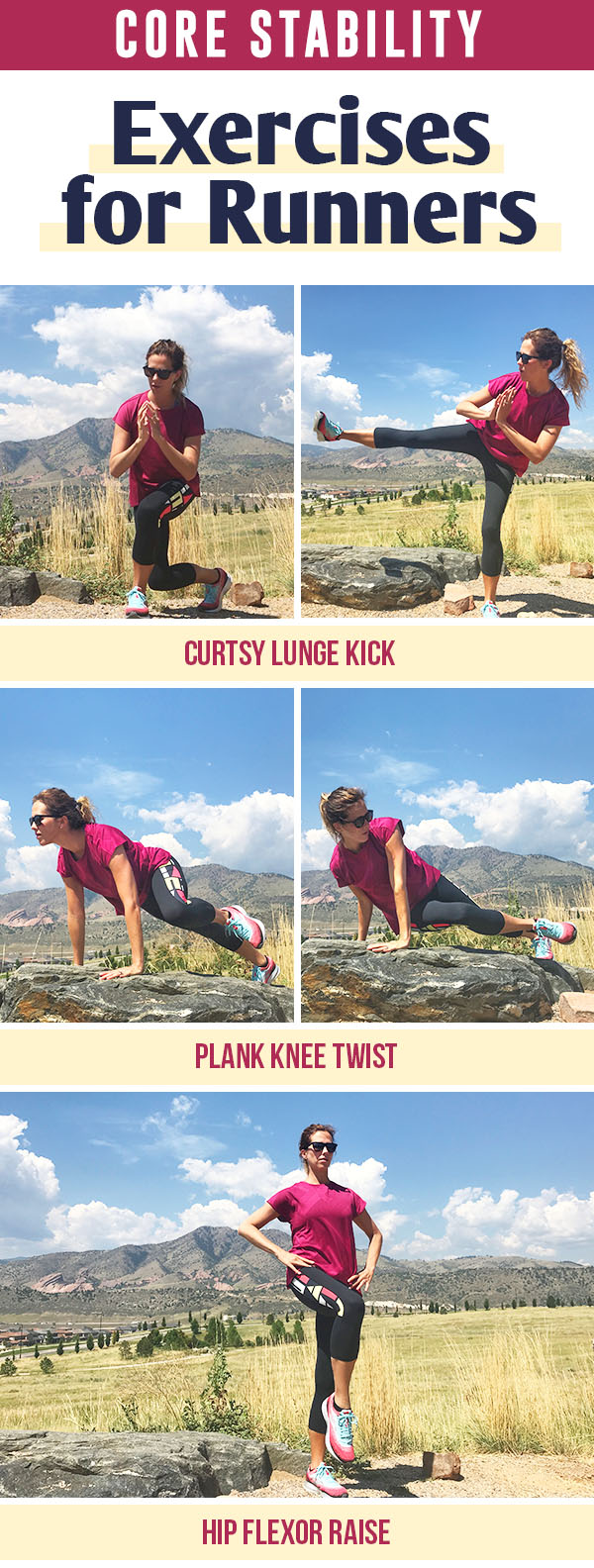
Some of the moves are also demonstrated in the video below. Be sure to Pin the final image so you don’t forget these!
#1 Plank Rotations
The following is a great way to up the ante of a regular plank. As with many of the following exercises, don’t rush through these. Take your time and use good form.
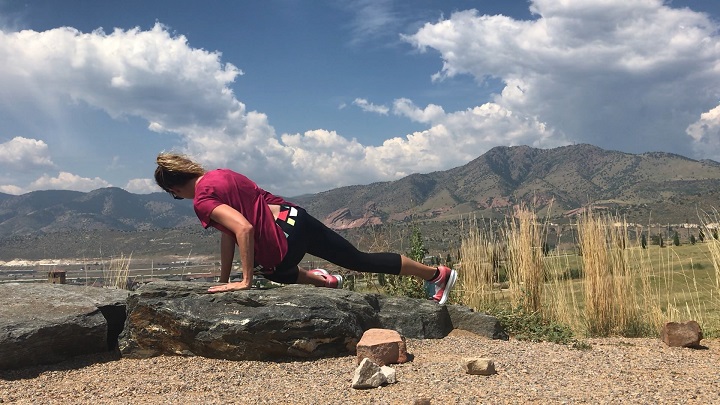
Starting in a full plank position, bring your right knee out to your right elbow. Then bring your right knee under your body to your left elbow while also dropping your hip almost to the floor.
Instead of keeping your hips high, this will force you to engage your hips, glutes, and core altogether for a great challenge and benefit.
Repeat on the other side.
#2 Single Leg Stance
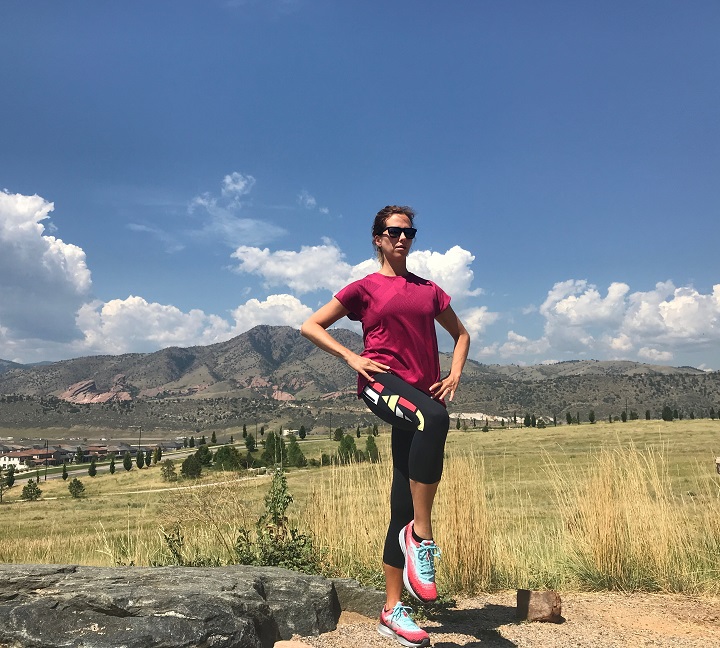
The single-leg stance exercise helps improve balance, stability, and proprioception. By focusing on one leg at a time, it challenges the muscles and neural pathways responsible for maintaining balance while mimicking the demands of running on a single leg. This exercise also helps strengthen the ankles, calves, and hip stabilizers.
As runners, we often spend more time stretching our hip flexors than strengthening them, but we really do need to ensure they’re strong too. This exercise may look easy, but please don’t skip over it, it’s been shown one of the best to predict healthy aging!
- Stand tall with your feet hip-width apart and arms relaxed by your sides.
- Shift your weight onto your left leg, engaging your core for stability.
- Slowly lift your right foot off the ground, bending your knee at a 90-degree angle.
- Find a focal point in front of you to help with balance.
- Hold the single-leg stance for 20 to 30 seconds, or as long as you can maintain proper form.
- Repeat the exercise on the other leg.
Once you can hold it for 30 seconds, try closing your eyes!! Still got it, then try standing on a pillow or unstable surface.
#3 Curtsy Squat with Lunge
This is a two-part exercise that will engage your abs, hips, and glutes.
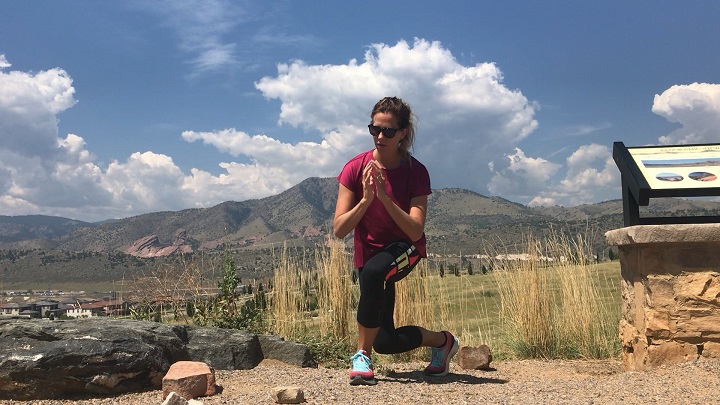
From a standing position, cross your right leg behind your left into a squat and then, while engaging your core, rise up while kicking your right leg out to the side. This forces power in your hips and engages the core to keep you from falling over.
#4 Clock Reach
I started doing this move every night when I brush my teeth because it made my ankle feel so much better after lots of trail running!
The clock reach exercise challenges balance, stability, and coordination by incorporating multi-directional movements. It enhances proprioception and body awareness while engaging the muscles of the lower body, including the hips, glutes, and ankles. This exercise mimics the demands of running, which involves dynamic changes in direction and weight shifting.
- Stand tall with your feet hip-width apart, arms relaxed by your sides.
- Imagine yourself at the center of a clock, with 12 o’clock directly in front of you, and the other numbers evenly spaced around you.
- Lift your right foot off the ground, finding your balance on your left leg.
- Begin by reaching your right foot forward to the 12 o’clock position, maintaining a slight knee bend in your supporting leg.
- Return to the starting position and then reach your right foot to each number on the clock, one at a time, in a clockwise or counterclockwise direction.
- Complete the repetitions on one side and then switch to the other leg.
#5 Single Leg Deadlift
The single-leg deadlift is a highly effective exercise for improving balance, stability, and strengthening the posterior chain, including the hamstrings, glutes, and lower back. It also helps develop hip mobility and proprioception
- Start by standing tall with your feet hip-width apart and arms relaxed by your sides.
- Shift your weight onto your left leg while slightly bending the knee.
- Engage your core for stability and maintain a straight back throughout the exercise.
- Slowly hinge forward at the hips, extending your right leg straight behind you while keeping it in line with your torso.
- As you hinge forward, reach your arms toward the ground or extend them out in front of you to help maintain balance. (if you are holding a weight, it should move along your shins)
- Lower your upper body until it’s parallel to the ground or until you feel a stretch in your hamstrings.
- Pause briefly in this position and then slowly return to the starting position, engaging your glutes and hamstrings.
- Repeat the exercise for the desired number of repetitions and then switch to the other leg.
Another option, especially if you’re including this in your strength training program is to add in an upper body movement too. Do a single armed row at the bottom of the movement or add in an overhead press once you return to your starting position.
#6 Bosu Ball Squats
Bosu Balls are a great way to increase the challenge of some balance exercises. Their unstable surface will help engage all the major muscles, plus the smaller stabilizing muscles.
Stand on the ball side of the bosu with feet slightly apart and do a squat. You can also flip the bosu over so the rounded side is on the floor and stand on the flat side and again perform a squat.
Another option is to do lunges with the bosu. Standing on the ball side of the bosu, do a reverse lunge. Alternate sides or stay all on one side then switch legs.

#7 Skaters With a Hold
Skaters are an outstanding exercise for runners for a number of reasons. One of the reasons is because they have you moving side to side, which as runners, we rarely do.
Someone should be able to snap a photo of you in the position and you’d look like a speed skater.
- Start by standing with your feet hip-width apart and arms relaxed by your sides.
- Take a lateral leap to your right, landing on your right leg with a slight knee bend and your left leg extended behind you.
- As you land, reach your left hand across your body to touch your right foot or as close to it as possible.
- Hold this position for a brief moment to challenge your balance and stability.
- Push off with your right foot and leap laterally to your left, landing on your left leg with a slight knee bend and your right leg extended behind you.
- As you land on the left side, reach your right hand across your body to touch your left foot or as close to it as possible.
- Hold the position briefly and continue alternating sides for the desired number of repetitions.
Looking for More Advanced Options?
If you’re looking for more advanced balance work, consider checking out a balance or wobble board. There are tons on the market and they can be great to incorporate into a workout or use with a standing desk.
I’ve previously shared some of the best balance boards for standing desks and home workouts in another article so definitely check those out as you progress in your training.

Incorporating Balance Exercises into a Running Routine
When it comes to incorporating balance exercises into your running routine, finding the right timing and frequency is key.
One opportune moment to include balance exercises is during your pre-run warm-up. Before hitting the pavement, take a few minutes to engage in dynamic stretches and mobility exercises to prepare your muscles and joints. This is an ideal time to integrate balance exercises as well.
By incorporating balance movements at the beginning of your workout, you activate your stabilizing muscles and enhance proprioception, setting a solid foundation for your run.
I often find they are easy to add in to a mobility day or when you’re doing some post run stretching.
This cool-down routine helps restore balance, relax muscles, and improve overall recovery. By engaging in balance exercises after your run, you promote muscle symmetry, relieve any residual tension, and enhance your body’s ability to adapt to the stresses of running.
Other ways to connect with Amanda
Instagram Daily Fun: RunToTheFinish
Facebook Community Chatter: RunToTheFinish
Get more running tips: Pinterest



 The Best Post-Run Routine (According to a Running Coach)
This is a wonderful blog post and resource for runners. You have some really amazing tips and awesome exercises! Though I am not a runner, I appreciate your wealth of knowledge and will send your link to all my runner friends :)
We did so many balance and core strengthening exercises when we ran in college. I definitely felt a difference in my running when we did too!
Great tips and exercises for runners! Balance is so important to avoid injury.
These are helpful exercises for me – I’m working on core stability right now. And those Brooks are so cute! My husband loves Brooks – I wish they fit my foot better.
I’m not much of a runner, but I could definitely use some more core stability for my squats and deadlifts! You know what they say… “A strong core a day keeps the back pain away”… or something like that.
I like to run but am not the best at it. A nice collaboration of exercises to work on core strength. Thanks for the post!