
‘Does running give you abs?’
It’s a question I get asked a lot, and I definitely understand why – I mean who doesn’t want great abs?
Running offers a ton of benefits as an exercise. It reduces tension and stress levels, leads to better heart health, and improves cardio-respiratory fitness.
But we might be fooling ourselves if we think our runs are going to give us abs.
Every time you go for a run, you also get a core workout. But is it enough to build abs? And, honestly, what do we even mean when we talk about ‘getting abs’?
There are ways you can use running to assist in building ab muscles. However, running alone isn’t enough to get you there.
But the good news is that with a few tweaks, running can be an excellent complementary workout to getting the abs of your dreams.
In this article, you’ll learn everything you need to know about how running helps you get better abs, how to use it to build abs, and what else you need to do to get the results you want.
Does Running Give You Abs? How Running Impacts Your Abs
To be able to answer the question of whether or not running gives you abs, we need to define what ‘getting abs’ even means. Next, we’ll look at how running can contribute to it.
What Does It Mean to ‘Get Abs’
Technically, we all have abs or what is known as transverse abdominals. But most people have a different idea of what ‘getting abs’ means.
Having ‘abs’ for some people means having a better muscular definition in the midsection. This means that the muscles on the surface of the abdominal wall (especially the rectus abdominis and the external obliques) can be clearly seen.
People who seek this type of ‘great abs’ want to achieve a six-pack look from their cardio routine.
Others, however, believe that having abs means having a strong core that can sustain all forms of exercise, such as running.
When you have a strong core, not only are the superficial abdominal muscles powerful, but the deep abdominal muscles (the internal obliques and the transverse abdominis) are also fit and healthy.
How Running Helps You Get Better Abs
Running can help you build abs and become stronger. There are two primary ways that running can assist you in reaching your goal of getting six-pack abs:
1. Running Helps to Build Core Strength
Running is a core-strengthening activity. The more you use your core muscles, the stronger they will get.
While it isn’t the most effective approach to improve core strength, some research has shown that it can engage muscles across the core which is enough to build strength and endurance in the midsection.
2. Running Helps to Reduce Body Fat
Running is not only excellent for burning calories, but it is also beneficial for lowering body fat, according to numerous studies. While losing body fat has no direct effect on your abdominal muscles, it can help you achieve improved midsection definition.
In other words, if you’ve got a lot of body fat (also called visceral fat), you won’t be able to see the strong muscles you might have in your midsection. Your muscles become more visible as you lose the excess belly fat, giving you a more defined look.
How to Use Running to Build Abs
While running isn’t a sure-fire way to build abs, there are certain running techniques you can incorporate into your training to start building abs today.
Let’s look at what these are:
Incorporate Speedwork
Speed intervals have been proven in studies to be good for both visceral and subcutaneous fat loss in the abdomen. So consider including a few sprint days in your weekly running schedule.
You can try doing structured intervals, such as 10-15 reps of 100m sprints and taking a 30-second walking break between each sprint. Fartlek, or unstructured bursts of speed, is another great option for burning calories and improving ab definition.
But remember these are not EVERY run.
Do Hill Runs
Hill climbs and sprints are other great running techniques to get abs. These encourage you to activate your core even more, which aids in the rapid development of those muscles.
The ideal approach to running hills is to choose one large hill or a series of small hills. For short hills, run up a hill without pausing, then walk down and go up the next one.
For a larger hill, pick an amount of time and run up the hill for that timeframe. You can then take a short walking break.
Recover Appropriately
Stress + rest = growth
You can’t simply do cardio every single day and get abs. If you run non-stop without rest days or cutback weeks, you simply keep breaking the body down farther and farther.
Instead, think to yourself that during rest is when the body actually rebuilds. That’s how it gets stronger, that’s how you build muscle and keep cortisol from going sky high.
Is Running Enough by Itself to Build Six-Pack Abs?
Unfortunately, running alone won’t give you build toned and sculpted ab muscles. But with the right training approach, proper diet, and a few other things, running is the perfect complementary activity.
We all know I don’t have six-pack abs, it’s one of the few things I still moan about now and then. However, long-time experienced personal trainer and former marathon runner Tara does.
She’s here to share with you exactly what it truly takes to get abs with running and how you can incorporate those techniques into your training program.
How Your Mental State Affects Your Progress
I ran three marathons, ran in college, and never saw the results I wanted. So no for most people, running alone will not give you abs.
Once I hung up my running shoes for good, trading in long runs for HIIT training, my body slowly crept down to my leanest point, hovering around 8% body fat.
The noticeable—some might even say drastic—changes in my body had about 20% to do with science and 80% to do with my mental state.
I stopped doing things I didn’t like
- I stopped hanging out with people I didn’t like
- I started looking for a community that built me up
- I started doing workouts that made me feel stronger
{Amanda’s note: seriously I’ve talked to about how cortisol, stress, can sabotage your weight loss!!}

But what do all of those changes mean for you?
If your run is the best part of your day, if you hit the streets to relieve stress, work through a problem, or just so you can hear yourself think after a day at the office; great. Keep doing it.
But constant feelings of frustration, whether because of a nagging injury or just staring at a PR that won’t budge, is like banging against a wall that won’t move.
And even if you’ve done ONE activity your whole life (as I did with running), a change in your routine might be the reset you need.
It might just answer your never ending question of “how to get six pack abs?”
Three Areas Every Runner Should Focus on to Getting Abs
Finding a workout I truly loved spiraled into other parts of my life.
- I stopped partying.
- I stopped binge eating.
- I changed my diet to embrace intuitive eating and fueling for performance.
- I included heavy strength training.
- I included sprint workouts.
As someone who struggled with my weight for years, I understand what it’s like to run miles upon miles and not see the results you want.
While running (particularly sprints) can be a great component to a complete program, it falls short all on its own.
As a trainer, there are three areas I really push on runners:
- resistance training
- lateral movements
- mobility
Weight Training Burns More Calories Than Just Cardio
When runners or triathletes come to coaches with frustrations, this is the first point we hit.
Your metabolism stays elevated long after you lift, particularly when compared to strict cardio. To get into a caloric deficit, the best strategy is to incorporate both.

When you go on a five-mile run, your heart rate stays at a steady state.
By adding in resistance training, combined with quick breaks so common in HIIT workouts, you spike your heart rate up then draw it back down. This tricks your body over and over again, never allowing it to anticipate your next move or intensity level.
While a five-mile run can easily become familiar, HIIT training gives very little room to plateau.
To build up your strength (thereby burning more calories) do these 3 lifts once a week:
- Weighted squats
- Weighted deadlifts
- Weighted curtsy lunges
Strength Training Better Engages the Core
When you run, you move in one direction, only: forward. Therefore, you consistently fire certain muscles (mainly your quads and hamstrings) while completely ignoring the rest of your body.
Resistance training with lateral movements (think side-stepping with a theraband, or lateral lunges) works the sides of your body—which are almost never used on a run.
Lateral training or lifting heavy things will both instantly activate your core and force you to use those muscles, which you aren’t necessarily doing as intensely while running.
Mobility Allows for Consistent Training
Let me tell you something you already know: It’s really hard to burn calories when you’re injured.
While there’s a lot of confusion in flexibility vs mobility, mobility is what allows your joints to move freely and easily through a range of motion.
As a runner, you need your ankles, hips, and knees to propel you forward.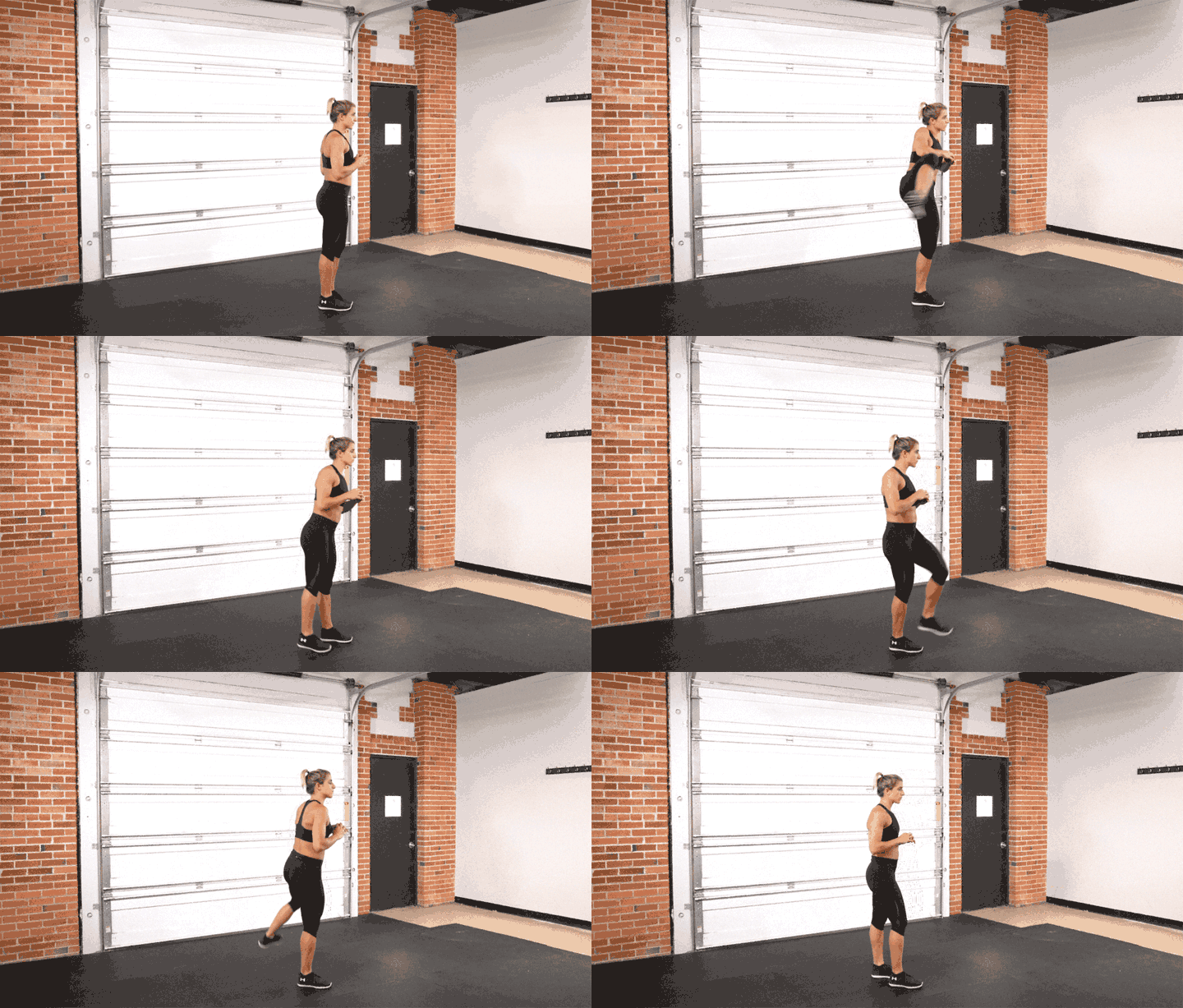
Mobility also helps you get MORE from a movement.
Have you ever been halfway through a lunge or squat and hear your coach scream, “Get lower!” and think to yourself, this is as FAR as I go!?
You have immobile hips. And therefore YOU are your booty are getting less out of that squat than the girl next to you, squatting below parallel.
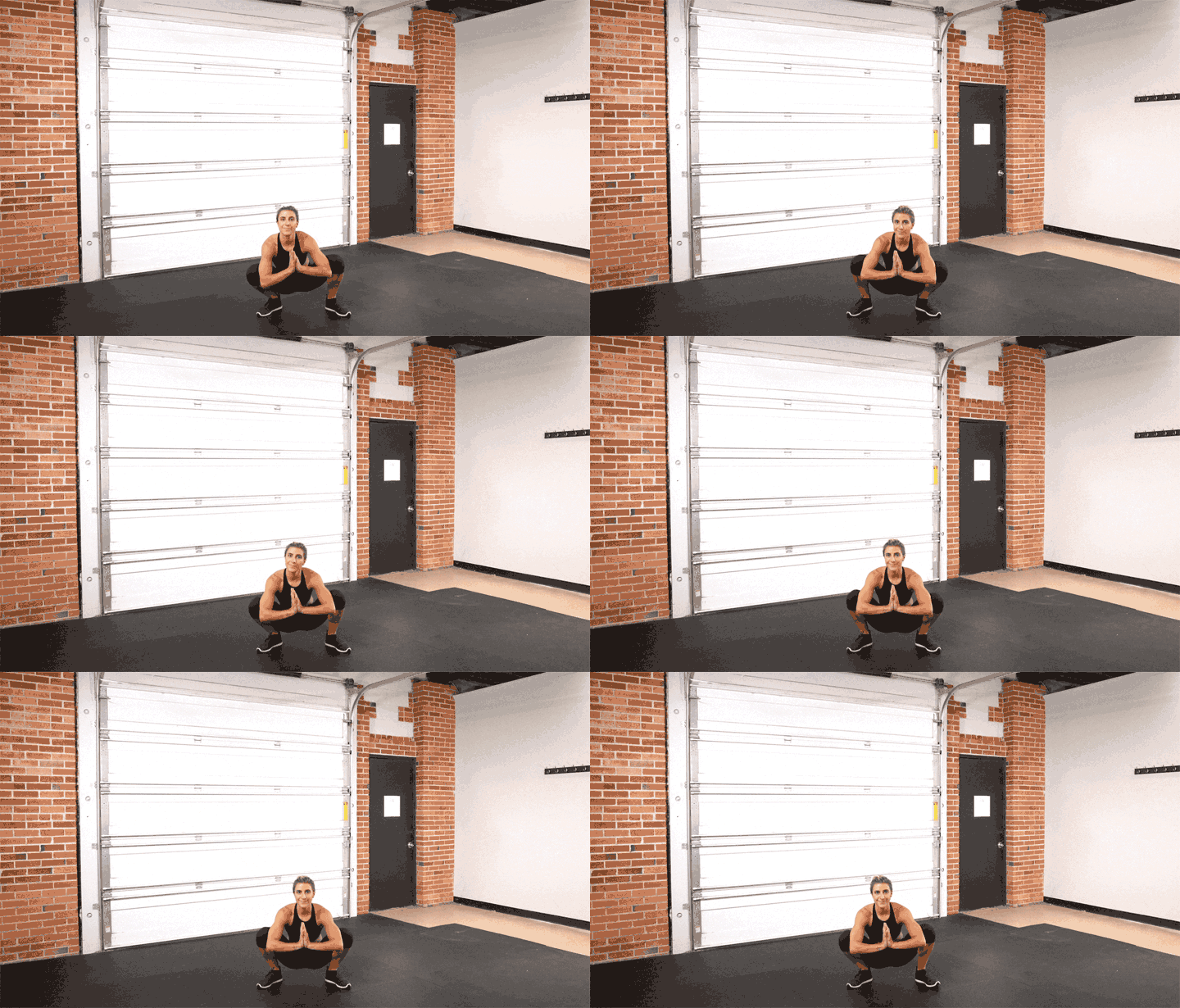
To stay mobile, do these 3 exercises before or after your run:
- Hip internal and external rotations (seen above)
- Cossack squats
- Frog Pose with Hip Rocks (seen below)
How to Incorporate Resistance Training Into Your Running Schedule: A Day-By-Day Guide
If you’re incorporating weights into your running schedule for the first time, there’s a couple things you need to think about:
- How much time do you REALLY have to workout?
- How can you prevent over training?
- How can you schedule lower-body workouts so they don’t interfere with your long runs?
To simplify things, let’s say you’re training for a half-marathon and run four times a week. Saturday is your long run.
Here’s how to alter your schedule to allow for resistance training:
- First, take out one of your runs and swap in a full-body workout, bringing you down to three runs per week.
- Next, add two days of mobility work, preferably before or after your shortest runs.
- Finally, schedule a lower body workout at the beginning of the week, giving you enough time to recover for your Saturday long run.
In practice, your new schedule looks like this: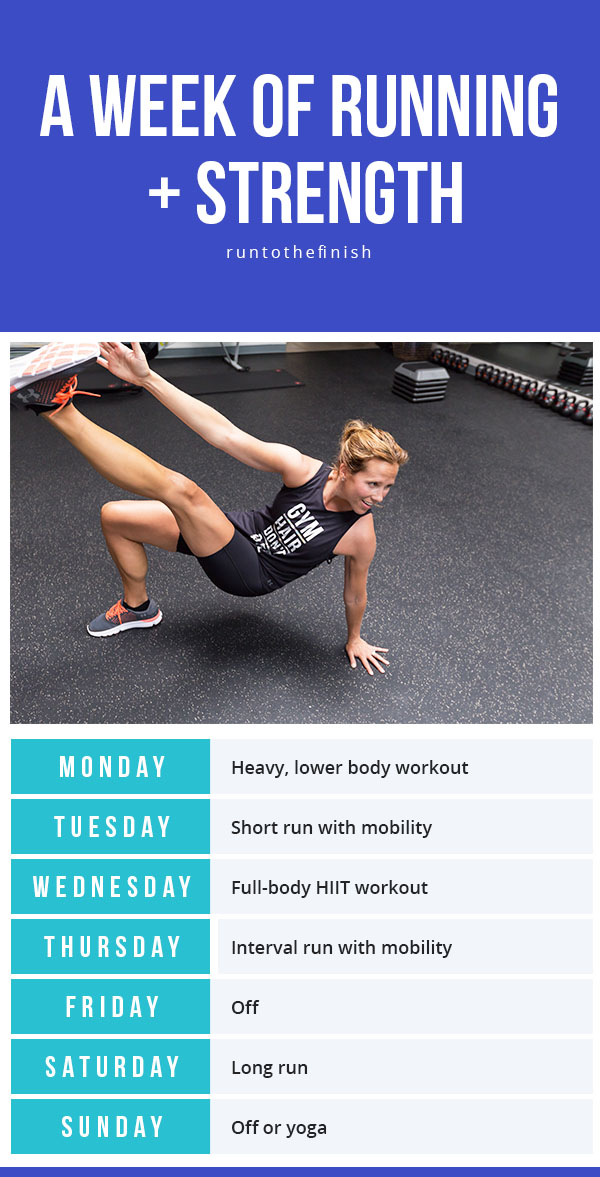
Monday: Heavy, lower body workout
Tuesday: Short run with mobility
Wednesday: Full-body HIIT workout
Thursday: Interval run with mobility
Friday: Off
Saturday: Long run
Saturday: Off or yoga
If you’re looking at your new schedule thinking, “There’s no way I have time for this,” you’re wrong.
The longest workout of your week should be your long run.
No matter what you believe, you do not need to spend hours at the gym each week to lift
Tara designed the TL Method to keep most workouts to 45 minutes (or under). There’s minimal equipment needed, so many of my clients can do the workouts in their living room. If weights seem scary, or you’re unfamiliar with the movements, each workout is demoed on video. Plus, there’s yoga flows and mobility work to incorporate into your practice.
Thanks to Tara for this great look at why we might need to change our training for aesthetic goals.
What to Eat for Better Abs
While the running and training portion is very important, the best way to get abs is to eat in a way that supports fat loss and simultaneously builds muscle.
There’s a reason why they say ‘abs are made in the kitchen’; your diet is essential to getting the abs of your dreams.
Eat to Reduce Body Fat
Start by eating to reduce body fat. The healthiest method for runners to achieve this is to consume as little sugar, refined, starchy carbohydrates, and highly processed meals as possible.
Prioritize Protein After Workouts
Protein helps develop and repair muscle, affecting how your body responds to runs and workouts.
When you run, your muscles use glycogen (a stored form of glucose) as a source of energy. As a result, your muscles’ glycogen stores are partially depleted. As you run, some of the proteins in your muscles are broken down and damaged.
Following a workout, your body attempts to refill glycogen stores as well as repair and regrow muscle proteins. Protein is required for this process.
Consuming protein soon after exercise can assist your body in completing this task more quickly. It provides your body with the amino acids it requires to repair and replace these proteins, ultimately resulting in muscular growth.
This is EXTRA important for running after menopause!! We know that it’s key to the fat loss.
Consume Adequate Carbohydrates
Consuming an adequate amount of carbs increases stamina and allows for physical adaptation.
If you don’t eat enough calories, especially carbohydrates, your body will start taking nutrients from muscles stores for energy. We want to eat clean carbs that are high in fiber and nutrients to fuel our bodies.
The result of this is the female athlete triad. Which is absolutely not going to move you in the direction of having six pack abs that look good.
Some good examples of such carbs are potatoes, quinoa, and whole grains such as oats and fresh fruits.
Eat Healthy Fats
Many people believe that in order to lose fat, they must eliminate fat from their diet. This is simply not true! Healthy fats are an important element of our diet.
However, we need to ensure they come from the right sources, such as avocado, olive oil, nuts, and seeds.
All right, hopefully this gave you some ideas to answer your burning questions about does running give you abs. More importantly ways to think about your training differently than you might have before.
Looking for more information on running weight loss?
- Why you gain weight after long runs
- Why Do You Gain Weight When You Start Working Out
- Does Weight Lifting Make You Gain Weight?
Other ways to connect with Amanda
Instagram Daily Fun: RunToTheFinish
Facebook Community Chatter: RunToTheFinish
Get more running tips: Pinterest




 How Do You Get Over a Bad Run Day?
Great post, Amanda. A positive mental attitude is so important. Stress, negativity, and cynicism are ab killers and flab expanders. There is a ton of science on this. Thanks, too, for the hip opening pointers. Great stuff.
Kevin
Thanks for reading Kevin! Appreciate you.
I totally needed to read this. I have been on the struggle bus with running and controlling my weight. It has been a super stressful year for me.. Thank You for this
Thank you for reading!