
Does muscle weigh more than fat? Or is it the other way around? This is a question that has probably popped up in your mind at one point or the other during your fitness and wellness journey.
One of the reasons I find many runners not lifting is they’ve heard that strength training makes you gain weight. Which often comes from hearing that muscle weighs more than fat.
It’s not surprising that we get confused about this topic because many of us grew up using the scale as a measure of progress with our health and fitness goals.
Weight loss however is not the same as fat loss.
And what most people are truly striving for is fat loss. Let’s look at how the muscle weighs more idea started and what you really need to know about strength training and weight gain.
Does Muscle Weigh More Than Fat?
Busting the Myth – Does Muscle Really Weigh More Than Fat?
The answer is simply no, does not muscle weigh more than fat. There certainly is a distinction, but not in the way people make it out to be. Instead of weight, it’s more about volume.
Think about it think way: would a pound of feathers weigh more than a pound of bricks? The answer is obviously no. In the same way, a pound of muscle and a pound of fat weighs exactly the same, i.e., a pound.
What we are instead talking about is the fact that muscle tissue is more dense than fat tissue. This means that it’ll take up less space for the same weight.
Going back to our feathers and bricks example, a pound of features will look a lot bigger because it’s fluffier, whereas bricks are dense and more compact for the same weight.
So, bricks will physically occupy less space than feathers would for the same weight.
That’s exactly how muscle and fat work as well. So, what we really need to consider is body size and body composition.
Interestingly, one pound of fat takes up 15% MORE space than one pound of muscle.
Again, it is denser therefore someone could actually be smaller and yet weigh more than someone who has less muscle mass.
@justget.fit provides a great example of this in the real world. Here she weighs 145 in both photos, showing that the scale isn’t telling the whole story

This is not to say that one is inherently better than the other! We are simply breaking down the idea that muscle weighs more than fat.
And this doesn’t mean that strength training will make you bulky.
In order to bulk up like a body builder, you need to do more than just lift weights.
Why Runners Should Care About Building Muscle
Building muscle through strength training can numerous benefits for runners, including reducing muscle imbalances, improving running economy, and even reducing the risks of injuries.
But that doesn’t mean that you don’t have certain questions regarding the potential downsides of building muscles.
Let’s go through some of your top questions and answer them to help you understand how building muscle will affect you as a runner:
What Does It Take to Get Bulky from Strength Training?
- Years of consistent strength training
- High protein, super high-calorie diet (rarely what anyone looking to lean out is eating)
- Heavy, heavy weight training with a focus on strength and hypertrophy
- When bulking they are actually putting on muscle and fat due to the high volume of food, then they go into a phase of leaning out, then bulking again
- Supplements likes creatine, protein powder and others
Why Am I Gaining Weight from Strength Training?
If you’ve started a new strength routine and are noticing the scale creep up, it’s probably not what you think.
- The average newbie cannot put on more than 2 lbs of muscle in a month
- That’s with consistent strength training and enough calories for muscle gain (often not happening with those on a diet)
- Those who have been strength training for longer can only put on .5 to 1 lb per month
Which means if the number on the scale has gone up 10lbs since you started working out last month, you didn’t pack on 10lbs of muscle.
- Workouts result in micro-tears and inflammation, the body holds on to water to repair this damage
- You may be eating more because strength workouts increase hunger levels
- You may need to add more protein to your diet to help with muscle building, fat loss and muscle repair
- You may need to increase your daily water intake to ensure you aren’t dehydrated which will also cause water retention
Building muscle may increase your body weight, but you will lose inches off your waist or thighs because it’s helping you to change the shape of your body.
Another great example of how she used strength training to build muscle, which increased the number on the scale, but dropped her overall body fat resulting in the “toned” look that many women are seeking.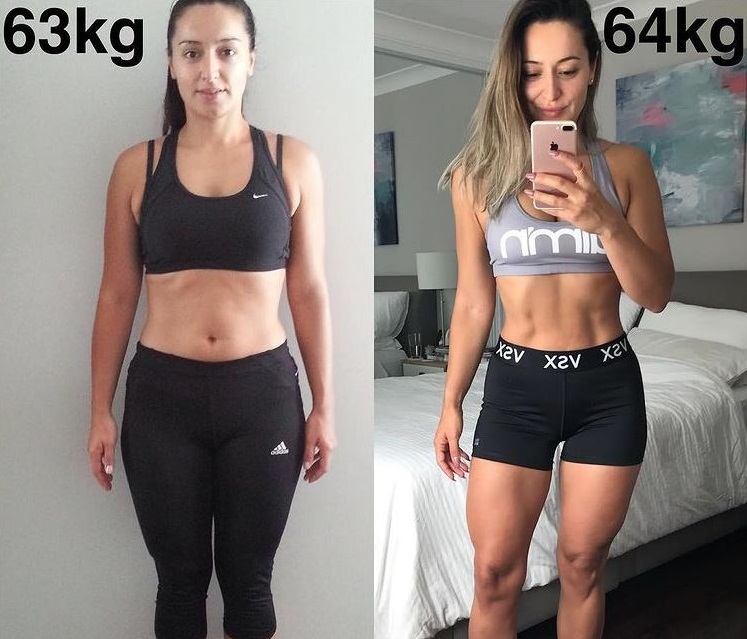
Worry less about the scale and more about performance.
Or if you’re in to measuring then focus on body measurements and body fat percentage.
Does Weightlifting Make You Gain Weight?
Strength training results in muscle gain, injury prevention and more power in your stride. It should be part of every runner’s training plan and it’s a required part of everyone I coach!
But if you’re still focused on the scale, let’s break this down a bit more.
Yes, strength training could cause weight gain, if you are actually building muscle or if you are overeating.
- If you replace 10lbs of fat with 5lbs of muscle then you lost weight and fat
- If you lose 5lbs of muscle from strict dieting and don’t build muscle, the scale has gone down but your body fat has gone up and your metabolism has dropped
- If you lose 5lbs of fat, gain 10lbs of muscle then the scale has gone up, but your body fat has dropped and the overall appearance is a much leaner figure
Another common issue is starting to take creatine for women. There may be some light initial water retention, but again this is not fat and the overall goal of helping you build muscle means moving towards your goal despite the scale.
What Happens When You Have More Muscle?
Muscle is attached to our tendons, bones, joints, and ligaments, and in this way is primarily responsible for the motion that occurs within the skeletal system.
Having more muscle is beneficial for a number of reasons. For one, it helps you burn more calories, and it even contributes to the maintenance of bones and other organs in your body.
Furthermore, muscle helps raise metabolism because it has a higher metabolic rate than fat. Put simply, the more muscle you have, the more calories you burn, even when at rest.
The ratio of calories burned by a pound of muscle to calories burned by a pound of fat is nearly two to one.
As a result, building muscle can help you lose weight by increasing your resting metabolic rate and burning more calories even when you’re not active.
What Happens When You Have Too Much Fat?
Fat’s primary function is as an energy reserve for your body. It also keeps your body warm and protects the organs.
There are three main types of fat, namely essential fats, subcutaneous fats, and visceral fats. If you want to learn more about them, I wrote about them in detail in my guide on how to lose body fat that you may want to check out.
However, there are risks associated with having too much fat. Excess fat can accumulate on your organs, impairing their function.
Body fat percentage, for example, can be a good indicator of your overall health. A high percentage of body fat puts you at a greater risk of health conditions such as heart disease and diabetes.
According to the American Council on Exercise (ACE), healthy body fat percentage for men ranges from 2% to 24%, and for women, it’s from 10% to 31%.
How to Determine Body Fat and Lean Mass Percentage
As you could tell from what you read above, having a poor muscle-to-fat ratio puts you at risk of many negative health conditions. So, it’s incredibly important to know and keep track of your body fat and lean mass percentages.
Here are some of the top ways you can measure it:
Body Fat Calipers
Body fat calipers, also known as skinfold calipers, are an inexpensive way to measure body fat and look like big sets of tweezers.
This device functions by separating the muscle from subcutaneous fat, which is fat that is located beneath the skin. A gauge measures the thickness of the pinch created by the tongs at a number of predetermined spots.
The thicknesses of the skin folds alone can be used to assess progress or an equation can be used to calculate body fat percentage.
It’s usually recommended to get a fitness professional at your local gym to take the reading for the most accurate measurements.
Bioelectrical Impedance Scales
A bioelectric impedance device can help you figure out how much body fat you have compared to how much lean muscle mass you have. It’s also commonly referred to as a bioimpedance scale.
Many of the devices that use this technology resemble standard bathroom scales, but they measure your body composition using electrical impulses.
Waist to Hip Ratio (WHR)
Another method that may not exactly tell you about your body fat percentage but can provide a useful glimpse into your health is the Waist-to-Hip Ratio (WHR).
This is a method recommended by the World Health Organization and is said to be more accurate than body mass index (BMI).
Get a measuring tape to figure out your WHR. Take your measurements around the smallest part of the waist and the widest part of the hips and buttocks. Next, divide the waist circumference by the hip circumference.
WHO considers a WHR of 0.9 or less for women and 0.85 or less for men to be healthy.
A Note on Body Mass Index (BMI)
The body mass index is one of the most common ways people measure body composition. Honestly, it’s an outdated metric and it won’t work for you if you’ve gained muscle and want an accurate picture of your body composition.
This is why it’s not recommended as a true measure of health or body composition, especially for active people who are building muscle.
I hope this helped give you a much better understanding of the muscle weighs more than fat discussion and what you need to focus on.
Looking for more information on working out and gaining weight?
- How to measure body fat at home
- Why Do You Gain Weight When You Start Working Out
- How to boost your metabolism
- Strength Training vs Running for Fat Loss
- Why you gain weight during marathon training?
Other ways to connect with Amanda
Instagram Daily Fun: RunToTheFinish
Facebook Community Chatter: RunToTheFinish
Sign Up to Receive a Weekly Newsletter with Top Running Tips



 Complete Splendid Spoon Review: Is it Worth It?