

You might have heard the term ‘tight hip flexors’ and wondered if it applied to you. Chances are, it does! And now we want you to think about doing more than some stretches to resolve it for good.

When there’s tension around the hip flexors, it makes the hips feel tight. Your lower body’s movement depends heavily on a group of muscles called your hip flexors, which are located around the top of your thighs.
They provide you the ability to walk, kick, bend, and rotate your hips. But if your muscles are too tight or if you move quickly, you can stretch or tear your hip flexors.
If you’ve ever dealt with tight hips after running, then it’s time to learn about what’s causing it so you can put an end to it.
What you might be surprised to learn is that it’s probably more about what you’re doing when not running!
In this article, learn what your hip flexors are, the signs to watch out for, and also what you can do to loosen tight hip flexors, including some useful stretches.
What are Your Hip Flexors?
First things first, your hip flexors are a group of muscles that go along the front of your upper thigh. These muscles help you move easily by allowing you to bend at the waist and elevate your leg.
To get a little technical, they consist of the iliacus, the psoas major, the rectus femoris, and the sartorius. The iliacus and psoas major combine to form the iliopsoas, the primary hip flexors.
When you walk, run, sit, or stand, they work together to flex and stabilize your hip and bring your thigh and torso together.
The rectus femoris aids in hip flexion and knee extension, whereas the sartorius aids in hip flexion, external rotation, and knee flexion.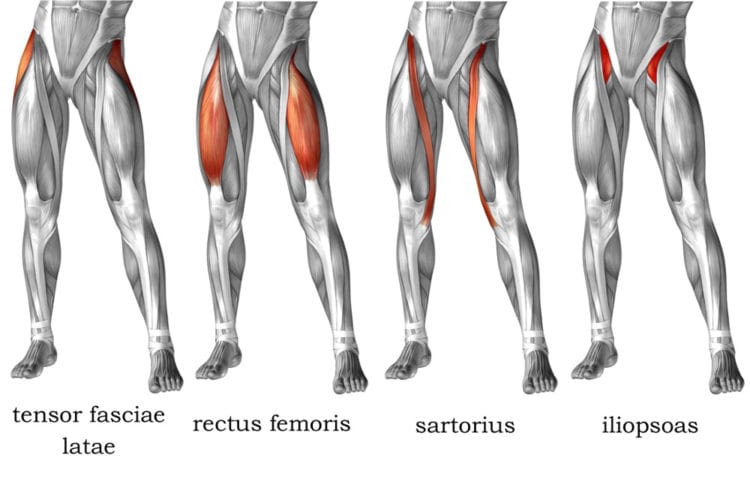 Tight hip flexors make it difficult for your pelvis to rotate properly, which can affect various other sections of your body because the hips link the lower back to the legs.
In conjunction with the quadriceps are the hip flexor muscles, which connect the pelvis to the quadriceps. They are key in moving you forward and stabilizing your body.
Hip flexors run into two common issues:
- Tightness that inhibits the glutes
- Weakness that limits leg swing power
So many muscles are worked during running that we often forget the smaller one’s like hip flexors.
What Causes Tight Hip Flexors?
Your hip flexors are engaged whenever you bring your knees toward your body.
This movement can cause strain if you do it repeatedly. Some common causes are sports that use the hip flexors a lot without doing anything to counteract it, like dancing, running, and martial arts.
The iliopsoas muscle gradually weakens from prolonged sitting, which is another reason we get tight hip flexors.
Another common cause is a weak core, which makes the hip flexors work harder to support and stabilize the spine.
If you don’t have enough core strength to maintain a tall posture during a long run, your hip flexors will step in to help. This overworks the muscle, which leads to fatigue and tightness.
So if you’re stretching constantly with no results, it’s time to focus on strength!
Signs of Tight Hip Flexors in Runners
Do you sit for long hours in front of a computer? Are you a runner? Do you bike? Ok, you probably have tight hip flexors. It’s almost universal at this point that everyone needs to work on their tight hip flexors.
Pain or discomfort in the front of your hip that often worsens with prolonged sitting or repetitive hip-flexion exercises like running and cycling are symptoms of tight hip flexors.
Some other signs of tight hip flexors include:
- Stiffness in the hips, lacking a full range of motion
- Fatigue in your hips after running. Tight hips are often weak, so they don’t perform as well.
- Lower back pain while running(or after running)
- Groin pain after running from other muscles overcompensating
- Weakened glutes (hard to activate due to the next issue)
- Anterior pelvic tilt leading to knee issues, IT Band Syndrome and other common running injuries
3 Hip Flexor Stretches to Loosen Tight Hips
There are a lot of really fantastic stretches for the hips, and I’ve done a huge article on stretches for tight hips.
So let’s talk about a couple of key things, and then we’ll focus on fixing our anterior pelvic tilt, with a set of moves called the 3D Stretches.
- Remember static stretching (holding a position) should never be done prior to a run
- Incorporating yoga for runners once a week is a great way to work on both flexibility and strength
- The butterfly stretch is excellent for hips and groin. (Sitting with soles of your feet pressed together in front of you and knees out to the sides. Over time, you want to get your knees closer to the floor and move your feet closer to your body.)
The goal is moving your body through all planes of motion (sagittal, frontal, and transverse), which increases circulation to prevent stiffness and mimics the natural way we move when walking and running.
These movements were provided by Michael Conlon, owner and physical therapist at Finish Line Physical Therapy in New York City.
He really believes three-dimensional hip flexor stretches are the most effective way to improve flexibility and joint mobility. Try doing these once in the morning and evening to see major improvements in your posture.
👉 3D Standing Hip Flexor Stretch
Instead of a low lunge, we are going to really work in to the hip joint.
Lunge out with your right leg, making sure planted left foot is pointing straight forward. Reach both arms up to the ceiling with arms touching your ears or as close as possible.
Drive hips forward while extending your arms back, making sure to squeeze left glute to feel the stretch through the front of your hip x10 (this will address the sagittal plane / front & back).
Next, drive hips forward while leaning your trunk towards your front leg (right) to feel an increased stretch in your left hip x5. Repeat this motion in the opposite direction x5 (these two will address the frontal plane / side to side).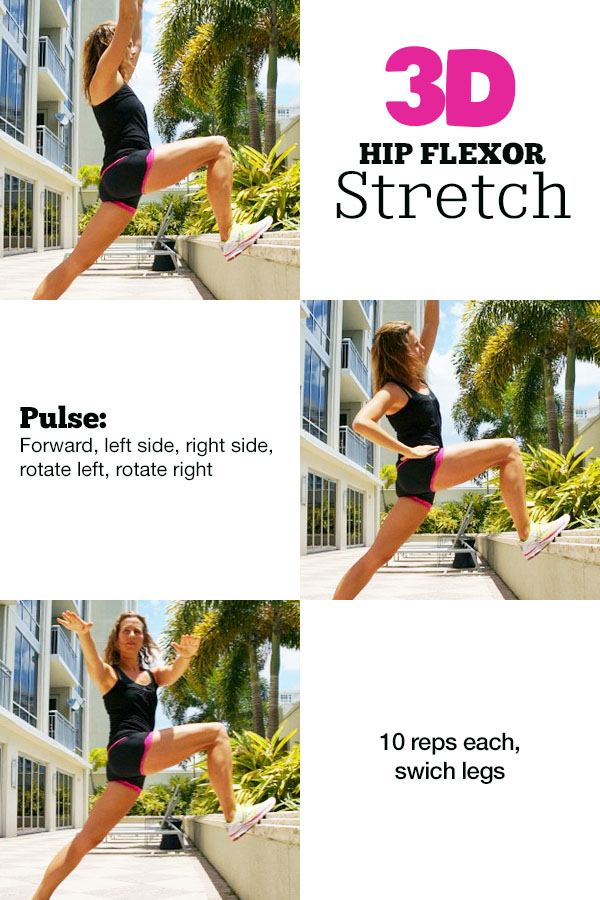
Next bring arms down to shoulder height. Drive hips forward while rotating your trunk towards the leg in front x5.
Repeat this motion in the opposite direction x5 (these two will address the transverse plane / rotation).
Switch legs and repeat the sequence with your left knee driving forward and your right heel remaining planted on the ground.
👉3D Hamstring Stretch
Next, focus on your hamstrings to help them release, as they could be causing tight hips, or tight hips could be creating tension there! This is going to follow the same pattern of pulsing forward and then rotating your body in both directions.
Extend your left leg out in front of you with knee slightly bent and toes pointing towards the ceiling. With your arms overhead, drive your arms and chest forward x10 (sagittal plane).
Next, place your right hand on your hip and reach your left arm overhead as you drive your chest forward x5. Switch sides, reaching your right arm overhead and driving your chest forward x5 (frontal plane).
Next, bring arms down to shoulder length, rotating to the right x5. Switch sides, rotating to the left x5 (transverse plane).
Switch legs and repeat the sequence
👉3D Seated Thoracic matrix (good during mid-day):
Sit at the edge of your chair in an upright posture. Reach both arms up to the ceiling with arms touching your ears (or as close as possible) and extend back behind you x10 (sagittal plane).
Next, place your right hand on your hip and reach your left arm overhead x5. Switch sides, reaching your right arm overhead x5 (frontal plane).
Next, bring arms down to shoulder length, rotating to the right x5. Switch sides, rotating to the left x5 (transverse plane).
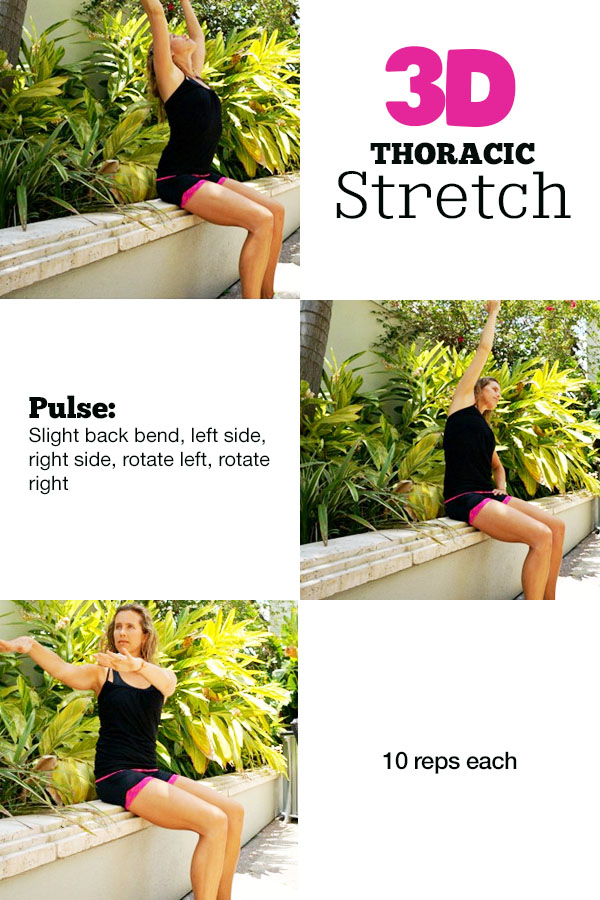
Remember, the goal of this set of moves is to help undo the effects of sitting all day and then going right into a sport that can create more hip tightness.
5 Ways to Prevent Tight Hip Flexors
It’s not just about remembering to do the warm-up before your run. It’s everything that you do before and after your run, plus throughout the day. Remember that a muscle is often tight when it’s being overworked or weak.
These are not in a specific order as you really need to implement all of them into your routine!
#1 Stand Up More Often
First thing’s first: get up throughout the day!
Set a timer for every hour and get out of your chair for a few minutes (and make sure to leave your smartphone on your desk – it’s part of the problem!).
#2 Keep Hydrated
Hydration is a crucial, often overlooked, component to optimal function and pain-free movement. Supple muscles can move more freely and maintain their elasticity, which helps you stay mobile.
One formula for rehydration is to drink 0.6 times your body weight in ounces of water/day. So if you weigh 150 pounds, you should drink 90 ounces of water/day.
This research study examined how being dehydrated vs. well hydrated affected a person’s hip sensation during activity. We’re not constantly reminding you to drink water/electrolytes for the fun of it. Staying hydrated will help running, strength training, and even cross-training feel better.
#3 Dynamic Warm Up
If you haven’t been doing a dynamic warm up, now is the perfect time to start. Not only will this help prevent many potential running injuries, but it’s also a great excuse to sneak in some movements that will both loosen tight hips and strengthen weak ones.
Even 5 minutes will go a long way toward loosening muscles and helping you run with better overall form.
A few ideas to get you started:
- Lunge matrix – lunging in all different directions wakes up the hips and provides strength
- Leg swings side to side and forward and back
- A Skips, B Skips, C Skips
The following video includes a demo of some great dynamic warm ups for your hips. We also detail all of the skips and provide follow along warm ups in our Running Technique course!
#4 Spend Time Foam Rolling Tight Hips
Tight hips after running aren’t just a result of the hip flexors, so there is a lot of areas to foam roll to help release them. Remember that foam rolling is really designed to tell the muscles and your brain to relax, so you don’t need to over do it or try to crush the area.
This foam rolling guide will give you a video demonstration, but a few things to consider.
- Use PT ball to get in to your TFL (Tensor Fascia Late), it’s where your front pocket would be (This being tight could feel like it’s your hip flexors)
- Work on your glutes big time, remember tight glutes can weaken your hips.
- Foam roll your quads and inner thigh as well to make sure nothing is pull on the hips
Try setting your foam roller by the TV. Then you’ll remember to grab it for just 5 minutes each night. Physical Therapist Stuart Wilson recommends this to all athletes to get you ready for the next days workout.
#5 Do More Glute Strength
If your glutes are weak, they will pull your pelvis further out of alignment, creating tight hip flexors and tight hips after running.
Not sure where to start? Here’s a few tips:
- Checkout our 30 Day Core Program – it’s 10 minutes of hips, glutes and abs you can do before any run
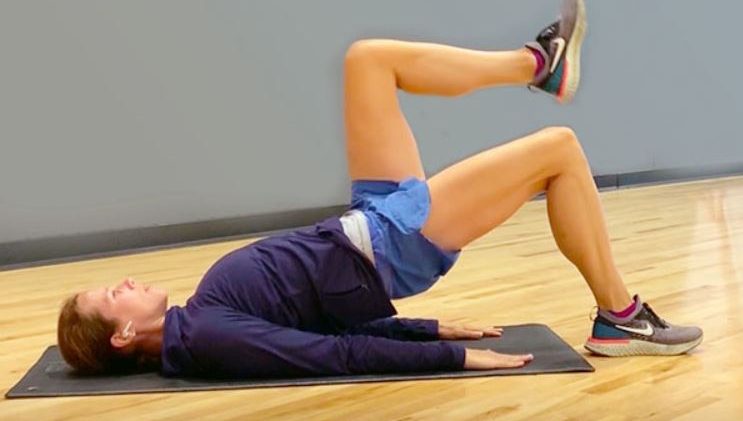
- Include hip bridges in your warm up, there are a million variations to progress this move
- Banded lateral walks in your warm up
- Do more single leg movements in your strength training routine (split stand squats, single leg deadlift, weighted lunges)
Hip and knee pain can have many causes. It’s always best to see a specialist to figure out what might be going on with you, including a look at your stride.
But starting with some of these tips can go a long way to resolving tight hip flexors.
Looking for more tips to help tight hip flexors after running?
- Need more hip stretches? Checkout these hip opening stretches
- How about calf issues? Some great calf stretches for runners
- Need a little more strength? Checkout these hip stability moves
- Need more strength ideas? Hip strength moves for runners.
Other ways to connect with Amanda
Instagram Daily Fun: RunToTheFinish
Facebook Community Chatter: RunToTheFinish
Sign Up to Receive a Weekly Newsletter with Top Running Tips



 Best Wool Running Gear for All Seasons
Excellent stretches that I plan to do today before my 4 to 6 mile run! A tight lower back due to hip inflexibility is my issue right now.