
Have you always wanted to run faster, but just didn’t know what to do to get better?
In this article, you’ll learn the two-pronged approach to how to run faster along with specific workouts and drills you can incorporate into your training plan today!
I will gladly run almost anywhere on Earth, except the track. It brings back horrible memories of high school when running was ridiculously hard for me and I always felt like I was missing something.
Speed drills for running might be my one exception to this rule.
Interestingly, I could run laps in the gym as part of the Varsity volleyball team without issue (ok lots of complaining, but doable). The track and I are just not pals, which clearly means I’ve got a mental block.
But you don’t need a track for speed workouts.
Luckily, you can do running strides, fartleks and tempo runs anywhere. Which means none of us with bad track memories need to fear that being required. But running faster isn’t the only thing you need to actually get faster.
Especially if you want to do it and not get hurt.
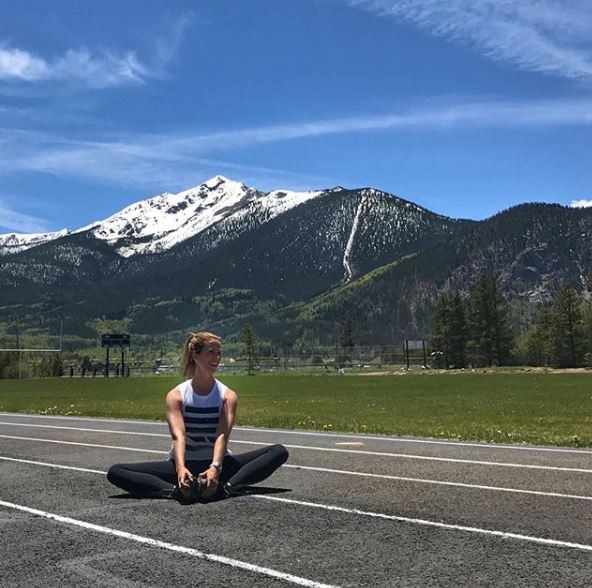
Here is the happiest I’ve ever been on a track, enjoying that I’m done glow. :)
How to Get Faster at Running?
It’s a two-pronged approach:
- Speed drills to improve muscular endurance
- Speed workouts to increase fast twitch muscles
It’s important to know there is a VAST difference between sprint speed and improving your speed over 13.1 miles.
Sprinters are going to throw their arms hugely up and down, while distance runners are focused on a smaller swing to conserve energy.
But in both cases, the speed of your arms can influence the speed of your run, which means it’s important to train!
Mostly, I’m noting this here to ensure you know the following exercises to improve speed can help both but are largely focused on the endurance runner and not those aiming for a 400-meter dash.
Why Speed Training Drills?
One of the things we too often do is dive into faster running without considering muscle strength or mobility needed.
Of course running faster does involve a process of pushing your pace in specific workouts. But without the appropriate progression, muscle strength and body integration those faster paces often lead to poor form.
Poor form over 13.1 or 26.2 miles or even done week after week, leads to imbalances, which leads to injury!
As does asking your body to push beyond its limitations without providing it the muscular and cardiovascular strength needed to hit your goals.
This is why I’m so often preaching the need for hip strength and glute strength exercises.
Benefits of Running Drills for Speed
Let’s look at what these running drills are designed to do:
- build leg strength
- improve foot turnover (running cadence)
- power off the ground
- Activate your glutes and psoas, often inhibited from sitting
- single-leg moves to address imbalances
- improving muscle efficiency
- activating our type II or fast-twitch muscle fibers
- ensure you’re creating equal power from both legs
- repetition of good form prior to running to ingrain it in our brains
Bonus points because these drills will create strength, which makes your easy runs feel easier!
Time to run faster without the sprints! Speed drills to get stronger and run faster! Share on XStep One: Drills to Get Faster
If you’ve been asking what exercises make you run faster? I’ve got a set of exercises to make you run faster detailed in the video below. You can also Pin the image to remember them later.
The following speed training drills for runners can be done all at one time once a week, or you can simply pick one to do prior to every run.
I’ve found that integrating one move in to your dynamic warm up is much easier than reminding yourself to do an additional workout in your week of already packed training.
Don’t feel like watching the video, no biggie!
I’ve also detailed each of the running drills here, so you can quickly read them too.
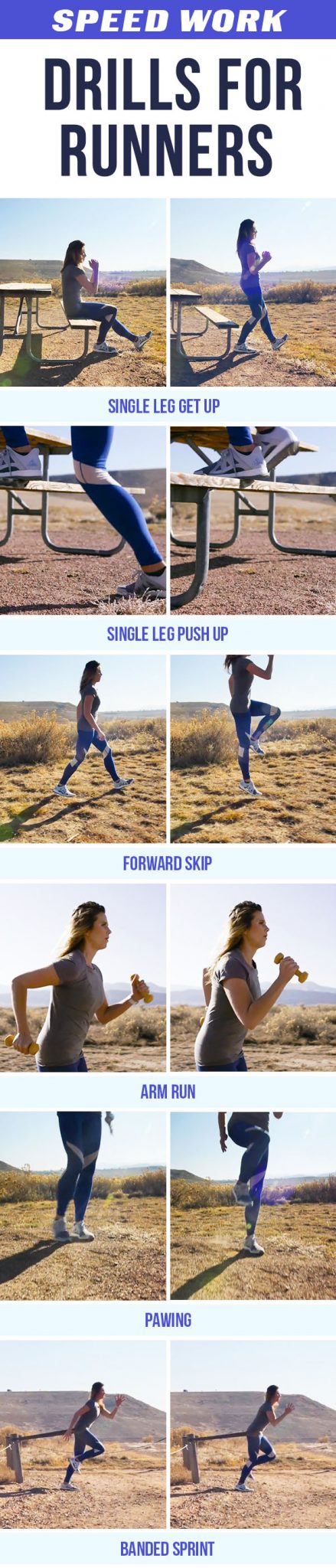
Repeat running speed drills 10-15 times per leg.
Single Leg Stand up
This is one of the first progressions to being able to do a pistol squat.
Sitting on a bench, place one foot at 90 degrees and the other straight in front of you lightly on the ground.
Your straight leg should bear as little weight as possible and as you progress remain off the floor. You’ll need to engage your quad, calf and core to stand up and then lower yourself back down with control.
Single Leg Step Up
Place one foot on a sturdy bench and engage your quad and glutes to pull yourself up on to the bench.
Tap your toe then return it to the ground with control. You aren’t fully standing up on the top of the bench or pausing on the ground, it’s a fluid movement.
High Skips
Skips of nearly every type are great for promoting speed, which is why we do them in our Running Form Course.
In this case, we’re focused on high forward skips. The goal is to get used to the feeling of your entire foot, ankle and calf working together to push off the ground with force.
Running Arms
The arms are so overlooked as part of our speed! (Read this post on runner upper body training for lots more ideas).
Here we are holding a light weight of about 3lbs in each hand, creating a stable base with core engaged and then running those arms. Keep them at 90 degrees and move them fast!
Pawing
This is a practice that will help you to quickly pick your foot up off the ground.
We know that faster running isn’t about a longer stride, it’s about a quicker foot turn over. This gets you used to hitting with your full foot and quickly retracting.
Banded Sprint
How to do sprints without injury? This is it!!
You have to practice the process of picking up your knees, instead of trying to lengthen your stride. We know that over striding leads to injury and this is going to ingrain in our brain a different pattern.
With the band around your waist, you’ll do a pattern of 1,2,3, hold. You’ll run hard for 3 steps and then on 4 hold the knee up for a second before repeating the process by ending with the other knee held high.
Exercises to Improve Running Speed
If you know that having just a couple of drills with no particular plan to put them in place means you won’t do it…you aren’t alone.
✅That’s why I created a 30 Day Running Technique program.
(Use code “getfaster” for $10 off!)
- 5 Weeks of progressive drills
- Each week you will get videos for a couple of specific drills to use before your runs
- They take no more than a couple of minutes
- You’ll work on improving your foot strike, the lean, then the power in your stride
Now as noted, you can’t just do the exercises to improve speed and voila you’re faster.
You also need speed workouts.
But these drills will help to ensure that as you pick up the pace, you don’t lose your form and become injured. They’ll also provide you with more power to make your speed sessions more effective.

What is a Speed Workout?
When most people talk about speed workouts, they aren’t thinking about the drills noted above.
They’re focused on hitting the track for 8 x 400 repeats or following a training plan that includes running various distances at 5K pace or 10K pace. And those are absolutely key ways to improve speed.
But need to be implemented correctly.
While we understanding not going from running 3 miles to running 10, we often like to push our speed from a 10 minute pace to a 6 minute pace because that’s what a plan says.
Then I get the emails about IT Band Syndrome and knee pain, and I don’t want that for you!
So, if you’re new to any kind of speed workout begin by checking out all the beginner speed workouts first.
But read along to know exactly what types of speed workouts are out there! I’ve linked specific posts under each speed workout where I dive into it in further detail.
Step Two: Speed Workouts for Runners
If you’re a seasoned runner, a good training plan should incorporate speed workouts to help you run faster and for longer distances.
Let’s look at the different types of speed workouts that are out there. While you may need to get used to running track for some shorter intervals, you can do a TON of speed sessions without ever setting foot on the oval. The roads, trails and treadmill are all great options.
Hill Sprints
Hill sprints are a great way to learn to run faster and the first speed workout we assign to all of the runners we coach.
By running hills, your muscles learn to contract with more force and power, while also preventing you from overstriding. In turn, your stronger quads allow you to pick your knees up for better running form.
They also allow you to increase your VO2 max, which is a measure of how much oxygen you can utilize during intense exercise.
Hill runs also engage and strengthen muscles in the glutes, core, hamstrings, quadriceps, calves, and upper body. This then translates to faster running on flat surfaces.
Anyone who has tried running up a hill would know that it’s not easy to run very fast up a hill, but you don’t need to either to gain the benefits of this type of speed workout.
👉Learn how to do hill sprints and various workouts >>

Tempo Runs
Generally speaking, a tempo run is exactly what it sounds like: a sustained running pace faster than an easy pace, far slower than a sprint. It’s a push you could sustain for an hour, but you will not do a tempo run for an hour.
More specifically, a tempo run is a short, sustained effort just above our anaerobic threshold when our body goes from having sufficient oxygen during the run to no longing having it to power our muscles.
And that sweet spot, right in the middle, is where all the magic happens.
By doing tempo runs, we train our bodies to take longer to reach the point anaerobic threshold which is when lactic acid starts building up in the body and we can feel pain and fatigue.
As we allow our bodies to take longer to reach that level, we can run faster for longer periods of time by increasing our aerobic capacity and delaying the onset of lactic acid building up in our bodies.
Tempo runs will also help practice mental toughness which is key when it comes to the mental game of learning to run faster.
By training at a space just outside our comfort zone, we tap into our inner selves and concentrate more than we normally would during a regular training session.
There are four main ways to calculate your tempo pace:
- At 80-90% max heart rate.
- A ‘comfortable hard’ pace
- A pace between your 10K and half-marathon pace
- A pace where it’s harder to hold a conversation
👉Learn all there is about how to do tempo runs here along with tempo run workout examples as well. In this post, I also dive into the step-by-step strategy you need to use to add tempo runs to your routine.
Fartlek
Fartlek is a Swedish word meaning ‘speed play’, and so it literally refers to playing around doing different speeds in an unstructured manner. They’re essentially portions of fast running with no defined recovery period.
They’re a great way to incorporate speed training since it’s less intimidating for many new runners than strict intervals! They’re also more fun for long-time runners to break up high mileage weeks.
By not having a structured way to go about it, you’re more likely to learn to push yourself harder than you normally would which will build your endurance too.
Fartlek training also allows you to have more control in your training sessions, and to become more attuned with your body. It preps your mind by engaging you to actively make decisions about the pace you want to run at.
👉If you want to learn all there is to Fartlek, read my post here where I go into 7 sample fartlek workouts to get you started as well as tips on how to incorporate it into your training!
Interval Training
Interval training involves running at a fast pace for a set time, followed by jogging or walking at a slower pace for a set time to recover.
It is much more structured than a Fartlek since you alternate between planned bursts of running followed by recovery.
What’s great about interval training is that the repeats can be done by time or distance. Intervals can be as short as a 30-second sprint to miles at marathon pace.
It’s important to keep in mind that the harder the effort, the shorter the interval should be. Make sure you are taking enough time between intervals to recover.
This can be done with a walk or a jog and it’ll allow you to do the next one at the same pace as the previous one while ensuring good running form.
👉Here are 9 Running Workouts to improve your speed >>
2 Bonus Tips to Help You Run Faster
Now that we’ve covered the two-pronged approach to how to run faster, here are two bonus tips you should keep in mind:
#1 Do Strength Training
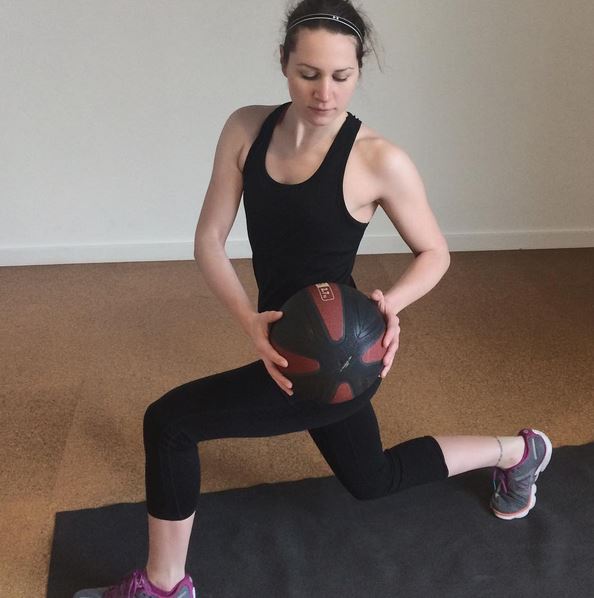
Strength training for runners has more benefits than I can count. Not only will it help you build strength, but it will also help with your running form and reduce the chance of injuries.
Plyometric movements for runners or bodyweight exercises that are explosive, such as lunges or jump squats, can improve speed and strength. They teach muscles to contract at a faster and more efficient rate.
Weight training by lifting weights with dumbbells, barbells, or kettlebells can also help maintain power, improve running form and efficiency during longer runs such whether that’s a half marathon or 10K.
Strength training exercises geared towards the core muscles are also key to preventing injuries, improving efficiency and feeling good as you push the pace.
✅Checkout our Strength Training for Runners program to get detailed workouts and videos >>
#2 Don’t Skip the Recovery Days
It might be tempting to keep training and skip the recovery days, but you’ll do more harm than good.
If you’re incorporating speed drills as well as speed workouts into your routine, but not see progress? Take a step back and be honest with yourself – are you allowing your body to recover?
The soreness we feel after a hard training day is because training causes microtears in our muscles.
By taking out the time to rest, it allows those muscles fibers to rebuild stronger than before.
In this way, recovery days are crucial to get stronger and to also be able to gain all the benefits from speed drills and speed workouts (as well any other type of training you’re utilizing!).
Skipping recovery can also lead to injury. So, train hard when you train, and rest properly when it’s time to rest.
And remember to be consistent when it comes to learning how to run faster. You won’t get results overnight, but with consistent efforts and by following all the guidelines and tips in this article it won’t be too long till you’re faster than ever before!
Other ways to connect with Amanda
Instagram Daily Fun: RunToTheFinish
Facebook Community Chatter: RunToTheFinish
Sign Up to Receive a Weekly Newsletter with Top Running Tips and Laughs



 The Best Glute Activation Exercises to Maximize Your Runs
This is great! I feel like I really need to include some speed drills into my routine. My body is just not used to running fast, and even though Ive done some speed interval workouts I feel like they have still been a struggle for me. I have never been able to do a pistal squat so maybe I should work on those single leg stand ups!